Grinnell College Logo

Contested U.S. Presidential Elections (Fall 2024)

HIS 295, Professor Sarah J. Purcell

Page 8 of 10

Wide Awake or Woke? The Youth Vote in 1860 and 2024

For the Democratic party in the upcoming election, organizing movements and large swells of support have been the biggest signals of hope for Harris’ campaign. In fact, hope is a very appropriate word, as many have been comparing the Harris-Walz campaign’s major public support as reminiscent of the 2008 Obama campaign, and the iconic slogan that went with it: Hope. While this connection is strong (especially because it is a success story that the Harris campaign seeks to emulate), there exists another strong comparison, the election of 1860.

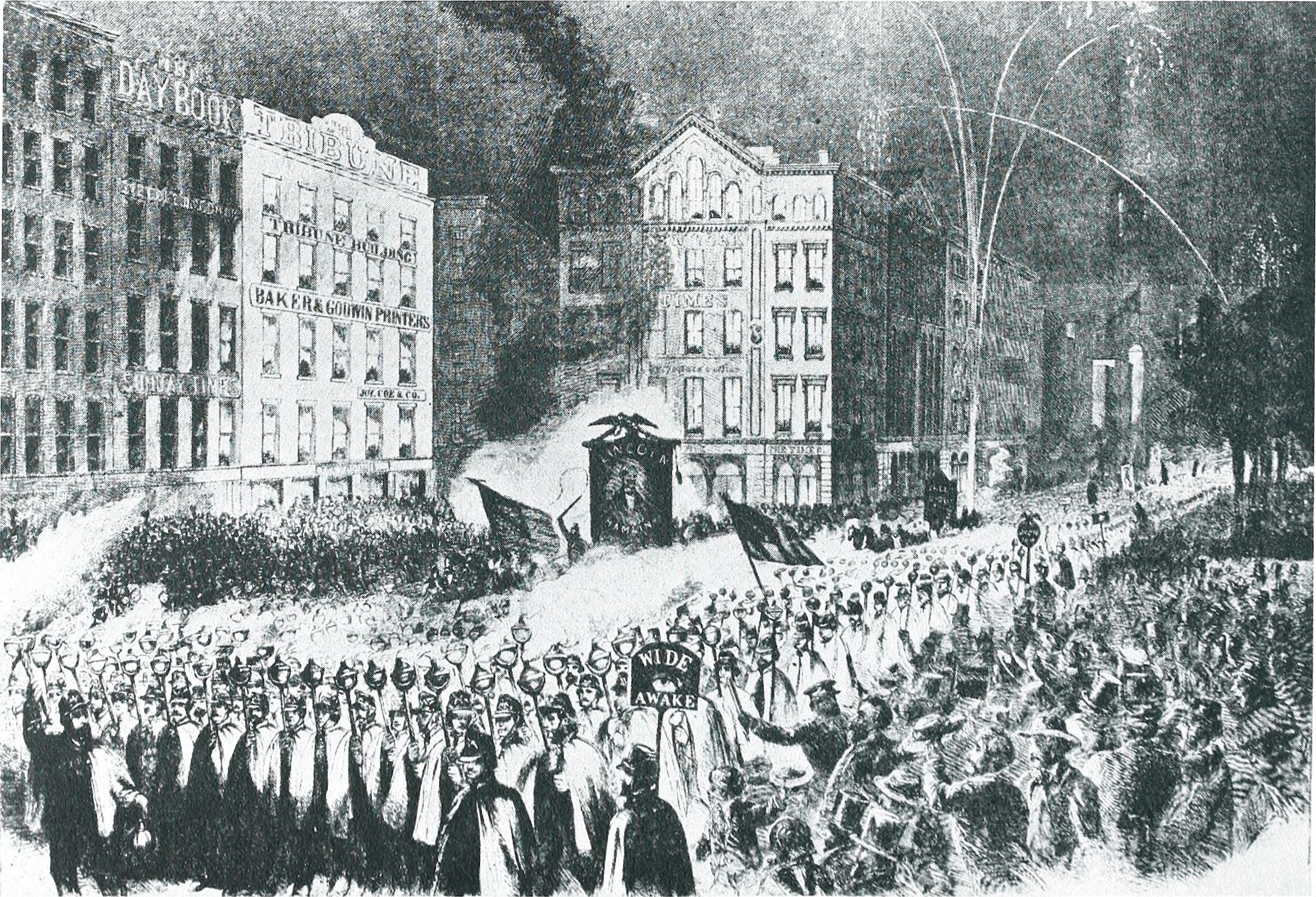
The election of 1860 (in the North) was between Abraham Lincoln, Republican, and Stephen Douglas, Democrat, who were (relatively) pro and anti slavery respectively. In the South the race was between John C. Breckenridge and John Bell. While there are a number of dynamics that make this election highly complicated, in this case the important thing is that Lincoln won the election (both a plurality of the national popular vote, and the required electoral vote majority) without being on the ballot in southern states. While his election precipitated the secession of most slave states, and the Civil War, the important part here is how Lincoln won. A major part of the Republican movement in 1860 was young voters, specifically the Wide Awakes. The wide awakes were a movement of mostly younger voters whose political involvement was a response to the highly partisan politics that preceded the election of 1860. The Wide Awake movement was one characterized by the ways they spread information (promotional materials, social events, even comics), and the militaristic way that they conducted themselves. They were not a movement built on hope (although they did have hope for the future), instead they were a movement built on resistance, as seen in their demonstrations. They marched in the streets wearing uniforms and carrying torches, acting almost as an army, there to resist the policies and aims of the Democratic party.

Wide awakes in uniforms carry torches in a march in Chicago.

Wide awakes in uniforms carry torches in a march in Chicago. Internet Archive Book Images Image from page 9 of “Abraham Lincoln’s political career through 1860” (1860), courtesy of Internet Archive Book Images.

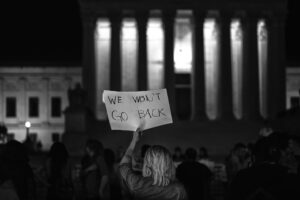
Compare this to the current Harris campaign. Harris is directing significant resources towards the youth vote, as evidenced through the campaigns focus on youth voters during National Voter Registration Day Additionally, the Harris campaign has been using popular methods of communication, similar to the Wide Awakes, to reach younger voters. Instead of cartoons, the Harris campaign has been using social media and memes as outreach, a strategy which (according to polling) has been paying off. While these mechanical similarities connect the Harris Campaign to the Wide Awakes, it is the attitude with which the youth vote is approaching the election. This attitude boils down to what has become the defining slogan of the Harris campaign: “We are not going back.” The slogan has existed in American politics for a long time, and can be seen to have been used in protests after the Supreme Court Dobbs decision, intrinsically linking the phrase to protest and discontent on the part of many voters. While this is not the same as the militarism of the Wide Awakes, it demonstrates that both 2024 and 1860 contained movements based on discontent, rather than hope like 2008.

A person holds up a sign reading “We won’t go back” on the day the Dobbs decision was leaked. Photo courtesy of Miki Jourdan, provided under CC BY-NC-ND 2.0

Why does 1860 matter as a comparison? It provides a foundation for understanding how a candidate can win support in a highly polarized election, and how important the discontent of younger generations can be in deciding an election where institutions (slavery and reproductive rights respectively) are at a turning point.  Will the “woke” reproduce the victory of the Wide Awakes?  Only time will tell.

A Guide to Voting in 1860 (and Helpful Tips for this November)

As the dozens of political texts, emails, and calls I receive daily keep reminding me, the election 2024 presidential election is just 45 days away! Are you registered to vote? Do you have a plan to vote early? Are you voting absentee? Do you know where your polling place is? Do you know what ID you must bring?

Voting is a deeply important way that we, as Americans, get to interact with our government. Please, if you are eligible to vote, make a plan. Vote early if possible! (If you live in Grinnell there will be early voting on Oct. 17 in the Joe Rosenfield ’25 Center from 9 a.m. – 3 p.m).

But this blog is for a history class and this week we are talking about the election of 1860. This is the election that directly preceded (and depending on who you ask, caused) the Civil War. This election is a big deal!

Do you know how you are voting in 1860? Well firstly, unless you are a man, good news—you don’t have to wait in line! Sure, it’s because you can’t vote, but the suffrage movement has only just begun. Further, Black men can only vote in Five states: Massachusetts, Rhode Island, Maine, Vermont, and New Hampshire. Additionally South Carolinians did not vote for president in 1860, as the Legislature still directly picked the state’s electors.

Let’s pretend you can vote though; what’s impacting your decision?

Here in 1860, slavery is at the front of many voters’ minds and there are four candidates. The first candidate, Lincon, is a Republican opposed to expanding slavery into new states and territories. Lincon’s former political rival for Illinois senate, Stephen Douglas, is the Democrat running on popular sovereignty, or the idea that each new state and territory should be allowed to decide if people should be able to legally own other people there. Douglas is, however, not the only Democrat running; John Breckinridge is running as the Southern Democratic candidate on a platform that is more pro-slavery than Douglas. Lastly, John Bell is running as the Constitutional Union candidate. Bell is anti-succession due to slavery, his platform is “the constitution”, and according to Michael Burlingame, his supporters would hand out bells for people to ring at rallies.

There is a lot of commotion in the lead up to the election. You probably saw or heard grassroots protests like the Wide Awakes—groups of young white (and a small number of Black) Republican men who marched through cities and towns with torches in support of Lincon. The Democrats have attempted to create a similar youth movement but have fallen flat. Historian Jon Grinspan argues that, while the Wide Awakes likely did not turn the election for Lincon, they did generate a great deal of youth momentum and enthusiasm for him, so while they probably did not convince you to vote for Lincon, maybe they made you more excited about him.

On November 6th, according to Grinspan, “Thousands of plain-clothed wide awakes policed the polls.” So maybe you gab with a Wide Awake friend before casting your vote for Lincon. Hopefully you remembered to live in a Northern state because Lincon is not on the ballot in the South. After you vote, your vote is read out loud in front of the small crowed gathered. Good job voting! Unfortunately, it seems like you won’t get a sticker.

In 1860 Lincon won the election. The civil war started soon after. Four years later, “In the middle of a devastating civil war,” Michael Burlingame writes, “the United States held its presidential election almost without discussion about any alternatives. No other democratic nation had ever conducted a national election during times of war.” After the election of 1860 we kept voting and slowly began to expand suffrage.

The election of 1860 was complicated and contested election. We don’t have to pretend to vote in this election. Suffrage, while still not universal, has been massively expanded, and yet turnout is down. In 1860 over 80% of eligible voters turned out. In the last presidential election, more Americans voted than ever before, and yet only 66% of eligible voters turned out.

I’m sorry to have to tell you this, but this year, if you are eligible, you must wait in the line, the 2024 election is deeply important. But hey, look on the bright side, now you get a sticker.

This November 5th Americans will once again vote for president. Unlike in 1860, all citizens over 18 can vote, your vote is private, and if you run into any trouble on election day, you can use your phone to call the election non-partisan Election Protection Hotline at 866-687-8683. Make a plan now, double check your voter status, and vote.


The Wide Awakes v. the Woke Mob: How Youth Political Organization is a Weapon & a Threat

By the election of 1860, political campaigning and organization had begun in earnest, although the candidates themselves rarely traveled like we see today. Abraham Lincoln received visitors at his home and relied on a network of political organizers to host rallies in his name, while Stephen Douglas, his opposition, made the unusual move of canvassing for himself. Republicans held speeches in German to appeal to immigrants and got abolitionists like Owen Lovejoy to embrace a more moderate platform to sway votes away from the Democrats, who retaliated by running racist cartoons and threatening secession if Lincoln won. But perhaps no campaigning efforts were to greater effect than demonstrations by the Wide Awakes.

“Who are these Wide Awakes?” you may be asking, and you wouldn’t be alone.

During one of the earliest marches of the Wide Awakes, a drunk New York politician observing them asked the very same question. The Wide Awakes were bands of young men, donned in military-esque costumes, who would march silently through the streets at midnight, stumping for Abraham Lincoln. Most interestingly about this grassroots organizing movement is that they emerged completely independently from the leadership of the Republican campaign, generating a thunderous yet virtually accidental wave of support for Lincoln.

What was so alluring about the Wide Awakes? They provided a fraternity space for the young men — not yet married or with children — to be active, social, and crucially, to feel their own power. The value of feeling like a part of something cannot be overstated; both the Trump and Harris campaigns have sought to cultivate this feeling, in different ways, in order to attract and retain voters to their base. At first glance, Donald Trump’s base may seem more akin to the Wide Awakes. After all, his supporters thrive on militarism, portrayals of masculine dominance, and feeling like a part of something, and this is to say nothing of the fascist militant groups like the Proud Boys that sprung up in his name. But his base did not emerge independently of his campaign — rather, the opposite is true.

The modern equivalent to the Wide Awakes is not a uniform, organized coalition, and their name was created not by their supporters, but by their opponents: the Woke Mob.

See, the unstoppable popularity of the Wide Awakes frightened the Democrats, who tried (and failed) to make their own alternative. The militarism, the mass organization, and in particular the youth support, signaling the changing views of a coming-of-age generation who could destabilize their traditional ideals, made the Wide Awakes a threat. The Democrats responded by belittling the Wide Awakes, attacking in particular their youth — calling them naive about the way politics works and condemning them as infant politicians, signifying the long-standing interrelation between age and political power that these young upstarts threatened to upend.

Compare this to the label of Woke today, which evokes the same kind of fear to modern Republicans that Wide Awakes did to pro-slavery Democrats. Woke is used primarily (although not exclusively) against young, politically active liberals and leftists who challenge the status quo and the modern Republican platform. A mob implies disorganization and violence, the kind of threats against themselves and their politics that Trump’s supporters fear. By decrying certain demographics of voters as weak, naive, or Woke, the supporters of such groups coalesce tighter together into more effective political machines. These aren’t machines in the traditional sense — there’s no central organizer and they aren’t an official collective — but whether it’s woke or weird, labels spread like wildfire.

It’s important to remember that there is no group of people known simply as the Wokes the way the Wide Awakes were named, but there doesn’t need to be: the term ‘Woke Mob’ is wielded against non-Republicans with the aim of creating a political out-group. Countless organizing groups such as Antifa and Black Lives Matter have sprung up under the umbrella of wokeness, the key difference being that it was a label applied to them, not one they chose like the Wide Awakes. Both Antifa and BLM have been branded militaristic — ironic coming from a party supported by white-supremesist militias. Trump has named his enemy; in doing so, he has made the threat they pose to him clear.

But if there is no group of people organizing as a collective Woke Mob, how can they be as effective as the Wide Awakes campaigning for Lincoln?

Remember that those most commonly accused of being woke are young leftists, who have grown increasingly aware of the power of their political voices. Youth political excitement about the presidential campaign had waned by the time Biden took office in 2020, and continued to wane well into 2024. But with the emergence of Kamala Harris, many voters feel represented, or at least like they have the opportunity to be heard, in a way neither the Trump nor Biden campaigns had offered. The majority of the young men involved in the Wide Awakes had come of age during a time of great political upheaval and unpredictability, and rather than be disillusioned, they pushed for a candidate they thought could steer them through the storm. A similar tactic is at play with young voters today — though none believe that one election will solve everything.

But the strength of young, woke voters coalescing behind the Harris campaign only matters if they’ve got something to advocate for, be it a candidate or a change in her policy, and a means by which to spread their views. For the Wide Awakes, it was the printing press. For the Harris campaign, it’s social media.

Newspapers printed details about Wide Awake marches, about local chapters, about stories from other states, drawing more and more young men into the fold. 20,000 Wide Awake uniforms were tailored by one of its founding members and shipped across the country, all in the name of fitting into an aesthetic of masculinity. Once again, there are parallels to Trump’s base, particularly in the form of his signature red hats and in the spread of alt-right rabbit holes. The kind of widespread sharing of information that the Wide Awakes capitalized on is no longer controlled by traditional newspapers; the Harris campaign is the first to use social media to all its advantages.

A crucial part of the Wide Awakes is how they functioned for a candidate but were not originated by the candidate. This mirrors the way young Democrats and leftists use social media to spread their political beliefs, often through capitalizing on trends, memes, and impersonations. Dozens, perhaps hundreds of accounts have sprung up impersonating Harris’s laugh, doing dance remixes of her speeches, or providing fact-checks against both her and Donald Trump. Even @kamalahq, her campaign’s Instagram account handle, was started by someone from her base, totally independent of her campaign leadership. It wasn’t until @kamalahq had a following that the Harris campaign took it over. These accounts simultaneously mock the candidate and endear their followers to her, gaining supporters by the thousands.

A common thread between the Wide Awakes of 1860 and those that are lambasted as the Woke Mob of today is that the energy, vigor, and political awareness of youth has been and continues to be drastically underestimated. From coming of age in a time of political upheaval, to being attacked as a threat and infantilized as a child, to the mediatization of campaigning  prior to the candidate or party’s knowledge, there are a multitude of parallels between the Wide Awakes and what Trump calls the Woke Mob. Decentralized political canvassing that demonstrates the power of the youth vote is a commanding tool — if it can be harnessed.


For further reading:

“‘Young Men for War’: The Wide Awakes and Lincoln’s 1860 Presidential Campaign” by Jon Grinspan, The Journal of American History, 2009, pg. 357-378, https://www.jstor.org/stable/25622297?seq=12

“‘To Protect the Rights of the White Race’: Illinois Republican Racial Politics in the 1860 Campaign and the Twenty-Second General Assembly” by Sally Heinzel, Journal of the Illinois State Historical Society, 1998, pg. 374-406, https://www.jstor.org/stable/10.5406/jillistathistsoc.108.3-4.0374

Youth Political Participation Now and Then


The election of 1860 was a four-way race between Republican Abraham Lincoln, Democrat Stephen Douglas, Southern Democrat John C. Breckinridge, and Constitutional Unionist John Bell. Douglas and Bell represented a more moderate center, and Lincoln and Breckinridge were at each end of the spectrum on slavery policy. Lincoln won the presidency with an overwhelming victory in the North and no support in the South—in many states he was not even on the ballot.

The election of 1860 and Abraham Lincoln’s candidacy galvanized the support of a new group of politically active voters: the Wide Awakes. The Wide Awakes were made up of young white men, particularly those in their teens, twenties, and thirties. Many of them (about a quarter) had not even been eligible to vote in the previous presidential election. These young men were new to politics and operated outside of the traditional campaign structures. They relied on a pseudo-military aesthetic, “popular social events, an ethos of competitive fraternity, and even promotional comic books,” according to Jon Grinspan in “‘Young Men for War’: The Wide Awakes and Lincoln’s 1860 Presidential Campaign” (p. 358).

In modern elections, the youth vote is an important and often elusive one. Before the 2022 midterm elections, there was a flurry of news coverage and political discourse about whether young voters were disaffected and disillusioned, as well as what could be done to engage them with the political and electoral process. A 2022 NPR poll found that only 14% of young voters planned to vote that November. A single month later found the same outlet reporting that young voter turnout was the second highest it had been for a midterm election in the past three decades.


The political engagement of young people is often alarming, unsettling, or even frightening to older voters and those with more power in the party systems or political elites. They often work outside of the traditional systems to garner support, and they sometimes have differing or more extreme values from older voters. However, the election of 1860 and more recent ones, including the 2022 midterms, show the influence of the youth vote in shaping the future of politics. The presence and impact of “wide awake” young people in the 2024 presidential election remains to be seen.

Sources

Jon Grinspan, “‘Young Men for War’: The Wide Awakes and Lincoln’s 1860 Presidential Campaign,” The Journal of American History 96, no. 2 (2009): 357–78, http://www.jstor.org/stable/25622297.

Michael Burlingame, “Abraham Lincoln: Campaigns and Elections,” University of Virginia Miller Center, https://millercenter.org/president/lincoln/campaigns-and-elections.

Image credits: https://www.flickr.com/photos/internetarchivebookimages/14594018200/

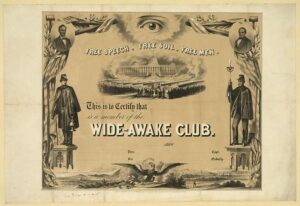
“Free Speech, Free Soil, Free Men”, courtesy of the Library of Congress https://loc.gov/pictures/resource/ppmsca.19788/

Youth involvement in politics is nothing new to us. It seems like at this point of time, especially in the context of the 2024 campaign for the presidential election, the amount of political organizations targeted for young people to join are endless. But when did these sorts of groups come about, and what can they tell us about radical groups today?

The earliest form of grassroots movements began during the election of 1860. The ‘Wide Awakes’ were a group of young men who supported Lincoln’s candidacy for president, and weren’t shy about their campaigning. The group used military tactics, including parading with instruments, in an effort to drum up support (pun intended) for Lincoln.

The impact of the Wide Awakes did not go unnoticed, and even inspired others in the opposing Democratic party to form similar organizations. In an attempt to drown out the noise being made by the Wide Awakes, supporters of the democratic candidate Stephen Douglas founded their own sorts of grassroots organization. Some of these included the Douglas Invisibles, the Bell Ringers, and the Chloroformers.

What set the Wide Awakes apart from these other groups though, is that they used a “military motif”. Such presentation of themselves made them a feared group, and one that seemingly advocated for violence.

Ultimately, their presence in the Lincoln-Douglas election was definitely a contributing factor in precipitating the American Civil War. In fact, Lincoln’s victory was directly correlated to the subsequent state secession. States simply could not accept the results of the election, which eventually lead to much violence. Sound familiar?

To this day, militant political organizations seem to thrive whilst carrying their military-grade weapons, this time semi-automatic rifles, to march in the name of a specific candidate. The most notable of these organizations is the Proud Boys. Now, while the Proud Boys are a militaristic organization similar to the Wide Awakes, I want to emphasize that they have evolved past the mere motif of militarism; the Proud Boys actively incite violence. In fact, the Anti-Defamation League labels the Proud Boys as “a right-wing extremist group with a violent agenda”, something they inevitably confirmed in January of 2021. Just recently in September of 2023, the leader of the Proud Boys was legally found responsible for playing a role in the insurrection and was sentenced to over twenty years in prison.

Seemingly similar to the 1860 election that resulted in the civil war, the Proud Boys incitement of violence at the capitol in 2021 was also over the election results. Several members of the group have been found guilty of storming the capitol while the electoral votes were being counted to confirm Joe Biden’s presidency. Regardless of political party affiliation, what happened on January 6, 2021 was a direct attack on the United States’ democracy.

Thinking about the insurrection in January of 2021 within the context of the 2024 election, I wonder how the Proud Boys and other militant organizations will react if Donald Trump loses the election again? How will violent groups become more organized as they have adapted and learned form the capitol riots? But ultimately, after studying the Wide Awakes’ promotion of violence during the 1860 election, I am left with my scariest question of all; are we headed for another civil war?

Sources

Grinspan, J. (2009). “Young Men for War”: The Wide Awakes and Lincoln’s 1860 Presidential Campaign. The Journal of American History, 96(2), 357–378. http://www.jstor.org/stable/25622297

U.S. Department of Justice. (2023, September 5). Proud Boys Leader Sentenced to 22 Years in Prison for Seditious Conspiracy and Other Charges Related to U.S. Capitol Breach”. Office of Public Affairs https://www.justice.gov/opa/pr/proud-boys-leader-sentenced-22-years-prison-seditious-conspiracy-and-other-charges-related


United States? More Like Divided States.

A picture is worth 1000 words.

The election of 1800 pulled the United States in both two and four directions, with the North and the South having their own polical race for the presidency. In the North the two candidates were Abraham Lincoln (Republican) and Stephen Arnold Douglas (Democrat) and in the South the two candidates were John Bell (Constitutional Union) and John Cabell Breckinridge (Southern Democrat).

This political cartoon entitled Dividing the National Map (author unknown) depicts all four candidates (from left to right: Abraham Lincoln, Stephen Douglas, John Breckinridge, and John Bell) vying for presidential control of the United States. This political cartoon was printed in Cincinnati, Ohio, a boarder state, which was in the Union. Eventually, the state of Ohio voted for Abraham Lincoln with 23 electoral votes. John Bell, standing on the ladder, is attempting to glue the country back together. The cartoon puts heavy emphasis on John Bell repairing the nation with a popular glue brand during the 1800’s, Spalding’s. John Bell was briefly secretary of war under William Henry Harrison until Harrison’s death and then resigned due to political tension within the Whig party. However, from 1846 to 1859 Bell was a Senator for Tennessee. John Bell opposed the expansion of slavery to the territories even though he was a slaveholder himself. I think that the addition of the popular glue brand signifies the fate of the United States rests in the hands of the American people. Being a Southern candidate, especially trying to gain support from the boarder states, I think that John Bell was trying to hold the country together while also supporting slavery. He was trying to garner support from the most vulnerable states who could either be pulled towards the North or the South. He originally opposed the secession of the Southern United States, however eventually ended up supporting the Confederacy. Basically, Bell was trying to pose himself as a popular candidate to the southerners that didn’t want to fracture the United States of America into the North and the South.

Photos and cartoons provide universal access to garner opinions on polical issues. This political cartoon allows a glimpse into the political campaigning of the 1860 election. However, today’s day and age we still have political cartoons. These political cartoons allow for expression of personal viewpoints. Even today political cartoons allow for expression of speech while also leaving some room for viewer interpretation. A similar political cartoon, posted in the Philadelphia Inquierer, was from the 2020 presidential election cycle but instead of a map of the United States it was the United States flag with Donald Trump tearing it apart and Joe Biden sewing it back together. The 2020 political cartoon and the 1860 cartoon express similar sentiments (although in 1860 it is four candidates and in 2020 it was two candidates) regarding tearing the country apart and then one candidate bringing it back together.

Woke-ism, Circa 1860

I once asked my now deceased but then 87-year-old grand-father if he thought he was “woke”. His answer was: “Well, I am not asleep, so yeah, I’m woke”. At the time, I thought this answer was funny, and that hidden in his cold but witty answers, there laid some very sensitive, intelligent, and open-minded man trying to understand a world that was so foreign to him. Now, his answer resonates differently with me. It does not only resonate differently, but it also reflects a certain historical truth that I had never imagined.

It is interesting to think that the “woke” movement, something traditionally attributed to today’s youth generation, can be traced back to many elections ago. In fact, even the nomenclature, the idea of being “awake” can be connected to certain other youth movements of the time.

In 1860, for example, there was a significant youth vote backing Abraham Lincoln, and this might be, in part, what made him win. Here’s a quick history lesson. In 1860, the ballot was mainly divided up between Abraham Lincoln, anti-slavery republican, and Stephen Douglas, pro-slavery democrat in the north and John C Breckenridge and John Bell in the South.  What is particularly interesting about this election is that Lincoln won, by both popular vote and electoral college majority, even though his name did not figure on the ballot in the southern states. As most of us know, this election led to the Civil war, the abolishment of slavery, etc. What I am interested in however is not the events that followed this contentious election, but more the role of the group of young men who called themselves the Wide-awakes and acted as a sort of political grassroots for Lincoln. They organized torchlight processions (yes, I know this sounds weird to our modern ears, but they were the good guys), rallies, and marches to promote Republican ideals and Lincoln’s candidacy. They were, in many ways, the birth of youth movements in the United States, and it is so fascinating that they called themselves the “Wide-awakes”. The concept of being awake seems to be an important one for people our age I suppose. We definitely seem to be keen on proving that we are not asleep.

More importantly than their name though, is what they showed the country. They were the pioneers (not the Grinnell kind) in terms of bringing importance and political significance to the youth crowd. Since then, many politicians, not only in America, have understood the value of including the young population in their campaigning. Harris has definitely understood that as she runs on issues that she knows appeal to young people (reproductive rights, climate change, …).

I don’t think my grandpa would have wanted to say that he was woke, in a political sense, even though he loved affirming that he was a democrat. I think he would not have wanted to admit that he was associating with the young generation of the 21st century. The thing is though, he didn’t have to associate with us, he could just as easily have associated with the Wide-Awakes of the nineteenth century, whose morals and values obviously differ from those of “woke” youth movements today, but whose message remains the same. We are awake to the problems, and we see them for what they are, and for what they will be for us when they become ours to deal with. I think my grandpa would have found some comfort in that definition of woke-ism, and in any case, he did say he was woke!


Sensationalized Media and Campaigning on Lies: The Role of “Fake News”

Defamatory statements, intentional disinformation, and their presence in campaign strategies are not new, nor are they a thing of the past. Instead, they have always existed, surviving by adapting to the current political climate. Throughout elections, the popularity of misinformation and sensational stories serve to show manifestations of some greater collective political anxiety.

Slander, Slander, and More Slander

In the election of 1800, newspaper articles dictated the outcome of Thomas Jefferson and Aaron Burr’s battle to become president. When Burr and Jefferson tied in the election, anti-Burr proponents were quick to issue a narrative damaging Burr’s character as the tie-breaking vote was delegated to the House of Representatives. The smear campaign garnered enough fear surrounding the stability of the U.S. under Burr and ended up dissuading the Federalist-controlled House of Representatives from electing him on the 36th round of voting. It didn’t help that throughout the ongoing scandal, enforcement of libel/slander laws concerning inter-party quarrels or attacks from opponent parties was lacking. It left Burr with little legal recourse to combat attacks on his character and ultimately lead to his complete public defacement upon accusations of treason in Burr v. United States (among other things). With bi-partisan support, Burr was ousted from U.S. politics.

A Coordinated Sensationalist Attack

In a similar vein, the contested election of 1824 between Andrew Jackson and John Quincy Adams provides a look at strategized misinformation and its utility in altering the political climate in the long run. With an additional audience of newly enfranchised white male voters, candidates now had to expand their campaign to include common men, along with aristocrats, to secure votes. In this climate, Jackson rose to prominence with his political promises and rhetoric that pandered to the growing number of recently enfranchised white men. Newspapers published headlines remarking about Jackson’s character, likening him to the average joe in an attempt to appear more relatable than Adams (a child of nepotism). When Jackson lost the election in 1824, he spread the conspiracy of a “corrupt bargain,” and easily turned it into sensationalized news. His insistence on corruption occurring between Adams and then-speaker of the House Henry Clay (also an 1824 presidential candidate) to elect Adams as president instead of Jackson served as the foundation for his election in 1828. As more white men were able to vote without property requirements, they increasingly wanted their interests to be fairly represented; Jackson’s positioning as an underdog victimized by corruption fulfilled that criteria. In the end, he set a strong precedent regarding effective methods to wield the media as a weapon.

Sensationalism, Misinformation, and Terrorism

Today, the utilization of the media as a political tool to manipulate public opinion remains steadfast. Nevertheless, the advent of various options for media consumption (TVs, electronic devices, newspapers, etc.) along with the internet itself has added layers of nuance to political messaging.

From his initial inauguration in 2016 to now, Donald Trump has rarely avoided controversy. However, it is clear that over the last few years, he, along with his other political allies, have upped the rhetorical ante dramatically. His recent debate against Kamala Harris provides a litany of misinformation, sensationalist clickbait-esque soundbites, and straight-up lies. In particular, his comment about Kamala Harris, saying “…she wants to do transgender operations on illegal aliens that are in prison” quickly became viral due to its wildly unsubstantiated nature. As a means of gaining control, Trump commonly defaults to fear-mongering and creating political boogeymen as a tactic to incite outrage toward his opponents in an attempt to dampen their message.

Amplified greatly by uninhibited access to social media and news channels, Trump’s intentional spread of misinformation frequently incited terroristic actions (stochastic terrorism) that mobilized his fan-base at whim. By using his supporters as lackeys, he built a de-localized group of policy enforcers who took it upon themselves to threaten the lives of adversaries in a relationship not so dissimilar to a king and knight squadron. Examples of Trump’s incitement include his repeated insistence on labeling COVID-19 as the “Chinese virus,” which led to a notable uptick in hate crimes against Asian Americans during 2021-2022, his comments about shooting protestors demonstrating in Minneapolis (causing them to be targeted/antagonized), and the infamous January 6th insurrection as a result of his election fraud claim. In addition, he set a precedent for militaristic action in response to the practice of free speech (regarding opposition to his policies/protesting) using misinformation as justification. His large-scale use of threats and violence against criticism created a hostile political environment where backlash and unrest continue to propagate to this day. Trump’s success of misinformation-backed crusading emboldens his supporters while simultaneously increasing growing public concern over the bounds of executive power.

Sources

Mike Levine (May 30, 2020): ‘No Blame?’ ABC News finds 54 cases invoking ‘Trump’ in connection with violence, threats, alleged assaults.

Libby Cathey & Meghan Keneally (May 30, 2020): A look back at Trump comments perceived by some as inciting violence

Khadijah Costley White (January 19, 2021): How Trump Shaped the Media

Carey Wallace (April 14, 2016): Forget Hamilton, Burr Is the Real Hero

William Nester (2013): The Corrupt Bargain, Chapter 6

Reeve Huston (2011): The Expansion of Democracy during the Jacksonian Era

Can We Get Back to Politics? Please?

Discourse surrounding modern American politics often focuses on the polarization and level of vitriol among candidates, voters, and commentators. This heightened level of tension is particularly evident during each presidential election. Many reminisce about the good ol’ days when civility and compromise still dominated political discourse and lament the current level of personal attacks. However, the modern political moment is not uniquely polarized or vituperative. In the election of 1800, the two candidates were themselves and the groups that they represented were highly polarized. The combination of the strong personalities of those involved with the burgeoning party system led to a sometimes nasty and personal campaign.

The election of 1800 was the first time that the brand new American electoral system was put under real strain. In 1789, George Washington was nearly unanimously elected after the creation of the United States Constitution. His Vice President, John Adams succeeded him in office in the election of 1796, but, under the constitutional rules of the time, the second place winner became the Vice President. Thomas Jefferson, a personal rival and partisan opponent, became his second-in-command. The two opponents faced off again in the election of 1800. John Adams represented the Federalist Party and Thomas Jefferson represented the Democratic-Republicans, with Aaron Burr as his “running mate.” The same rules applied in 1800 as in 1796. Jefferson and Burr tied in the electoral college, and, as a surprise to everyone, Burr refused to step aside and become Vice President. The election was thrown to the House of Representatives, where it took thirty-six ballots to elect Jefferson as President.

Even beyond those directly participating in this election, there was a great deal of interest and sense of personal stakes. Alexander Hamilton, who had largely retreated from politics because of personal and political scandals and tragedies, reentered the conversation out of his opposition to Aaron Burr. In a letter he wrote to Harrison Gray Otis, a member of the House of Representatives from Massachusetts, he framed the contest as an existential one for the country. Despite his well-known and long dislike of Jefferson, he says “Mr. Jefferson, though too revolutionary in his notions, is yet a lover of liberty and will be desirous of something like orderly Government—Mr. Burr loves nothing but himself—thinks of nothing but his own aggrandisement—and will be content with nothing short of permanent power in his own hands.” The upcoming presidential election of 2024 does matter—every election matters. But this is not the first time that the results of an election seemed to threaten to the future of the nation and the collapse of civilized political discourse.

Sources

Herbert Sloan, “‘In a Choice of Evils… Jefferson Is in Every View Less

Dangerous than Burr’: Alexander Hamilton to Harrison Gray Otis on

the Deadlocked Presidential Election of 1800,” OAH Magazine of

History 18, no. 5 (2004): 53–57,

http://www.jstor.org/stable/25163723.

James Horn, “Election of 1800,” Thomas Jefferson Encyclopedia,

https://www.monticello.org/research-education/thomas-jefferson-

encyclopedia/election-1800/.

Title from “The Election of 1800” from Hamilton: An American Musical.

Light on policy, heavy on grievance: 200 years of personality politics

If you have felt like the 2024 election has been light on policy, you are not alone in your thinking. 

As election day creeps closer, news articles are emphasizing the lack of clear policy positions as voters try to nail down where candidates stand. Nowhere has the lack of clear policy been more apparent than at the presidential debate on Tuesday, Sept. 10. Kamala Harris and Donald Trump traded pointed remarks and personal attacks, but little time was spent articulating the details of their agendas. When asked about his plan to replace the Affordable Care Act, Trump simply stated that he has “the concepts of a plan,” but he could not name the specific elements he will include. When Harris was asked to explain her vision for improving the economy, she struggled to point to specific policy changes she would implement to reduce the effects of inflation. 

For policy nerds — and frankly, anyone who pays attention to politics — the general devaluing of policy debates, replaced instead by personality politics, is alarming. After all, what is the role of the president if not to enact policy? 

Jimmy Kimmel summed it up nicely during his post-debate monologue on Sept. 10: “Who are we kidding, this election isn’t about the issues.” He’s not wrong. A 2023 study by Filipe Falcão et al. found political outcomes are most influenced by voters’ personality traits and the way they perceive the personality traits of the candidates. Policy often takes a backseat. But why is that? Why has it seemed policy plays an insubstantial role in presidential campaign strategy and election outcomes? 

Part of the answer may come from elections 200 years ago. The presidential elections of 1824 and 1828 mark pivotal moments that deeply influenced modern electoral dynamics. These elections, and the “Corrupt Bargain” claim that led to Andrew Jackson’s rise, paved the way for a style of campaigning that is reflected in modern politics. 

As William Nester reveals in his book on Jackson, the personality-driven politics, populism, and politics of grievance that we see overshadowing substantive policy discussions today grew out of this early 19th-century period. In many ways, these elections set the stage for modern presidential campaigns, characterized by emotional appeals and personal grievances drowning out detailed policy platforms.

After the election of 1824 was decided by the House of Representatives, where Speaker of the House Henry Clay played a consequential role in rallying support for John Quincy Adams, the nature of presidential elections shifted. Although historian Donald Ratcliffe has called into question whether Jackson truly won the popular vote in 1824, the frequent reality in politics, as this case reflects, is that constructed narratives matter more than objective truth. Jackson crafted a rhetoric around the perceived unfairness of the election result; he attacked the elitist, career politician mindset officials in Washington often hold and played up his toughness, military experience, and anti-establishment attitude. Regardless of whether Jackson actually won the popular vote in 1824, his ability to campaign on this narrative heading into the 1828 election, a tactic that had not previously been attempted to this degree, proved majorly effective. 

The 1828 election between Jackson and Adams was, by many accounts, an “ugly” election, with personal attacks becoming standard. Supporters of Adams threw accusations of adultery at Jackson, while Jackson supporters claimed Adams was only a successful diplomat because he procured women for officials of other countries. But while Jackson kept up the flamethrowing, Adams backed down. His refusal to play the dirty game likely contributed to his landslide loss to Jackson in 1828. This victory, in turn, only gave subsequent candidates more reason to attempt the objectionable strategy centered on personal grievances.

Supporters watch as former President Donald J. Trump walks onto the stage at a rally in Indianola, Iowa on Jan. 14, 2024. (Photo by Zach S.)

The parallels between Andrew Jackson’s rise to power in 1828 and Donald Trump’s campaign in 2016 are striking. Both men capitalized on a wave of populist sentiment that viewed the political establishment as corrupt and out of touch with the concerns of average citizens. Similar to Jackson, Trump ran on a platform that emphasized his outsider status as he railed against “the elites,” offering a brand of politics based on grievance rather than nuanced policy proposals. All the while, truth was secondary. What mattered was not the accuracy of the narrative but simply whether it landed with voters.

Ultimately, a well-crafted personal narrative that resonates with voters, making them feel seen and represented by someone who claims to understand them, often seems to be a more effective electoral approach than appealing directly to voters’ stances on substantive issues. As Americans become increasingly disillusioned with the political system, it seems likely that campaigns will remain intentionally light on policy, instead opting to appeal to the personality traits voters find most desirable in a candidate — traits that take priority over policy.

« Older posts Newer posts »
css.php
The views and opinions expressed on individual web pages are strictly those of their authors and are not official statements of Grinnell College. Copyright Statement.