
For the Democratic party in the upcoming election, organizing movements and large swells of support have been the biggest signals of hope for Harris’ campaign. In fact, hope is a very appropriate word, as many have been comparing the Harris-Walz campaign’s major public support as reminiscent of the 2008 Obama campaign, and the iconic slogan that went with it: Hope. While this connection is strong (especially because it is a success story that the Harris campaign seeks to emulate), there exists another strong comparison, the election of 1860.
The election of 1860 (in the North) was between Abraham Lincoln, Republican, and Stephen Douglas, Democrat, who were (relatively) pro and anti slavery respectively. In the South the race was between John C. Breckenridge and John Bell. While there are a number of dynamics that make this election highly complicated, in this case the important thing is that Lincoln won the election (both a plurality of the national popular vote, and the required electoral vote majority) without being on the ballot in southern states. While his election precipitated the secession of most slave states, and the Civil War, the important part here is how Lincoln won. A major part of the Republican movement in 1860 was young voters, specifically the Wide Awakes. The wide awakes were a movement of mostly younger voters whose political involvement was a response to the highly partisan politics that preceded the election of 1860. The Wide Awake movement was one characterized by the ways they spread information (promotional materials, social events, even comics), and the militaristic way that they conducted themselves. They were not a movement built on hope (although they did have hope for the future), instead they were a movement built on resistance, as seen in their demonstrations. They marched in the streets wearing uniforms and carrying torches, acting almost as an army, there to resist the policies and aims of the Democratic party.
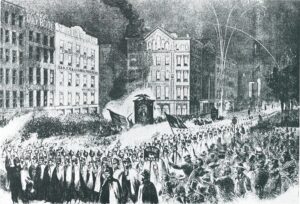
Wide awakes in uniforms carry torches in a march in Chicago. Internet Archive Book Images Image from page 9 of “Abraham Lincoln’s political career through 1860” (1860), courtesy of Internet Archive Book Images.
Compare this to the current Harris campaign. Harris is directing significant resources towards the youth vote, as evidenced through the campaigns focus on youth voters during National Voter Registration Day Additionally, the Harris campaign has been using popular methods of communication, similar to the Wide Awakes, to reach younger voters. Instead of cartoons, the Harris campaign has been using social media and memes as outreach, a strategy which (according to polling) has been paying off. While these mechanical similarities connect the Harris Campaign to the Wide Awakes, it is the attitude with which the youth vote is approaching the election. This attitude boils down to what has become the defining slogan of the Harris campaign: “We are not going back.” The slogan has existed in American politics for a long time, and can be seen to have been used in protests after the Supreme Court Dobbs decision, intrinsically linking the phrase to protest and discontent on the part of many voters. While this is not the same as the militarism of the Wide Awakes, it demonstrates that both 2024 and 1860 contained movements based on discontent, rather than hope like 2008.
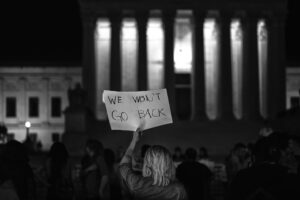
A person holds up a sign reading “We won’t go back” on the day the Dobbs decision was leaked. Photo courtesy of Miki Jourdan, provided under CC BY-NC-ND 2.0
Why does 1860 matter as a comparison? It provides a foundation for understanding how a candidate can win support in a highly polarized election, and how important the discontent of younger generations can be in deciding an election where institutions (slavery and reproductive rights respectively) are at a turning point. Will the “woke” reproduce the victory of the Wide Awakes? Only time will tell.

This is so fun! I love the comparisons of how campaigns use different forms of popular media. I also wonder if a comparison should be made between the grassroots nature of the Wide Awake movement and the grassroots outpouring of pro-Harris memes (primarily from young people) following Biden’s exit from the race?