
Grinnell College Logo

HIS 295, Professor Sarah J. Purcell

Author: W. Shepard

Electoral College Reform

The Electoral College was designed to balance the influence of populous states with that of smaller ones in presidential elections, as well as to balance the interests of the Framers between limiting congressional influence in the executive branch without instituting directly elected presidents. However, its relevance and fairness have come under scrutiny, prompting calls for reform. Advocates argue that the system undermines the principle of one-person, one-vote, while opponents contend it protects the interests of smaller states.

There are several different reform proposals. The most direct way would be to amend the Constitution and replace the Electoral College with a national popular vote. However, amending the Constitution is a very difficult process with a really high threshold. In addition, the polarization of modern America makes it nearly if not impossible that enough of a coalition could form to amend the Constitution. Since its institution, there have been more than seven hundred proposed amendments to modify or abolish the Electoral College. That is the highest number of amendments proposed on any one subject of constitutional reform.

Another possibility would be legislation, at the national or state level, that requires states to allocate their electors in a more proportional manner—getting rid of the current winner-take-all system. Like Maine and Nebraska, the votes of all citizens of a state would count. Or, at least, less votes would be “wasted” than are now.

One of the most promising current reform plans is called the National Popular Vote Interstate Compact (NPVIC). The NPVIC is an agreement between states to award all of their electoral votes to the candidate who won the national popular vote, regardless of who won in their state. Seventeen states and the District of Columbia have currently joined, but the NPVIC will not go into effect until enough states have joined that would determine the results of the Electoral College—states adding up to 270 electoral votes. This seems the likeliest avenue for reform, but it is not without issues. Because it is a voluntary compact, the NPVIC is not legally binding. States can leave at any time, and they might choose to do so if the national popular vote selects a candidate that they do not want to support with their electors. It is also useless until enough states join that puts it into effect.
The Electoral College and Contested Elections

The Electoral College is a feature of the American political and electoral system, established in the Constitution as a compromise between direct popular voting and congressional selection of the president. Each state is allocated a number of electors equivalent to its representation in Congress, and these electors cast votes to determine the president. The method of choosing electors is left up to the individual states, and, with the exceptions of Maine and Nebraska, each state uses a winner-take-all system, where the winner of the statewide popular vote receives all of the state’s electoral votes. While intended to balance the influence of populous states with less populous ones, the system has led to significant controversies, especially during contested presidential elections, particularly when the Electoral College fails to select a president, and the election is thrown to the House of Representatives.

One of the most notable instances of this occurred in 1824 when none of the candidates received a majority of electoral votes. The election was decided by the House of Representatives, leading to accusations of a “corrupt bargain” between John Quincy Adams and Henry Clay. Similarly, in 1876, Rutherford B. Hayes lost the popular vote to Samuel J. Tilden but won the presidency through the highly disputed electoral count, culminating in a compromise that effectively ended Reconstruction.

The most recent and perhaps the most influential example on modern politics came in the election of 2000. Vice President Al Gore won the popular vote but lost the presidency to Texas Governor George W. Bush after a highly controversial Supreme Court decision ended a recount and effectively awarded Florida’s crucial electoral votes to Bush, raising questions about political bias in the courts, voter disenfranchisement, and the legitimacy of presidential elections under the Electoral College.

In 2016, Donald Trump also secured the presidency despite losing the popular vote to Hillary Clinton. A candidate being elected president despite a majority of voters preferring his or her opponent is always controversial, but the polarizing effect of Donald Trump on the electorate created even more of a sense that his inauguration was an illegitimate reflection of the people’s will. This raised and intensified questions about the relevance and future of the Electoral College. Advocates for reform argue that the system is outdated and disproportionately amplifies the votes of certain states, while supporters contend it protects the interests of smaller states and less populated areas.

Sources

  • CNN, “Bush v. Gore: Too Close to Call,” (2015), https://youtu.be/wufOcpTH0HU?si=HJjcyBN26n9NmTMn
  • Jack N. Rakove, “Presidential Selection: Electoral Fallacies,” Political Science Quarterly 119, no. 1 (2004): 21–37, https://www.jstor.org/stable/20202303.
  • Margaret Hogan, “Corrupt Bargain,” The Miller Center at the University of Virginia, https://millercenter.org/contested-presidential-elections/corrupt-bargain
  • Shiela Blackford, “Disputed Election of 1876,” University of Virginia Miller Center, https://millercenter.org/the-presidency/educational-resources/disputed-election-1876

Concessions: Protecting or Undermining Democracy?

The presidential election in 2000 was contested between Republican Texas Governor George W. Bush and Democratic Vice President Al Gore. Bush became the president despite Vice President Gore winning the popular vote. The results of the Electoral College were not clear at the time and remain contested. Bush won Florida’s electoral votes by such a close margin that a recount was required. A series of legal battles led to the very controversial Supreme Court decision in Bush v. Gore, which ended the recount, giving the victory to George W. Bush. On December 13, 2000 Al Gore conceded the election and congratulated George W. Bush on his victory. Citing an earlier acrimonious election, Gore quotes Senator Stephen Douglas’ concession to Abraham Lincoln: “Partisan feeling must yield to patriotism.” Gore’s language is clear and strong. Although he strongly disagreed with the court’s decision, he affirmed his acceptance of it and said, “for the sake of our unity as a people and the strength of our democracy, I offer my concession. I also accept my responsibility, which I will discharge unconditionally, to honor the new President-elect and do everything possible to help him bring Americans together.” Despite Gore’s credible and valid concerns about the process that awarded the presidency to Bush, he conceded the victory in order to preserve American democracy and the institutions that uphold it.

On the other hand, in the election of 2020, Donald Trump did not have legitimate reason to believe that he had won the election. Despite this, he persisted in claiming that the election was stolen, including filing (and losing) many lawsuits. During the recent vice presidential debate, JD Vance, Trump’s new running mate, again refused to say whether Trump lost the previous race. The speech that comes closest to a concession for Trump has some lines that seem similar to Gore’s from twenty years earlier. However, at no point does the former president actually say that he lost the election or that he is conceding. He merely says that a “new administration will be inaugurated.” He frames his challenges to the election as an attempt to “ensure the integrity of the vote” and to fight “to defend American democracy.” However, in doing so, he potentially encouraged, or at least failed to condemn, political violence against the institutions that make up American democracy.

Sources

E. J. Dionne and William Kristol, “Chronology,” eds. Bush v. Gore: The Court Cases and the Commentary (Washington, D.C.: Brookings Institution Press, 2001), http://www.jstor.org/stable/10.7864/j.ctvddztfj.

E. J. Dionne and William Kristol, “Introduction,” eds. Bush v. Gore: The Court Cases and the Commentary (Washington, D.C.: Brookings Institution Press, 2001), http://www.jstor.org/stable/10.7864/j.ctvddztfj.

Does One Party Have a Monopoly on Patriotism?: Campaign Songs and Partisanship

The presidential election of 1876 was contested between Republican Rutherford B. Hayes of Ohio and Democrat Samuel J. Tilden of New York. Tilden won more electoral votes, but the ballots in several states, Florida, Louisiana, South Carolina, and Oregon, were disputed. An Electoral Commission established by Congress confirmed Rutherford B. Hayes as the winner, despite not having won a plurality of the national popular vote. The election was influenced by electoral fraud, voter intimidation, and disenfranchisement of Black voters. The contest was only resolved by the Compromise of 1877, where Hayes promised to end Reconstruction in exchange for his election as president.

Since the very first presidential election, music has been an important part of campaigning and American political culture. Songs written specifically for a campaign might extol the virtues of the candidate or attack the vices of an opponent. Supporters of Samuel J. Tilden and his running mate Thomas A. Hendricks promoted their candidacy with a song called the “Grand March.” Usage of the music was not restricted to the campaign or its supporters—its sheet music was made available to military bands, orchestras, and choruses. Although some campaign music named candidates or opponents specifically and by name, others, including the “Grand March,” had a broader, less partisan, and more patriotic appeal. A song called “Adams and Liberty,” written to celebrate President John Adams, is sung to a melody that is now know as “The Star-Spangled Banner.”

In modern politics, campaign music continues to be influential. Sometimes a particular song becomes strongly associated with a candidate, such as Fleetwood Mac’s “Don’t Stop” and former President Bill Clinton. Music can also serve to subtly (or less so) hint at the values of a campaign and party. For example, Democratic presidential nominee Vice President Kamala Harris using Beyoncé’s song “Freedom” in her campaign advertising, the Republican National Convention featuring a performance by Kid Rock, and the Democratic National Convention including a musical roll call. Lee Greenwood’s song “God Bless the U.S.A” was originally not used in campaigning, with Greenwood saying that he wrote it for all Americans. However, he agreed to sing it for Ronald Reagan, turning it into a song that is seen as primarily Republican. In fact, Republicans are often seen to have a monopoly on patriotism in modern political culture. However, the Democratic Party is currently pushing back against that idea. In addition to their music-based show of state pride, the 2024 Democratic National Convention placed a heavy emphasis on patriotism, including chants of “USA” and intense use of the American flag. Since the party system first developed, both have seen themselves as the true protector of American democracy and the other as a threat. This competition over which side is more truly American can be seen throughout modern politics and historical elections, including in the fight over campaign songs.

Sources

A political playlist: The fight over campaign songs

At convention, Democrats claim patriotism, American flag as their own

Democrats try to take patriotism back from GOP

Disputed Election of 1876

Early Rally Songs – Voices, Votes, Victory: Presidential Campaign Songs

How the Democrats reclaimed patriotism

Voices, Votes, Victory: Presidential Campaign Songs Forgotten Candidates

Youth Political Participation Now and Then


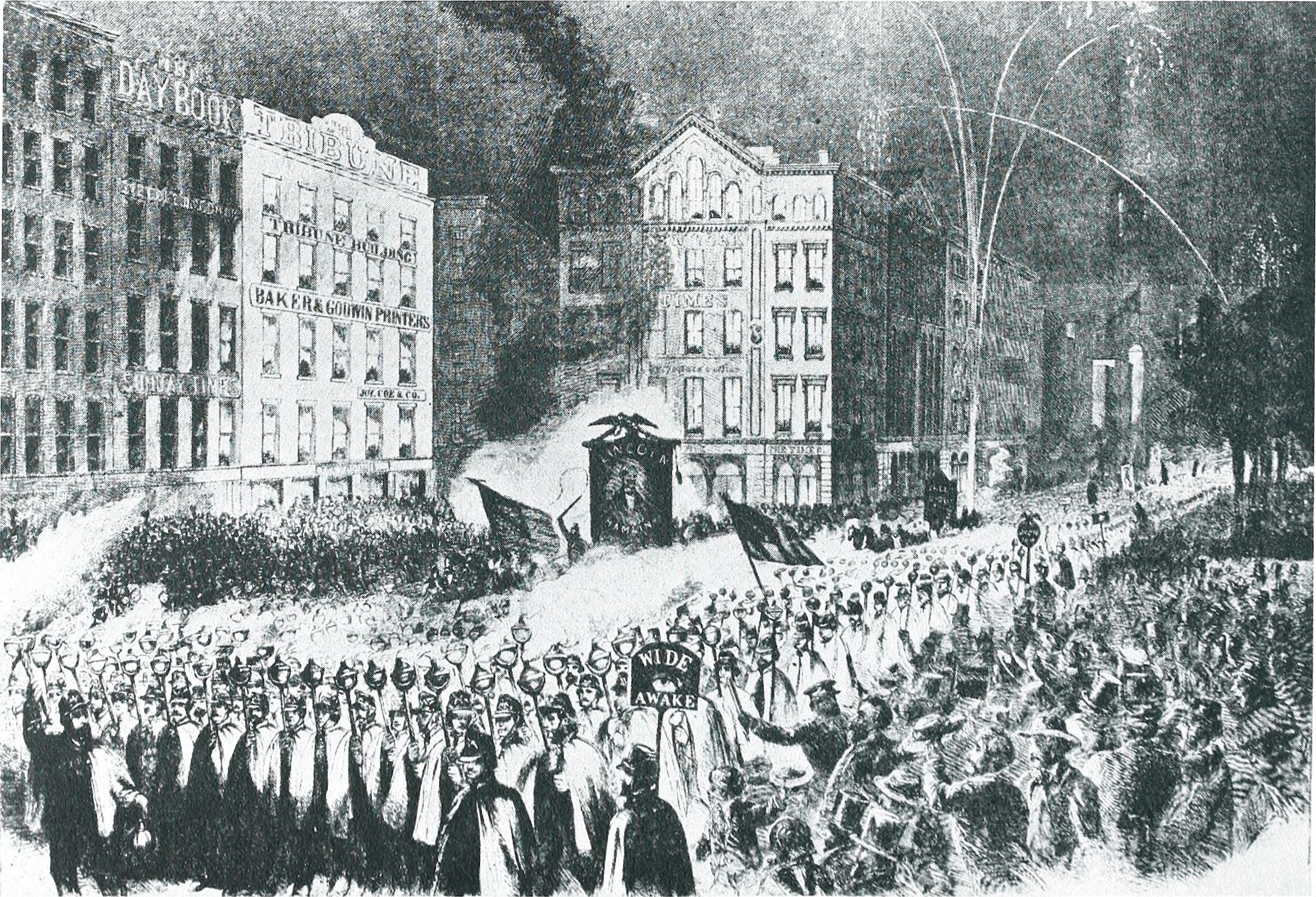
The election of 1860 was a four-way race between Republican Abraham Lincoln, Democrat Stephen Douglas, Southern Democrat John C. Breckinridge, and Constitutional Unionist John Bell. Douglas and Bell represented a more moderate center, and Lincoln and Breckinridge were at each end of the spectrum on slavery policy. Lincoln won the presidency with an overwhelming victory in the North and no support in the South—in many states he was not even on the ballot.

The election of 1860 and Abraham Lincoln’s candidacy galvanized the support of a new group of politically active voters: the Wide Awakes. The Wide Awakes were made up of young white men, particularly those in their teens, twenties, and thirties. Many of them (about a quarter) had not even been eligible to vote in the previous presidential election. These young men were new to politics and operated outside of the traditional campaign structures. They relied on a pseudo-military aesthetic, “popular social events, an ethos of competitive fraternity, and even promotional comic books,” according to Jon Grinspan in “‘Young Men for War’: The Wide Awakes and Lincoln’s 1860 Presidential Campaign” (p. 358).

In modern elections, the youth vote is an important and often elusive one. Before the 2022 midterm elections, there was a flurry of news coverage and political discourse about whether young voters were disaffected and disillusioned, as well as what could be done to engage them with the political and electoral process. A 2022 NPR poll found that only 14% of young voters planned to vote that November. A single month later found the same outlet reporting that young voter turnout was the second highest it had been for a midterm election in the past three decades.


The political engagement of young people is often alarming, unsettling, or even frightening to older voters and those with more power in the party systems or political elites. They often work outside of the traditional systems to garner support, and they sometimes have differing or more extreme values from older voters. However, the election of 1860 and more recent ones, including the 2022 midterms, show the influence of the youth vote in shaping the future of politics. The presence and impact of “wide awake” young people in the 2024 presidential election remains to be seen.

Sources

Jon Grinspan, “‘Young Men for War’: The Wide Awakes and Lincoln’s 1860 Presidential Campaign,” The Journal of American History 96, no. 2 (2009): 357–78, http://www.jstor.org/stable/25622297.

Michael Burlingame, “Abraham Lincoln: Campaigns and Elections,” University of Virginia Miller Center, https://millercenter.org/president/lincoln/campaigns-and-elections.

Image credits: https://www.flickr.com/photos/internetarchivebookimages/14594018200/

Can We Get Back to Politics? Please?

Discourse surrounding modern American politics often focuses on the polarization and level of vitriol among candidates, voters, and commentators. This heightened level of tension is particularly evident during each presidential election. Many reminisce about the good ol’ days when civility and compromise still dominated political discourse and lament the current level of personal attacks. However, the modern political moment is not uniquely polarized or vituperative. In the election of 1800, the two candidates were themselves and the groups that they represented were highly polarized. The combination of the strong personalities of those involved with the burgeoning party system led to a sometimes nasty and personal campaign.

The election of 1800 was the first time that the brand new American electoral system was put under real strain. In 1789, George Washington was nearly unanimously elected after the creation of the United States Constitution. His Vice President, John Adams succeeded him in office in the election of 1796, but, under the constitutional rules of the time, the second place winner became the Vice President. Thomas Jefferson, a personal rival and partisan opponent, became his second-in-command. The two opponents faced off again in the election of 1800. John Adams represented the Federalist Party and Thomas Jefferson represented the Democratic-Republicans, with Aaron Burr as his “running mate.” The same rules applied in 1800 as in 1796. Jefferson and Burr tied in the electoral college, and, as a surprise to everyone, Burr refused to step aside and become Vice President. The election was thrown to the House of Representatives, where it took thirty-six ballots to elect Jefferson as President.

Even beyond those directly participating in this election, there was a great deal of interest and sense of personal stakes. Alexander Hamilton, who had largely retreated from politics because of personal and political scandals and tragedies, reentered the conversation out of his opposition to Aaron Burr. In a letter he wrote to Harrison Gray Otis, a member of the House of Representatives from Massachusetts, he framed the contest as an existential one for the country. Despite his well-known and long dislike of Jefferson, he says “Mr. Jefferson, though too revolutionary in his notions, is yet a lover of liberty and will be desirous of something like orderly Government—Mr. Burr loves nothing but himself—thinks of nothing but his own aggrandisement—and will be content with nothing short of permanent power in his own hands.” The upcoming presidential election of 2024 does matter—every election matters. But this is not the first time that the results of an election seemed to threaten to the future of the nation and the collapse of civilized political discourse.

Sources

Herbert Sloan, “‘In a Choice of Evils… Jefferson Is in Every View Less

Dangerous than Burr’: Alexander Hamilton to Harrison Gray Otis on

the Deadlocked Presidential Election of 1800,” OAH Magazine of

History 18, no. 5 (2004): 53–57,

http://www.jstor.org/stable/25163723.

James Horn, “Election of 1800,” Thomas Jefferson Encyclopedia,

https://www.monticello.org/research-education/thomas-jefferson-

encyclopedia/election-1800/.

Title from “The Election of 1800” from Hamilton: An American Musical.

css.php
The views and opinions expressed on individual web pages are strictly those of their authors and are not official statements of Grinnell College. Copyright Statement.