
Grinnell College Logo

HIS 295, Professor Sarah J. Purcell

Author: Ella B

The Impact of the Unelected Silent Rulers

In 2000, George Walker Bush was elected to be the 43rd President of the United States, beating his Democratic opponent, Al Gore. Bush won the electoral vote while Gore won the popular vote, in a fashion one might call Trumpian today. This election was one of the most contested elections in US history, and for good reason. As I said earlier, Bush won the electoral vote, and this is a key factor when thinking about this election, as some people still think he might not have actually won even the electoral vote. In the state of Florida, the results were too close to call on election night, which lead to an automatic recount, a fairly banal situation all things considered. Where it loses all sense of banality, however, is when a controversy over various voting irregularities, including the nightmarish “hanging chads” on punch-card ballots, erupted which made it difficult to determine voter intent. Florida kept going back and forth on who had won the election with recount process that dragged on, and legal battles reaching the U.S. Supreme Court. That legal battle, intuitively named Bush v. Gore, had the Supreme Court rule over whether there should be a recount, which would question Bush’s victory. They infamously ruled to stop the recount, subsequently giving Bush Florida’s electoral votes.

The Supreme Court, on that day, might, and might is important here, have led to the election of the minority choice. That is detrimental when thinking of the protection of democracy. Even more interestingly, the decision said: “None are more conscious of the vital limits on judicial authority than are the Members of this Court, and none stand more in admiration of the Constitution’s design to leave the selection of the President to the people, through their legislatures, and to the political sphere. When contending parties invoke the process of the courts, however, it becomes our unsought responsibility to resolve the federal and constitutional issues the judicial system has been forced to confront”, themselves admitting to the importance of giving the Presidential nomination choice to the people, while simultaneously not allowing there to be a recount in case of doubt, in a razor-thin margin election.

This is fascinating, and terrifying, to think of considering the upcoming election, which will, undoubtably, be contested. Today’s court has also been criticized for exhibiting a less neutral and more politically driven decision-making tactics. Today, the Court has six republican judges and three democratic judges, which means that they might be swayed to make decisions based on party alliance, and with a clear majority in place, can we be sure they will be objective and simply stick to the laws of the Constitution? 2024 will, without a doubt, present many lawsuits which will end up in the hands of the “big” court. How, as an unelected body, can they end up being the subjective deciders for who is to be the next leader of this country?


Really, we are still suppressing?

Land of the free, home of the brave, country of voter suppression! Not allowing certain groups of people to vote seems almost comically antiquated, but fret not, we are still on that train! With the 2024 presidential election, it seems crucial to dive into the necessities of voting, as well as the history of voting being taken away from people, specifically minorities. While things are not as bad as they used to be, in fact really far from that, there are still patterns of racial discrimination within the voting system.

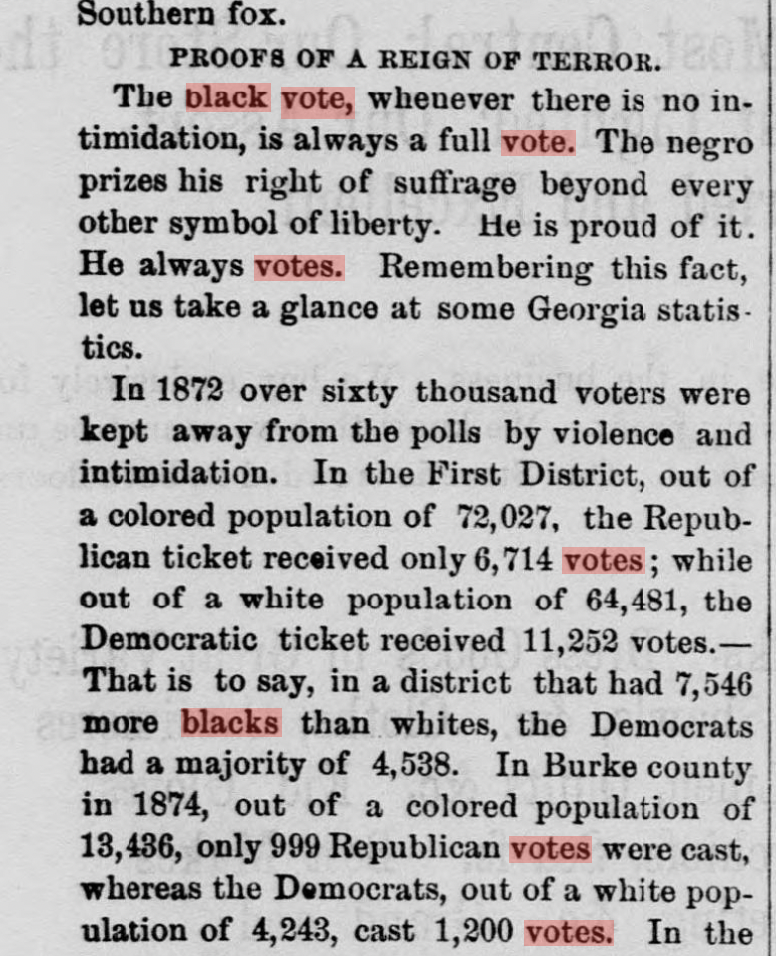
Here is a little crash course on the landscape of voting after the civil war and during the reconstruction period. Before the civil war, black men in the south were allowed to vote but their vote only counted as three thirds of a vote, and truth be told, they did not have a right to vote, they had the obligation to vote for whoever their enslavers were voting for. This is much more complex and difficult then the long sentence I have just written about it, but we will go off of this information for now. After the civil war, in 1870, black men were finally given the right to vote in the south. While this is in theory nice, as one can expect, it is not actually what happened. Many obstacles were set in place to prevent freed black men from voting, such as literacy tests, poll taxes, and straight up terrorism from the Ku Klux Klan. In fact, during the election of 1870, President Johnson of the democratic party (party of the recently succeeded then returned states), attempted, very lightly, to get the southern states to protect the vote of the newly freed black men. As history shows us, this failed miserably, almost as miserably as reconstruction. Klan attacks were numerous, and people were terrorized, sometimes even killed. This led to a hundred more years of black people fighting their way to equality, especially when it came to voting.


Excerpt from the West-Jersey Pioneer, published on October 26th, 1876. Retrieved from the Newspaper archives of the Library of Congress.


It is easy to believe, or even expect, that such things would not be happening today. How could our progressed society show signs of such antiquated bigotry. But no, this problem, while manifesting differently, still exists. Latosha Brown, a community organizer, political strategist, and consultant, admitted on NPR to being worried about the way votes were going to be counted due to new rules which might be purposely disenfranchising certain groups. This poses a significant threat to our Democracy. If minorities are having their right to vote purposefully taken away, how can we possibly say we have evolved from the era of the 1870’s?

Woke-ism, Circa 1860

I once asked my now deceased but then 87-year-old grand-father if he thought he was “woke”. His answer was: “Well, I am not asleep, so yeah, I’m woke”. At the time, I thought this answer was funny, and that hidden in his cold but witty answers, there laid some very sensitive, intelligent, and open-minded man trying to understand a world that was so foreign to him. Now, his answer resonates differently with me. It does not only resonate differently, but it also reflects a certain historical truth that I had never imagined.

It is interesting to think that the “woke” movement, something traditionally attributed to today’s youth generation, can be traced back to many elections ago. In fact, even the nomenclature, the idea of being “awake” can be connected to certain other youth movements of the time.

In 1860, for example, there was a significant youth vote backing Abraham Lincoln, and this might be, in part, what made him win. Here’s a quick history lesson. In 1860, the ballot was mainly divided up between Abraham Lincoln, anti-slavery republican, and Stephen Douglas, pro-slavery democrat in the north and John C Breckenridge and John Bell in the South.  What is particularly interesting about this election is that Lincoln won, by both popular vote and electoral college majority, even though his name did not figure on the ballot in the southern states. As most of us know, this election led to the Civil war, the abolishment of slavery, etc. What I am interested in however is not the events that followed this contentious election, but more the role of the group of young men who called themselves the Wide-awakes and acted as a sort of political grassroots for Lincoln. They organized torchlight processions (yes, I know this sounds weird to our modern ears, but they were the good guys), rallies, and marches to promote Republican ideals and Lincoln’s candidacy. They were, in many ways, the birth of youth movements in the United States, and it is so fascinating that they called themselves the “Wide-awakes”. The concept of being awake seems to be an important one for people our age I suppose. We definitely seem to be keen on proving that we are not asleep.

More importantly than their name though, is what they showed the country. They were the pioneers (not the Grinnell kind) in terms of bringing importance and political significance to the youth crowd. Since then, many politicians, not only in America, have understood the value of including the young population in their campaigning. Harris has definitely understood that as she runs on issues that she knows appeal to young people (reproductive rights, climate change, …).

I don’t think my grandpa would have wanted to say that he was woke, in a political sense, even though he loved affirming that he was a democrat. I think he would not have wanted to admit that he was associating with the young generation of the 21st century. The thing is though, he didn’t have to associate with us, he could just as easily have associated with the Wide-Awakes of the nineteenth century, whose morals and values obviously differ from those of “woke” youth movements today, but whose message remains the same. We are awake to the problems, and we see them for what they are, and for what they will be for us when they become ours to deal with. I think my grandpa would have found some comfort in that definition of woke-ism, and in any case, he did say he was woke!


The Year the Unity Died

In December of 1800, Alexander Hamilton, a framer and honored member of the Federalist party, wrote to his friend Harrison Gray Otis, a fellow Federalist, about his preference for Thomas Jefferson, the unofficial leader of the Democratic-Republicans, over Aaron Burr, another Democratic-Republican. Yes, lots of fancy jargon, let us take a step back for a moment.

Simply said, in 1800, there were two political parties that dominated the American political scene; the Democratic-Republicans, who stood for smaller federal government and more freedom to the people, and the Federalists, who stood for stronger federal government and a more elitist structure of society. Now, the idea that our ancestors had some distant and modified version of our current “two-party” system might not seem chocking, however, one must remember that before 1789, the idea of political parties, or factions as they called them, was seen as a threat not only to democracy but also to the survival of the republic. Humans being human quickly became divided however, into the two parties mentioned above, and this almost innocent idea that the country would be able to function under the leadership of one united government trickled down. Even though the existence of political parties was very much present and known throughout the 1790’s, the electoral process was still functioning under the idea that there would be no political parties. More specifically, there was no procedure for a president and a vice-president to run together on a same ticket. Instead, the candidate with the majority votes would be elected president and the candidate with the second most votes would be vice-president. Today, this system would be nothing but a funny thought experiment (picture it: Harris-Trump, Make America Not Go Back Again?) but one can clearly see how this system was thought out with the intension of staying clear of political parties.

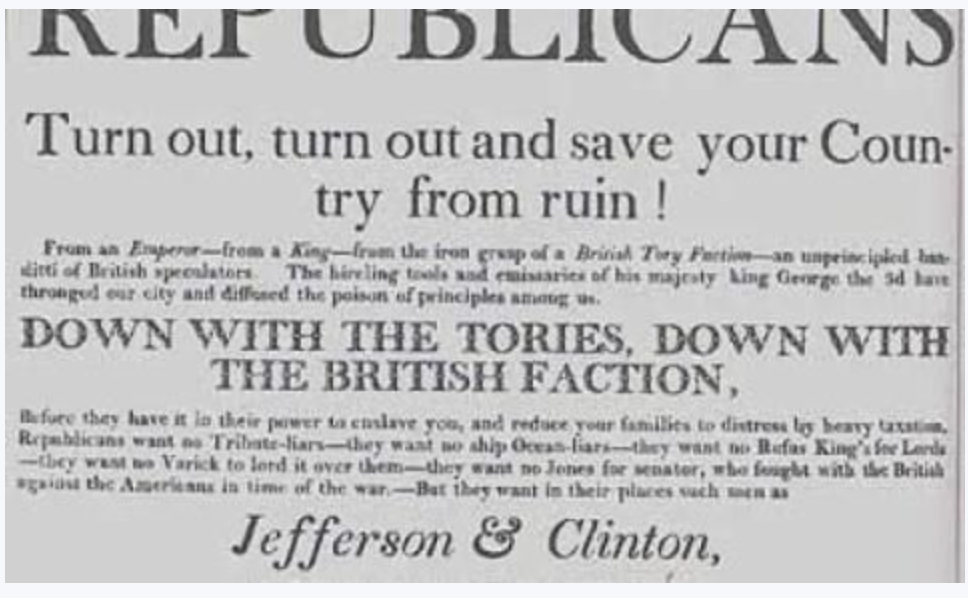
Now that the context has been established, we may return to the impact the election of 1800 had on the rise of political parties. This dissonance between the electoral system and the political parties finally came to a head when Thomas Jefferson and Aaron Burr, both of the same party but strongly against one another, were ultimately going to end up being voted into office together. While the election process was long and cumbersome (that is another story for another time), the “enemy pair” did end up being voted in together, which lead to the birth of the 12th amendment. Shortly, the 12th amendment stated that the president and vice-president would be voted in together on the same ticket. This amendment is seen by many as being the catalyst towards the party system in the United States.

Hamilton and Otis were far from knowing that their political party would soon cease to exist, but what they were even further from knowing is that the election system they had built would disappear and leave room for the rise of very strong factions, everything they had ever feared. That is how I would recommend remembering the election of 1800, the election of 1800 is the year the unity died.

Jefferson and Clinton grouped ticket for the election of 1804. Image from the Ronald Reagan Presidential Museum and Library.

css.php
The views and opinions expressed on individual web pages are strictly those of their authors and are not official statements of Grinnell College. Copyright Statement.