Grinnell College Logo

Contested U.S. Presidential Elections (Fall 2024)

HIS 295, Professor Sarah J. Purcell

Setting the Stage: Election Denial

The Electoral College has long been controversial in its role in determining elections, but this is not necessarily a new or isolated idea. US elections throughout history have often put emphasis on the importance of different voting systems in response to election results. However, there has never been a presidential candidate with enough potential to threaten both the popular vote, electoral vote, and voting entirely—until now. Donald Trump’s influence on local and state governments to do his dirty work has raised serious issues regarding the upcoming 2024 election & subsequent certification.

Leveraging Electoral Votes

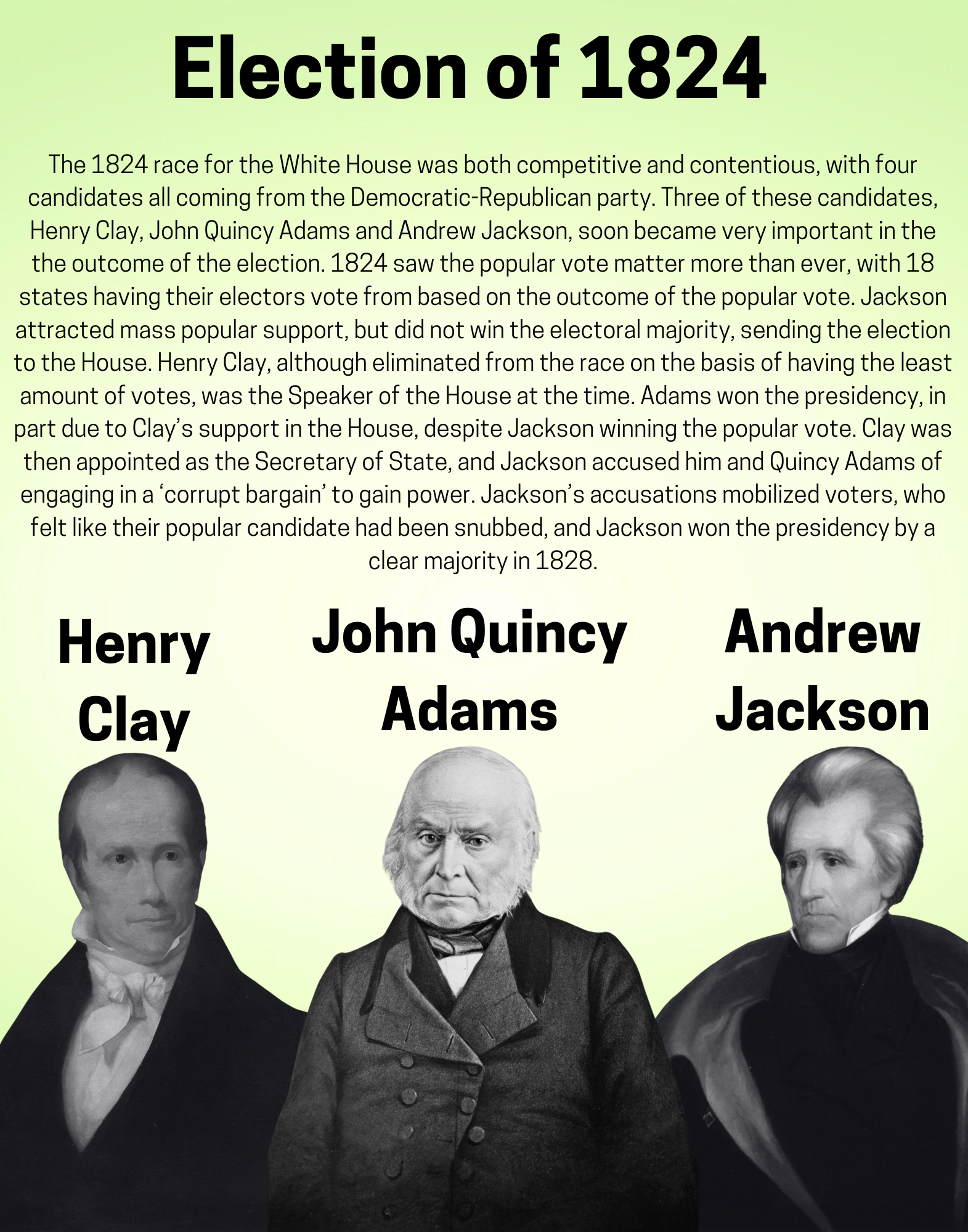
In 1824, Andrew Jackson became the first president to lose an election despite gaining the popular vote and most electoral votes. Electoral votes were split between the four candidates: Andrew Jackson, John Quincy Adams, Henry Clay, and William H. Crawford and none had the majority necessary to win. To deal with this hiccup, the decision was sent to the House of Representatives, of which candidate Henry Clay was the Speaker of the House. While the House deliberated, Adams negotiated enough states’ electoral votes to reach the majority to win the election. The emphasis placed on electoral votes over popular votes jaded the growing non-property-owning white male voters, who didn’t feel represented by wealthy property-owning white men like Adams. Although Jackson may have lost in 1824, he made sure to exploit his loss to the fullest until his election in 1828, campaigning as a “man of the people” and victim of corruption.

Election Interference

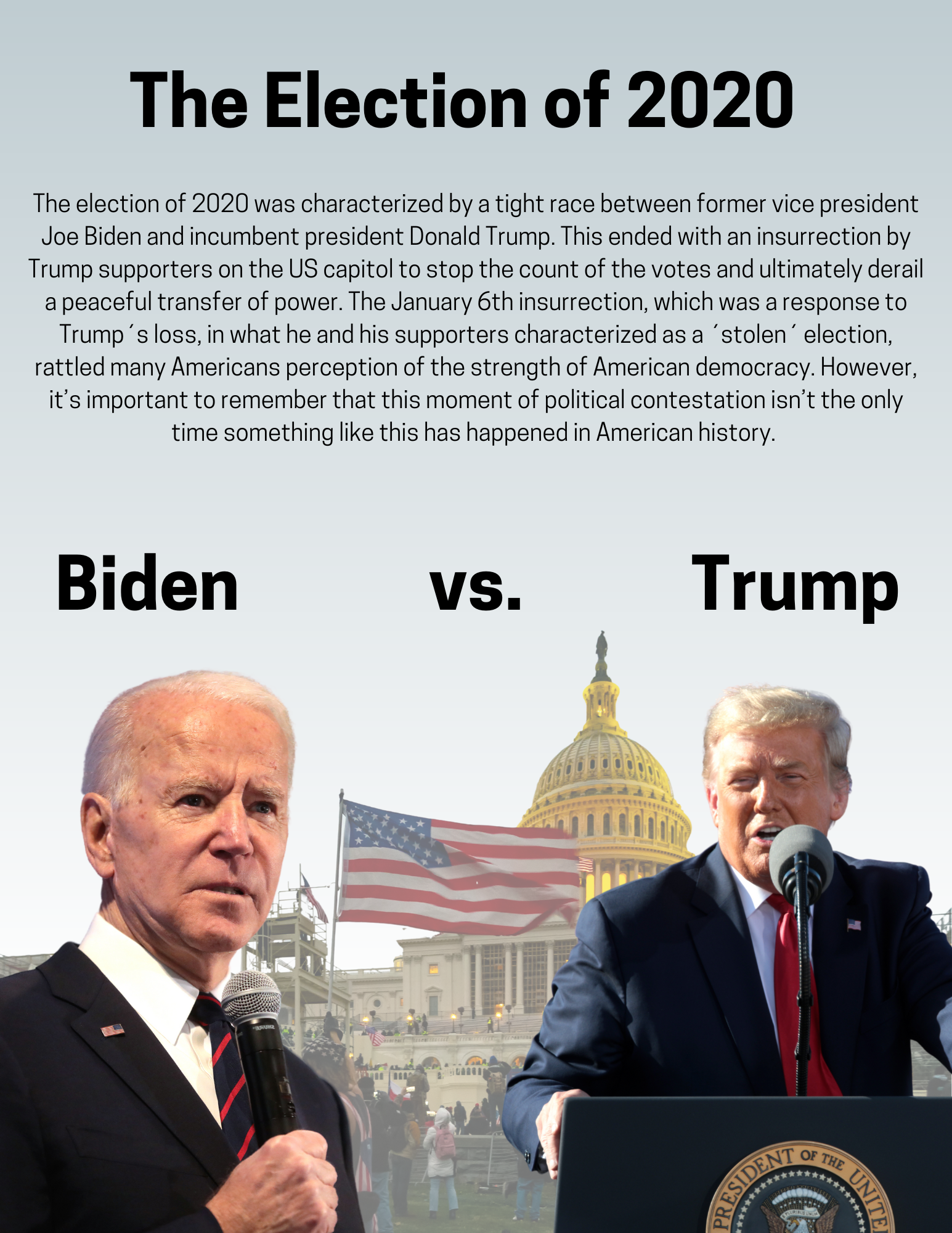
When Trump lost the 2020 election, he resorted to election fraud claims to cast doubt on the efficacy of the Electoral College. Citing a litany of nonexistent voter fraud cases as proof, Trump has left lasting damage to how voters view voting and vote counting.

Like Andrew Jackson’s strategy of playing the long (but still technically legal) game, Donald Trump has chosen a similar, but illegal, route. Since 2020, Trump has consistently worked to underhandedly influence the 2024 election. Taking the Jackson approach, Trump has spared no effort in politically astroturfing 2024 election with claims of Democratic intervention. Through this, he aims to further weaken Republican voters’ confidence in the electoral process, allowing him to easily sneak in and manipulate the results in the chaos of it all. Delegating tasks to his  cronies implanted in swing states, Trump’s fellow Republicans work to interfere in vote counting  by any means necessary, including various attempts to alter voting laws and criteria to vote. An instance of this coordinated effort was exposed recently when three Georgia election officials by the names of Janice Johnston, Rick Jeffares, and Janelle King voted to give county boards the power to overrule election officials’ ballot decisions, which could create a loophole to deny election results. Accordingly, the Georgia courts reversed this illegal move, but the source of the threat continues to propagate not just in Georgia, but also in other key swing states where the same sentiment is held. Trump brain rot spans a large area of the U.S. and while there may be countermeasures in place to safeguard the voting rights and hinder bad faith actors, the issues will continue to persist until they are properly uprooted.

Sources

Andrew Garber and Wendy Weiser (August 14, 2024): Donald Trump’s Latest Plan to Mess With Georgia’s Election Is Not Some Clever Loophole

Cate Cadell (January 6th, 2024): Trump skips Illinois loyalty oath promising not to overthrow government

Andy Kroll, ProPublica, and Nick Surgery (August 10th, 2024): Inside Project 2025’s Secret Training Videos

State-Sponsored Trolling

The advent of social media has revolutionized how we interact with one another; you’re able to form connections with people you would have never been able to and reach countless others due to the curated and fast-paced nature of their algorithms. However, this culture has sprouted some peculiar societal shifts, with countless online goers engaging in para-social relationships with public figures. While generally regarded as unhealthy behavior, this trend has paved the way for a new form of political influence through posting.

Ragebaiting

Ragebaiting has seemingly become a mainstream political tactic in U.S. politics, thanks largely in part to Donald Trump. The strategy stems from the larger bubble of disinformation seen throughout election history but deviates due to the online facet, which plays a crucial role in the virulent spread of ragebait; Trump’s use of Twitter (and now TruthSocial) as the medium in which he communicates with the public, exemplifies this. He uses a combination of emotional appeals, volatile rhetoric, and audacious displays of bravado to insert himself into the public sphere and general conscious, regardless of the public’s disdain.

Paternal…Guidance?

Emotional appeal has long been a core campaign tactic with its roots in the 1824 election. Responding to his own loss, Andrew Jackson utilized the media to implant the idea of a corrupt bargain into the public’s minds. This spread of misinformation, in conjunction with populist rhetoric targeting newly enfranchised white male voters, ultimately paved the way for his election in 1828. Trump follows in Jackson’s footsteps, employing similar emotionally tinged rhetoric to target his core base of conservative white male voters. In addition, Trump’s carefully curated para-social relationships with his followers adds nuance to the misinformation he spreads. For example, in his speech to calm down insurrectionists on January 6th, 2021:

It’s a very tough period of time. There’s never been a time like this where such a thing happened where they could take it away from all of us — from me, from you, from our country. This was a fraudulent election, but we can’t play into the hands of these people. We have to have peace. So go home. We love you. You’re very special. You’ve seen what happens. You see the way others are treated that are so bad and so evil. I know how you feel, but go home, and go home in peace.

Trump makes outright claims of election fraud, but he intersperses it between the larger, repeated mentions of his supporters as if they are closely related, almost family. He knows they are going “through a tough time” and notes that he “loves [them],” as if insurgency is something as insignificant as puberty. He strategically feeds these para-social relationships to quell his displeased supporters, acting as some larger paternal father-figure to the rioter coalition. Using these relationships, he continues to propagate the belief that he cares about these people, emboldening his supporters in the process.

Humble Brag

Intrinsically, tweet communication has limited capabilities that make it a good medium to fire off quippy, thoughtless remarks. These limiting factors, however, are usually observed in random’s shitposts, not the president’s shitposting.

Donald Trump’s choice to mindlessly fire off tweets has worked astronomically well to garner supporters. It is an understated populist approach, with the functionality of streamlining “relatable,” plainspoken communication that appeals to the public, who otherwise may not be all that knowledgeable about governmental affairs. Moreover, his disregard for stature plays into the public’s perception of his direct, and by extension honest, character, increasing his likeability independent of his politics. Furthermore, Trump often uses rhetoric that fuses his supporters and himself as one, which helps contextualize comments such as these:

With me, 60 Minutes does the exact opposite! They take everything I say, realize how totally BRILLIANT it is, and take it out. So, with Kamala they add, with “TRUMP,” they delete. Like the Democrat Party, THEY ARE A THREAT TO DEMOCRACY!

BETA MALE Howard Stern made a fool of himself on his low rated radio show when he “interviewed” Lyin’ Kamala Harris, and hit her with so many SOFTBALL questions that even she was embarrassed. He looked like a real fool, working so hard to make a totally incompetent and ill-equipped person look as good as possible, which wasn’t very good. I dropped Howard a long time ago, like most others, and have since been credited with very good judgment! MAGA2024

He goes after groups or individuals, calling them offensive names in the process, all the while bragging about why he, or the larger Trump faction, is holier than thou despite what others may say. By combining all their identities into one Trump amalgamation, Trump strengthens his supporters’ para-social inclination; a slight to Trump is a slight to the whole Trump amalgam, which is certainly worthy of attack. On top of that, his brisk comments such as “MAGA2024” and “THEY ARE A THREAT TO DEMOCRACY” are subtle but aim to tie these attacks back to the cause they fight for: a corrupt government predicated on the fall of Donald Trump, and at large, the American people.

More Calls for Insurrection

If one insurrection wasn’t bad enough, how about justification for another one? Para-social relationships with Donald Trump have reached peak heights, and it is unlikely any one of his disciples will choose to jump ship now. His influence over his people is strong, and reality only drifts further away from the group with every passing day. Amid this, Trump’s recent repeated calls for the liberation of Colorado are concerning  regarding post-election violence:

We are now known, all throughout the world, as OCCUPIED AMERICA…But to everyone here in Colorado and all across our nation, I make you this vow: November 5th, 2024 will be LIBERATION DAY in America. I will rescue Aurora and every town that has been invaded and conquered—and we will put these vicious and bloodthirsty criminals in jail or kick them the hell OUT OF OUR COUNTRY… I am announcing today that upon taking office, we will have an OPERATION AURORA at the Federal Level…  I will invoke the Alien Enemies Act of 1798 to target and dismantle every migrant criminal network operating on American Soil. No person who has inflicted the violence and terror that Kamala Harris has inflicted on this community can EVER be allowed to become POTUS!

His supporters, along with him himself, do not seem to have the intention of accepting a Trump loss; it is simply unfathomable. Trump’s inclusion of loaded phrases like “OCCUPIED AMERICA” and the “[invasion] and [conquering]” of Aurora, CO aim to stir up sensationalist news, further stoking the flames of violence against immigrants and provoking his fan-base to act not just against the aforementioned “bloodthirsty criminals,” but putting a target on Kamala Harris as well.

Sources

Adriana Gomez Licon and Jesse Bedayn (October 11, 2024): Trump drives his anti-immigration message in Aurora, Colorado

Ken Bensinger (December 13, 2023): Inside the Troll Army Waging Trump’s Online Campaign

Susan B. Glasser (March 23, 2023): Trolled by Trump, Again

Archive of Donald Trump’s Posts: Trump Twitter Archive

(January 6th, 2021): President Trump Video Statement on Capitol Protestors

Margaret A. Hogan: Contested Presidential Elections: Corrupt Bargain

Trump Portrays Himself as a Strongman. At What Cost?

Former President Donald Trump has repeatedly compared himself to Former President Andrew Jackson, in some ways imitating the post-election behavior of Jackson. Donald Trump’s rhetoric of mass deportations also reeks of Andrew Jackson’s initiation of the ‘Trail of Tears’, the forced relocation of a hundred thousand Native Americans. Trump’s use of ‘Palestinian’ as a slur is also reminiscent of the antebellum rhetoric of 1960, when antislavery politicians were derogatorily referred to as ‘Black Republicans’ and another racist, derogatory term I cannot repeat here.

This pattern of comparing himself to people he sees as ‘strongmen’, even if those people are deeply controversial, speaks to Trump’s goal of being seen as a ‘savior’ figure for the country. Another piece of proof that he aims to be a ‘strongman’ is his promise to be a dictator for a day. This all adds up to a throughline of a desire to take unprecedented amounts of power to do what he sees as necessary to, supposedly, save the soul of the country.

However, despite claims to the contrary, Trump’s aims are to ‘save’ a country for specific groups of people, at the expense of others. For example, he has tried to paint an image of Christians as a targeted group within the country, a move that has led to his campaign having a deep connection to one particular religious group. Further, his America that is ‘great again’ would be without millions of undocumented immigrants, especially from Central America, who he plans to deport en masse. This shows how he has the desire to be a strongman, but his view of that entails alienating and expelling groups that makeup parts of the core of this country to supposedly improve the lives of the straight white Christian majority that he sees as the true America–something that would impact the lives of those who do not make up the majority group in a very different way than is implied by rhetoric such as ‘Make America Great Again’.

A Disturbing Return of Rhetoric

Last Friday, Donald Trump went to Aurora, Colorado in the latest effort of his to highlight a supposed issue of widespread migrant crime. While there, he repeated false claims that the city is overrun with migrants who are Venezuelan gang members and have taken over apartment buildings. Trump has made similar claims regarding the migrant community–this time Haitians–in Springfield, Ohio–who he falsely claimed were eating people’s pets. All of this is a part of the overriding argument that there is a migrant crime crisis in our country, and as such we should deport millions and restrict pathways to legal immigration.

But these claims are false. The mayor of Aurora said “There are no apartment complexes under gang control”, residents of the supposedly gang-controlled apartment buildings disputed the line, and the governor of Ohio called the claims ‘garbage’. In fact, since the Civil War, immigrants have never been incarcerated at a higher rate than native-born citizens, with recent data showing immigrants are incarcerated at less than half the rate. On the contrary, immigrants are significantly more likely to be the victims of crimes than those born in the country.

This rhetoric is not without consequence. The city of Springfield ground to a halt following Trump, his running mate JD Vance, and other Republicans promoting this conspiracy theory as hospitals had to lock down and schools had to close due to bomb threats, while the migrants in the city had to consider moving for their own safety. Meanwhile, xenophobia in Aurora has been a roadblock to opportunities and housing for migrants.

Claims of migrants being a risk to the safety of the country are nothing new. The Know Nothing movement in the mid-19th century was a party with membership of only White, protestant men, whose party positions were primarily centered around anti-immigrant sentiment. While at the time focused on Irish immigrants, the view of immigrants among Know Nothings is reminiscent of that of Trump and his allies in the modern day, as they try to ‘other’ a new group of immigrants, framing them as a risk to the livelihood of ‘true Americans’. This parallel to antebellum rhetoric shows how problematic and extreme this rhetoric is, even if it is unlikely to literally lead to a second Civil War.

Washington’s Worst Fear

In recent American elections, it appears that only a few states matter in the grand scheme of things. In such a vast country, the privilege and attention given to the few swing states might upset the majority. The road that America traveled down to get to this point was long and tumultuous. To fully understand the American system of the electoral college, it is necessary to understand the history that led to this process. Many characteristics of modern American politics weren’t even thought of at the birth of the country. Things currently required like candidates campaigning were completely foreign centuries ago. The system itself was also completely dysfunctional because political parties emerged. 

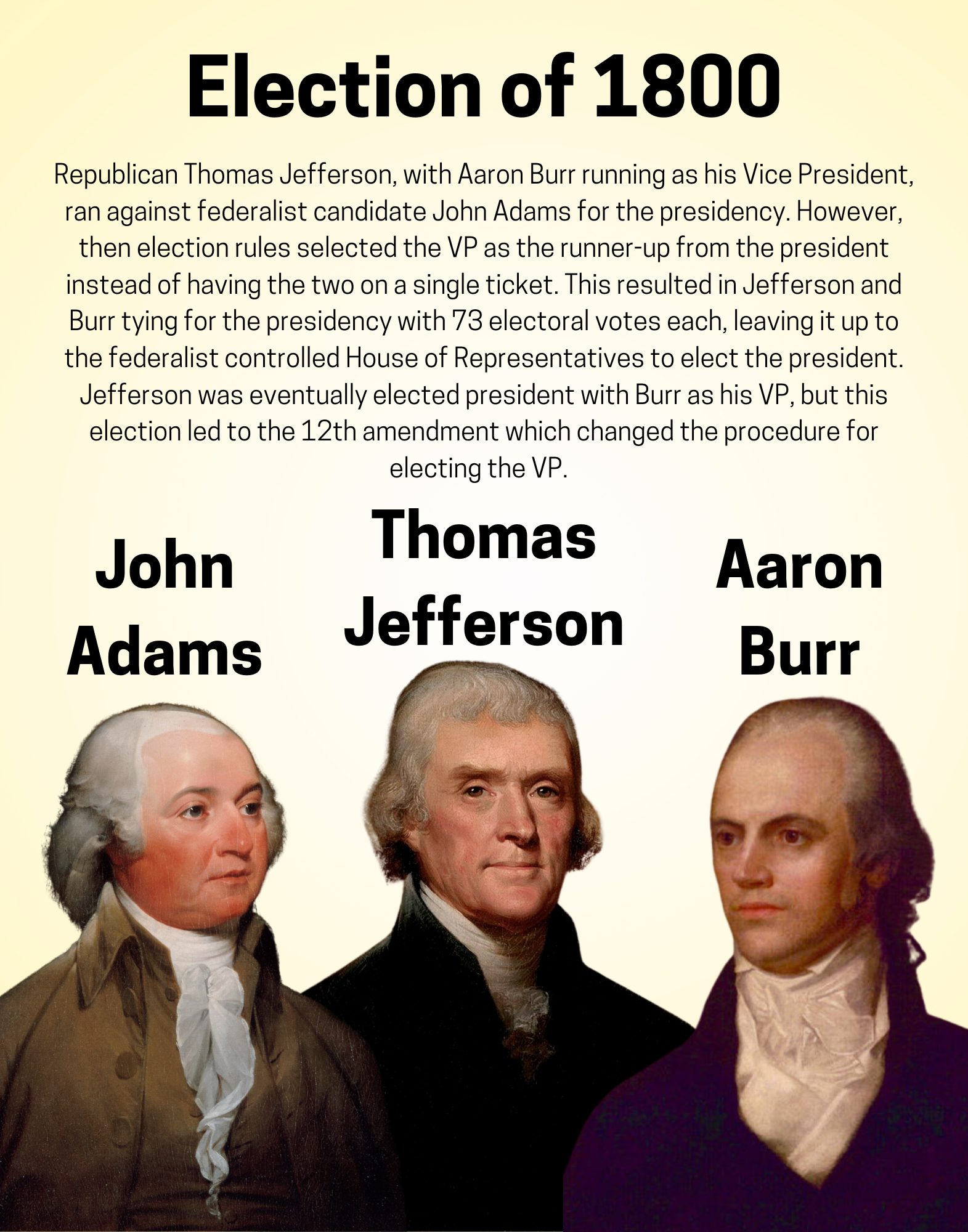
When the colonists finally gained their independence from Britain, they had a perfect start to their nation. How could they not rally behind the noble figure of George Washington. Washington unanimously won the Presidency, but this utopia would not continue to be the reality and he could sense it. Washington was a brave man and although he had many motivations to not pursue a third term, one of his main reasons was that he didn’t want to set a power hungry precedent. Another reason was the development of political parties and the stark polarization that was present between the Federalists and Democratic-Republicans. Originally, first place in the Presidential Elections became President and second place became Vice-President. The College was created before political parties were present and aimed to get the two most qualified candidates from the country into the Oval Office.  Washington was extremely fearful of what political parties would become and how they would divide the Nation. With the political scene set by the Elections of 1796 and 1800, it was clear there needed to be change. None of the four candidates could reach the majority in 1800 to become President and the House of Representatives had to decide the Presidency. A big change had to be made and that came in the form of the 12th Amendment

Even with this change to the Constitution which designated votes for Presidents and Vice Presidents, the Election of 1824 found problems with the system as well. Even though Andrew Jackson had the most electoral votes, he couldn’t reach the majority to be elected for President. This election was resolved by the House of Representatives and Jackson lost to what he thought was a Corrupt Bargain. After this election, there were certainly more bumps in the road but for the most part the Electoral College did its job.

At the end of the day, we are a part of a Democratic Republic and the Electoral College enables both aspects of this system to be true. The Electoral College was created to prevent smaller states from being ignored by candidates. If it was just a popular vote these states would be completely neglected and only high population cities would be targeted by candidates. Although it might not seem the most ideal or fair at times it has been tried and tested. After the Election of 1824, problems with the Electoral College doing what it was supposed to do were rare. There is a recent phenomenon of candidates winning the popular vote but losing the Electoral vote. This is not super common, but it makes sense to a certain extent. There are high population states that end up in a landslide while some lower population states that have a decent amount of Electoral votes and are extremely tight. The nature of the winner-takes-all system allows the Electoral College to be a Democratic-Republic. Instead of the Electoral College, the biggest problem our country faces is the extremely polarizing nature of political parties as Washington warned.

The Election of 1876: A Comparison to 1824 and 2000

If the election of 1876 were a sitcom, it would have all the tropes, at least, for an election. Voter fraud, disenfranchisement targeting people of color, shady behind-the-scene deals—you name it, the 1876 Election has got it. 

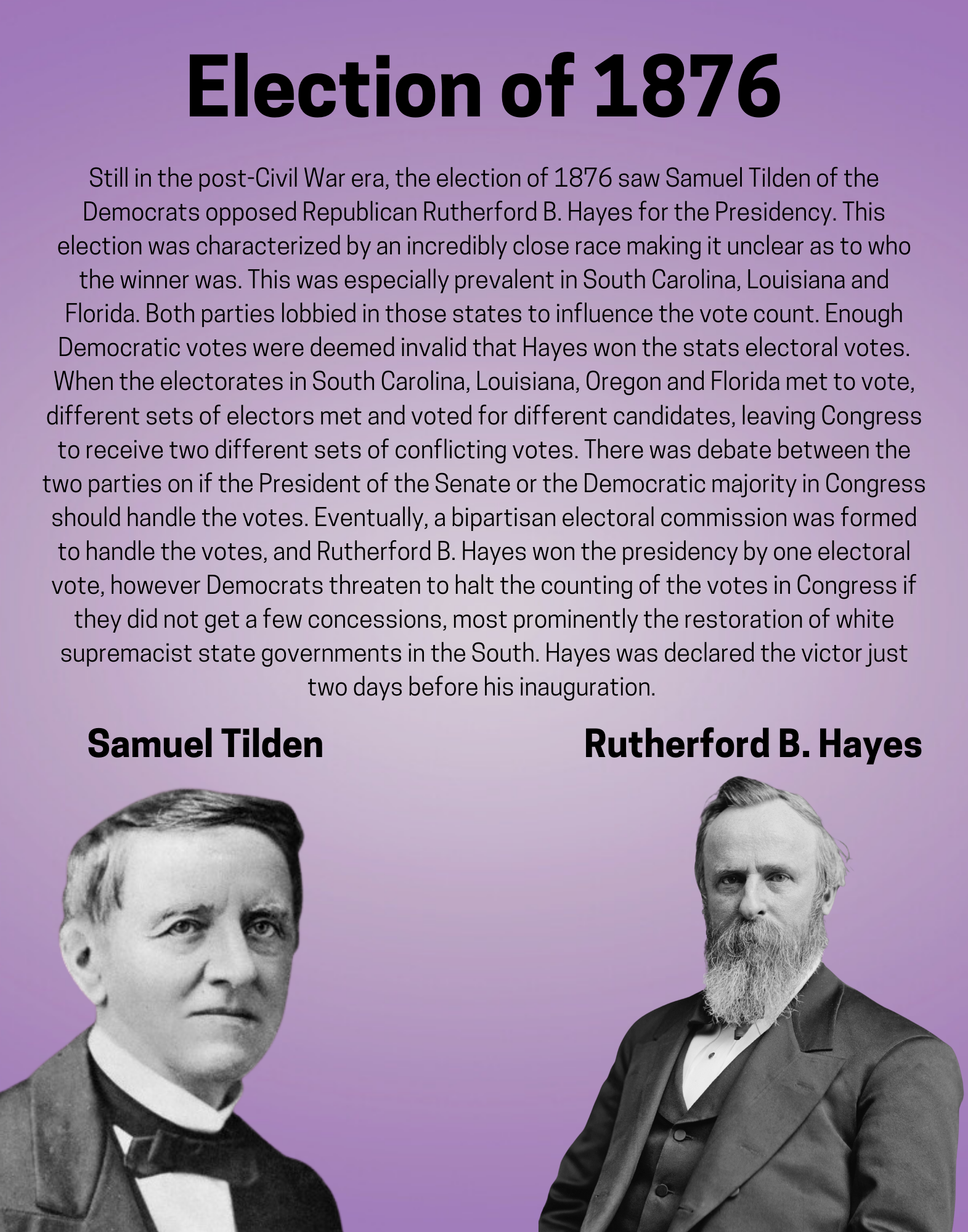
As votes from the 1876 Election were being counted up, Rutherford B. Hayes, the Republican candidate, called election fraud. Only, unlike some, he was right. Voting ballots had truly been manipulated, specifically targeting newly enfranchised Black voters into wrongly voting for their choice of candidate. Military groups intimidated voters at the polls and at home, using political violence to sway the election outcome to their side. It wasn’t until March of the next year that Hayes would finally be named the President—but only after he made a deal to end Reconstruction. 

We can draw parallels both to the past and the future for the 1876 Election. Just like in the 1824 Election, in that infamous “corrupt bargain” that allegedly gave John Adams the election and Henry Clay the position of Secretary of State, conversations to make Hayes president were going on behind closed doors. Hayes, though an abolitionist himself, became known as the president who failed Reconstruction in exchange for his own political position. 

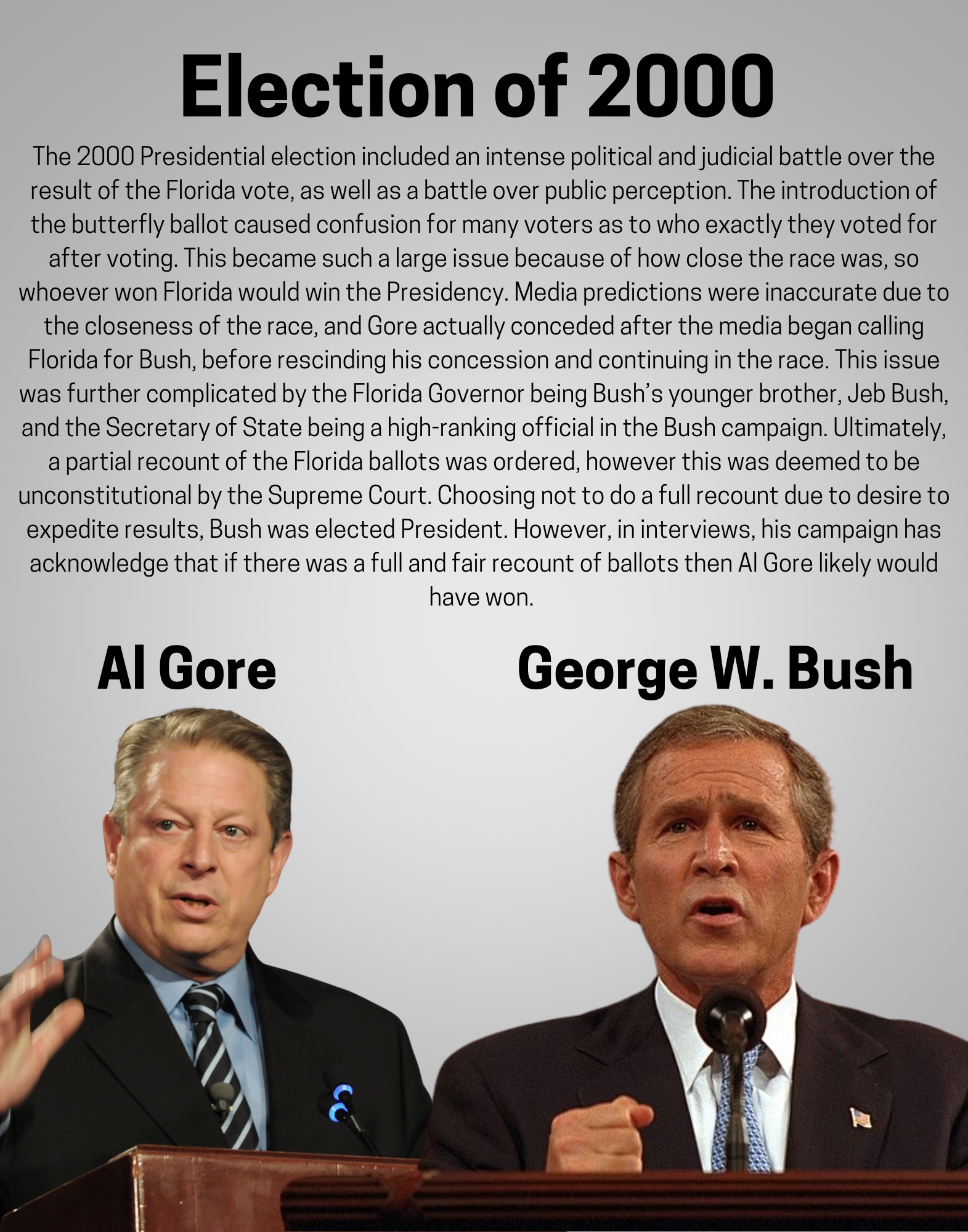
The Election of 1876 also draws parallels to a more recent one, the 2000 Election. Both elections took months to resolve and required special intervention. In the case of 1876, it was creating the new Electoral Commission to settle the race. For 2000, the Election was thrown to the Supreme Court. Issues of voter fraud came up in both presidential races, too. 

From these parallels, we see that political bargaining, contestation, and voter fraud is nothing new to the United States. In 2020, former President Donald Trump tried to appeal to this cycle in history, saying voter fraud had lost him the election. There was no such proof of this statement. 

Yet, as these issues do not exist in a vacuum, they are, in fact, important to keep in the forefront of our minds. The projected gap between presidential candidates Kamala Harris and Donald Trump is projected to be narrow in the 2024 election. Maybe the cycle is set to run again this year. 


Election of 1876 Video

References:


File:1876DemocraticPoster.png – Wikimedia Commons. (1876).

https://commons.wikimedia.org/wiki/File:1876DemocraticPoster.png

File:1876 Electoral map.png – Wikimedia Commons. (n.d.). https://commons.wikimedia.org/wiki/File:1876_Electoral_Map.png

File:Colton’s South Carolina LOC 78696479.jpg – Wikimedia Commons. (1876). https://commons.wikimedia.org/wiki/File:Colton%27s_South_Carolina_LOC_78696479.jpg

File:Electoral Commission (United States).jpg – Wikimedia Commons. (n.d.). https://commons.wikimedia.org/wiki/File:Electoral_Commission_(United_States).jpg

File:Joseph Philo Bradley – Brady-Handy.jpg – Wikimedia Commons. (n.d.). https://commons.wikimedia.org/wiki/File:Joseph_Philo_Bradley_-_Brady-Handy.jpg

File:Samuel Tilden. Portrait of the American politician, who served as the 25th Governor of New York, Samuel Jones Tilden (1814-1886), by José María Mora, c. 1870.jpg – Wikimedia Commons. (n.d.-b). https://commons.wikimedia.org/wiki/File:Samuel_Tilden._Portrait_of_the_American_politician,_who_served_as_the_25th_Governor_of_New_York,_Samuel_Jones_Tilden_%281814-1886%29,_by_Jos%C3%A9_Mar%C3%ADa_Mora,_c._1870.jpg

Images, I. a. B. (n.d.). Image from page 11 of “The story of Washington, the National Capital” (1889). Flickr. https://www.flickr.com/photos/internetarchivebookimages/14578076170/

Wikipedia contributors. (n.d.-a). File:DDAvis.jpg – Wikipedia. https://en.m.wikipedia.org/wiki/File:DDavis.jpg

Wikipedia contributors. (1876). File:Hayes-Wheeler.jpg – Wikipedia. Retrieved from https://en.m.wikipedia.org/wiki/File:Hayes-Wheeler.jpg


Wikipedia contributors. (n.d.). File:President Rutherford Hayes 1870 – 1880 restored.jpg – Wikipedia. https://en.wikipedia.org/wiki/File:President_Rutherford_Hayes_1870_-_1880_Restored.jpg

Wikipedia contributors. (n.d.-b). File:Ulysses S Grant by Brady C1870-restored.jpg – Wikipedia. https://en.m.wikipedia.org/wiki/File:Ulysses_S_Grant_by_Brady_c1870-restored.jpg


The Power of One Vote

The sentiment that your vote doesn’t count has long been building in the United States of America. This type of thinking is especially dangerous in a democracy when it’s been proven that one vote can be the difference between victory and defeat. This reason alone might not be enough to convince someone to vote, so hopefully the issue of autonomy can convince them. In the past, marginalized groups in this country didn’t even have the chance to vote and were actively prevented from it. To disregard your own privilege in the current day is a disservice to everyone who fought for the right to vote. In the Elections of 1860 and 1876, it was evident that this country wasn’t ready for African Americans to be near society, let alone part of the voting block. 

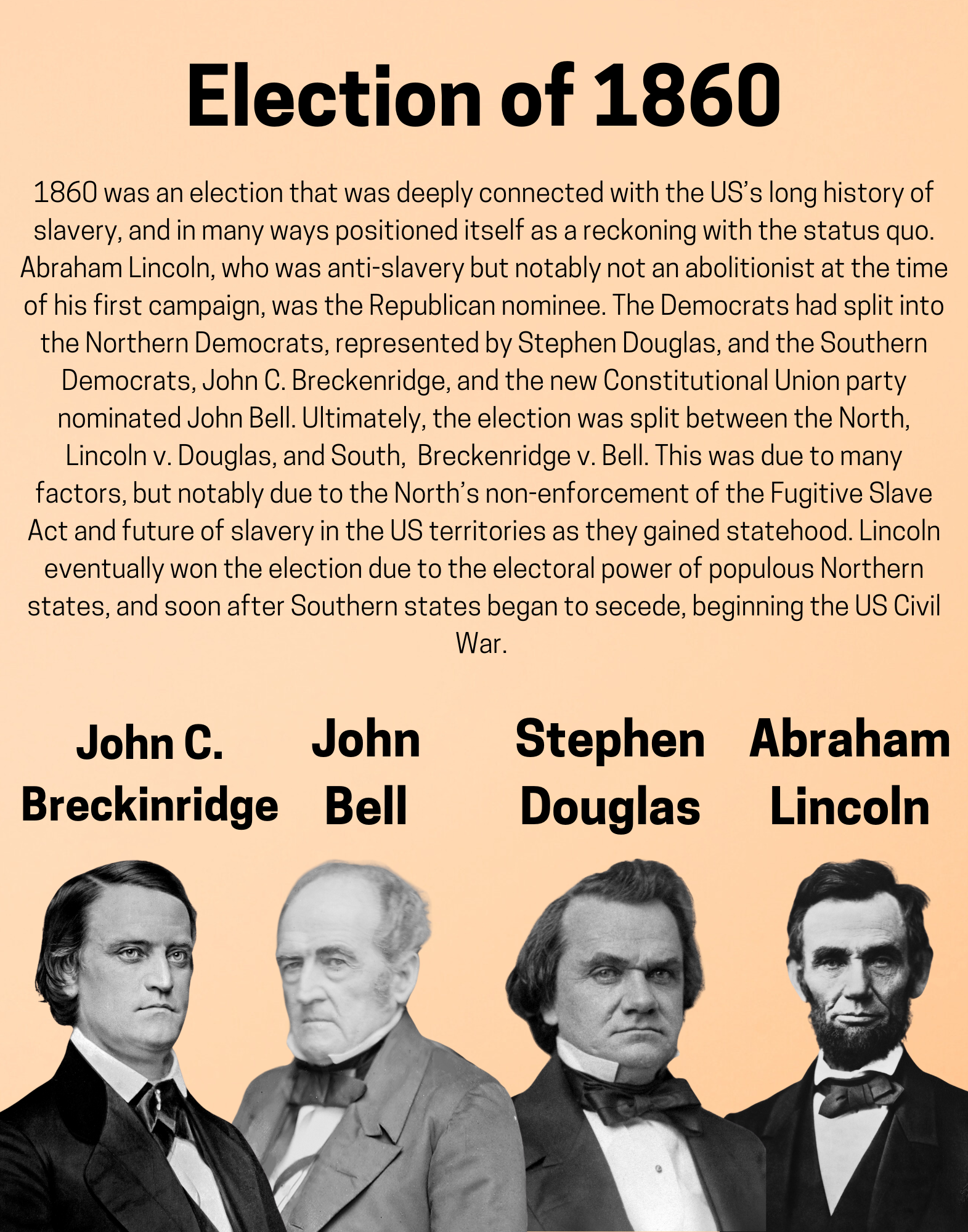
A modern day misconception of the Election of 1860 is that Abraham Lincoln was a staunch anti-slavery candidate. However, this was not the case; he merely opposed the expansion of slavery into newly admitted states. This small threat to the institution of slavery showed how important the suppression of black rights was to southern people. The only time Southerners showed concern for black voting rights was when they were determining how much their population should count toward representation in the House of Representatives. The South seceded from the Union because of the slight threat that they found to their own voting power. 

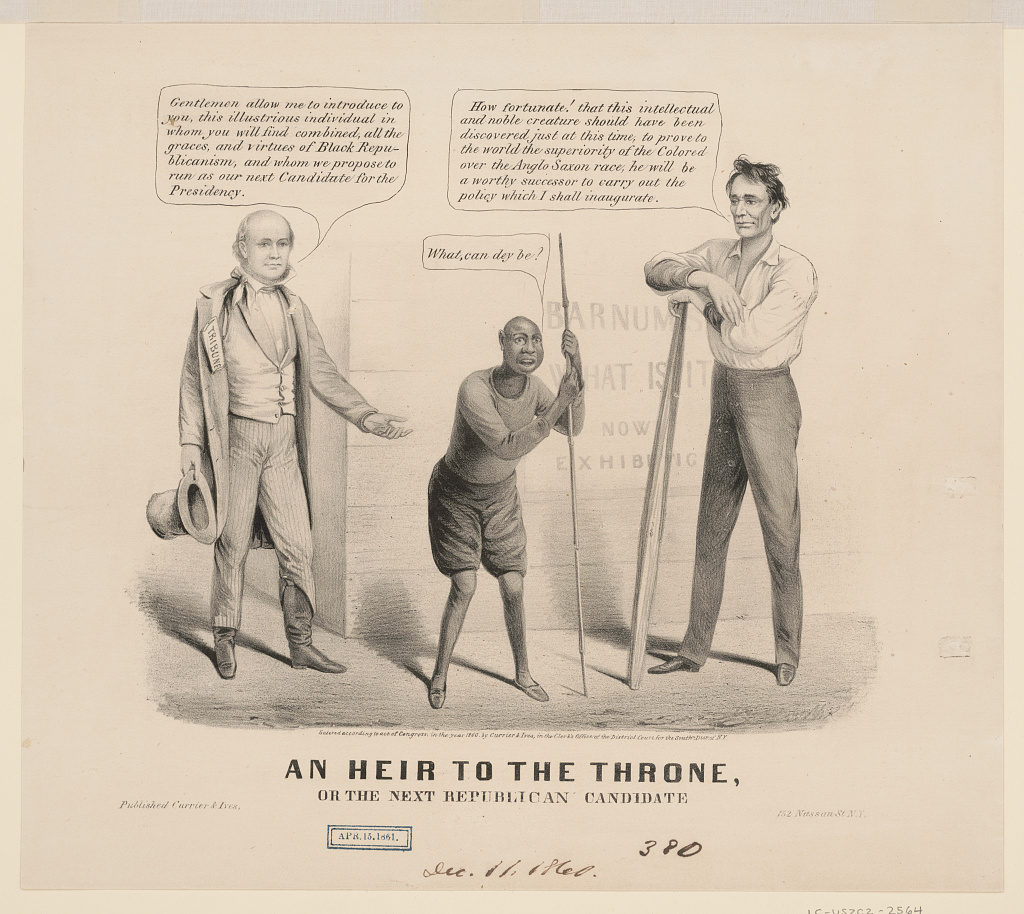
Published by Currier & Ives, c1860.

Their perceptions of how extreme and radical the other side were is evident in cartoons like this. They attempted to paint the Republican party as completely anti-slavery and extremely sympathetic to blacks which simply wasn’t the case. Anything besides the enslavement of black people in this country was unacceptable to the white population. These viewpoints were carried on into the Civil War and throughout Reconstruction. The Election of 1876 was another controversy that proved the nation was not ready for egalitarian voting. As the black population became involved in voting and even getting to some public offices, there was disproportionate blowback soon after the Civil War. Autonomy for blacks wasn’t as important to Rutherford B. Hayes as securing his election victory. Even though the 13th, 14th and 15th Amendments were passed in the previous decade, the Ku Klux Klan and many others committed horrible violence to keep the newly enfranchised blacks out. This didn’t completely prevent their involvement in politics because many were willing to fight for their constitutional right. The election of Hayes, however, was the nail in the coffin for this population and their autonomy wasn’t fully realized until around a century later.

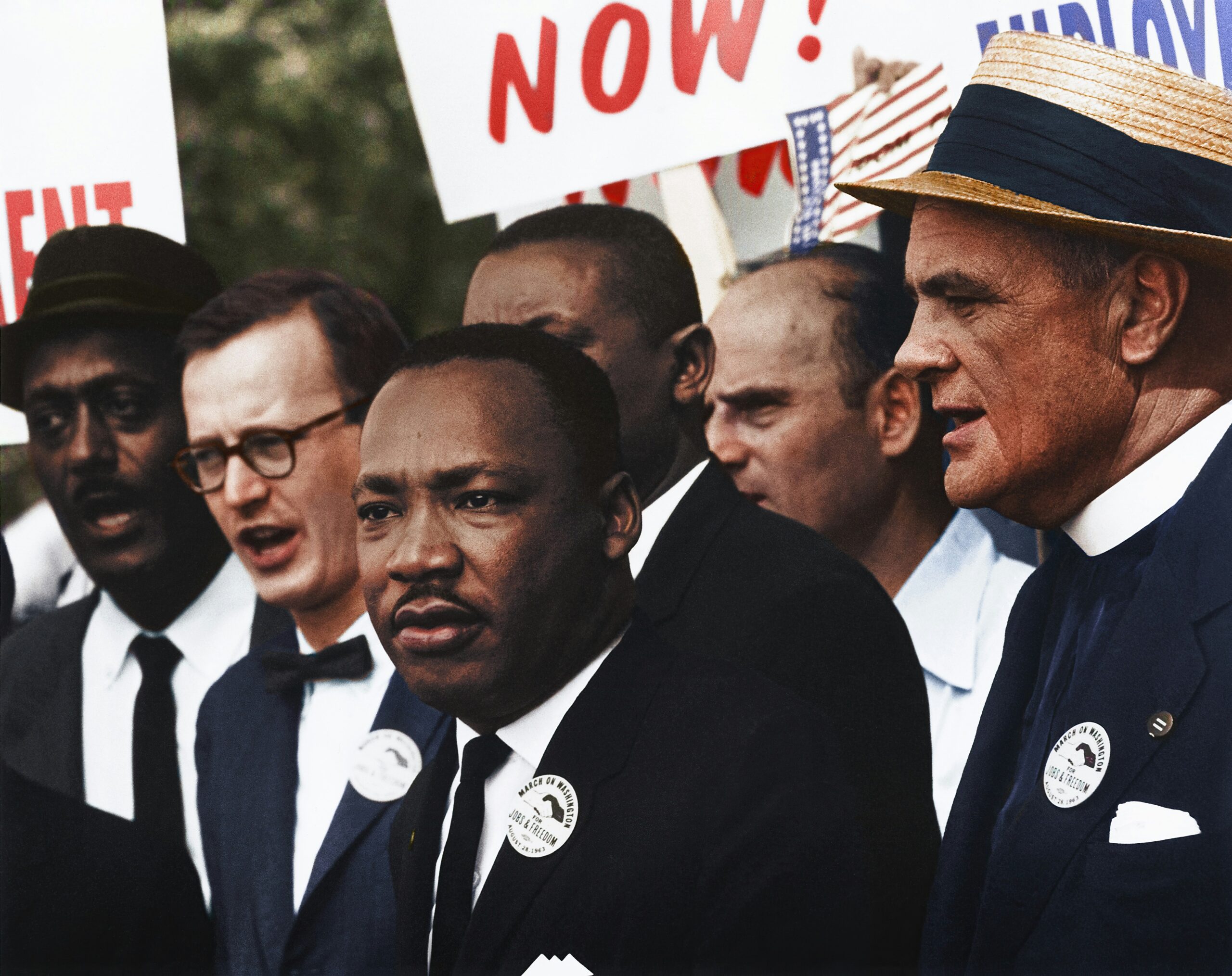
Dr. Martin Luther King, Jr. by Rowland Scherman and Jordan J. Lloyd.

The fact that many had to fight their whole lives to attempt to overcome adversity to even get the legal right to vote should inspire you to cast your ballot without hardship. 

Pathways to Contesting an Election: The Vote

Many moving into the 2024 election have been worried about the outcome being contested. Elsewhere   I have looked at some potential structural challenges to the election – via Congress and via the Judiciary – but there is still one element of the electoral process that could majorly play a role in the election, which is the voting process itself.  Under the umbrella of the voting process there are two major areas, one of which has been more resistant to challenges in recent history than the other.  The first is who votes and how, and the second is how the votes are counted.

In the last 50 years (until 2020) the public consciousness has not placed much importance on the issue of who votes.  The assumption is that any 18-year-old citizen has the right to vote, regardless of race or gender.  While who does vote was considered, the ability to vote was assumed.  This has not always been the case, and it is very important to remember that a potential contributor to a contested election is who gets their vote counted.  This is a precedent set by 1876, where massive voter suppression campaigns in the form of violence and regulations designed to prevent black people from voting caused the votes cast to be suspect, forming the basis for the disputes over the election in 1876.  Based on the example of 1876, it is very important to focus on who is allowed to vote, and it is not a solved problem.  For example, many states have started to pass laws that are considered by some to be voter suppression, and the consent decrees created by the Civil Rights Act have started to be weakened.  The campaign to reduce the power of mail in and absentee ballots, when combined with the weakened enforcement of the Civil Rights Act indicates the possibility of a slide back towards a time where universal suffrage was not assumed, which could contribute heavily to a contested election in 2024, just as it did in 1876.

In addition to who votes, the method of counting votes is another potential way to challenge the results of an election.  The clearest example of this was in 2000 in Florida, where frequently changing and unclear voting laws resulted in the judicial challenges to the election and were the grounds on which the Supreme Court decided the election for George W. Bush.  The debate over how a vote is counted is not one that is confined to the 2000 election.  In 2020 there was a lot of noise (and court cases) put forward about voter fraud, which was the underlying concept that caused the election to be considered “contested.”  Combining the continued rhetoric over voter fraud with states like Georgia and elsewhere, where the vote counting process is in flux and changing frequently, the conditions that precipitated a contested election in 2000 and 2020 appear to be present heading into 2024.

While suffrage and the vote counting process is something that, after the Civil Rights movement, many Americans had accepted as automatic, the 2000 and 2020 elections demonstrate just how important paying attention to these processes are in ensuring uncontested elections.  In the extreme case, the election of 1876 serves as a reminder of what can happen when these areas are ignored, meaning that heading into 2024 the rights to vote and have your vote counted need to be defended in order to avoid destabilizing contested elections, and are strong candidates for pathways to a contested election this year.

« Older posts
css.php
The views and opinions expressed on individual web pages are strictly those of their authors and are not official statements of Grinnell College. Copyright Statement.