Grinnell College Logo

HIS 295, Professor Sarah J. Purcell

Author: klassenk

Cartooning the Elections

Humor has always found its way into elections, especially in the context of the most recent presidential elections. Perhaps one of the most effective ways humor has been used consistently over time in elections has been through political cartoons. 

These pieces of political art allow for both humor as well as commentary, important in especially hotly contested presidential elections. Over time, these cartoons have obviously evolved, particularly due to the rise of social media use, but their usage throughout the various elections remains constant. From Lincoln to Trump, cartoons have acted as a means to engage with the public during presidential elections.

In this cartoon, Lincoln and Douglas are literally racing to the White House. Lincoln’s taller figure rivals Douglas’ tiny one, clearly making faster and longer strides to win the presidency much quicker than Douglas. The third figure in this photo is an enslaved person, evident by his use of “Massa Duglis” inside his speech bubble. This enslaved individual signifies the contention in the 1860 election surrounding slavery.
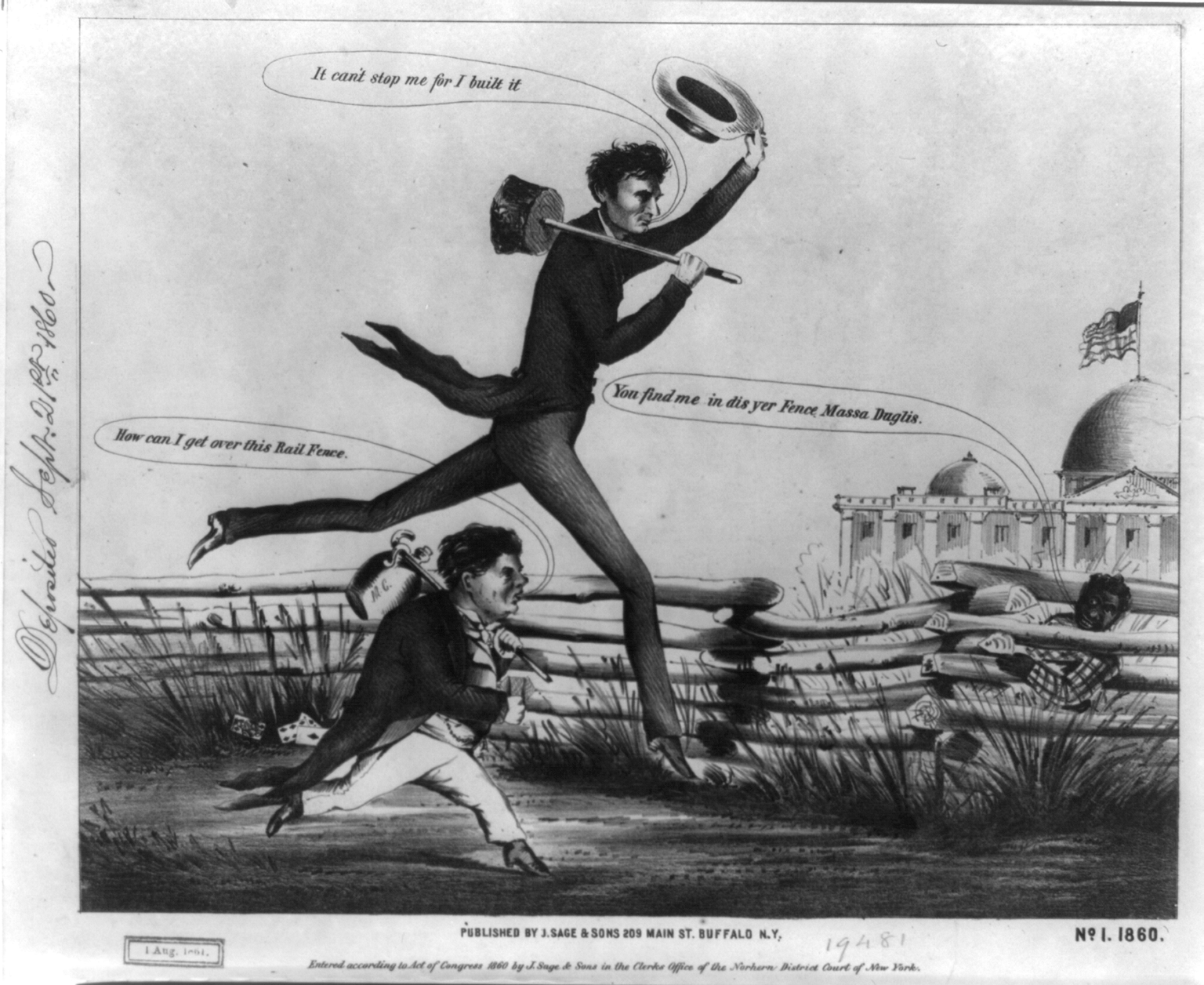
[Lincoln & Douglas in a presidential footrace]. No. 1, 1860


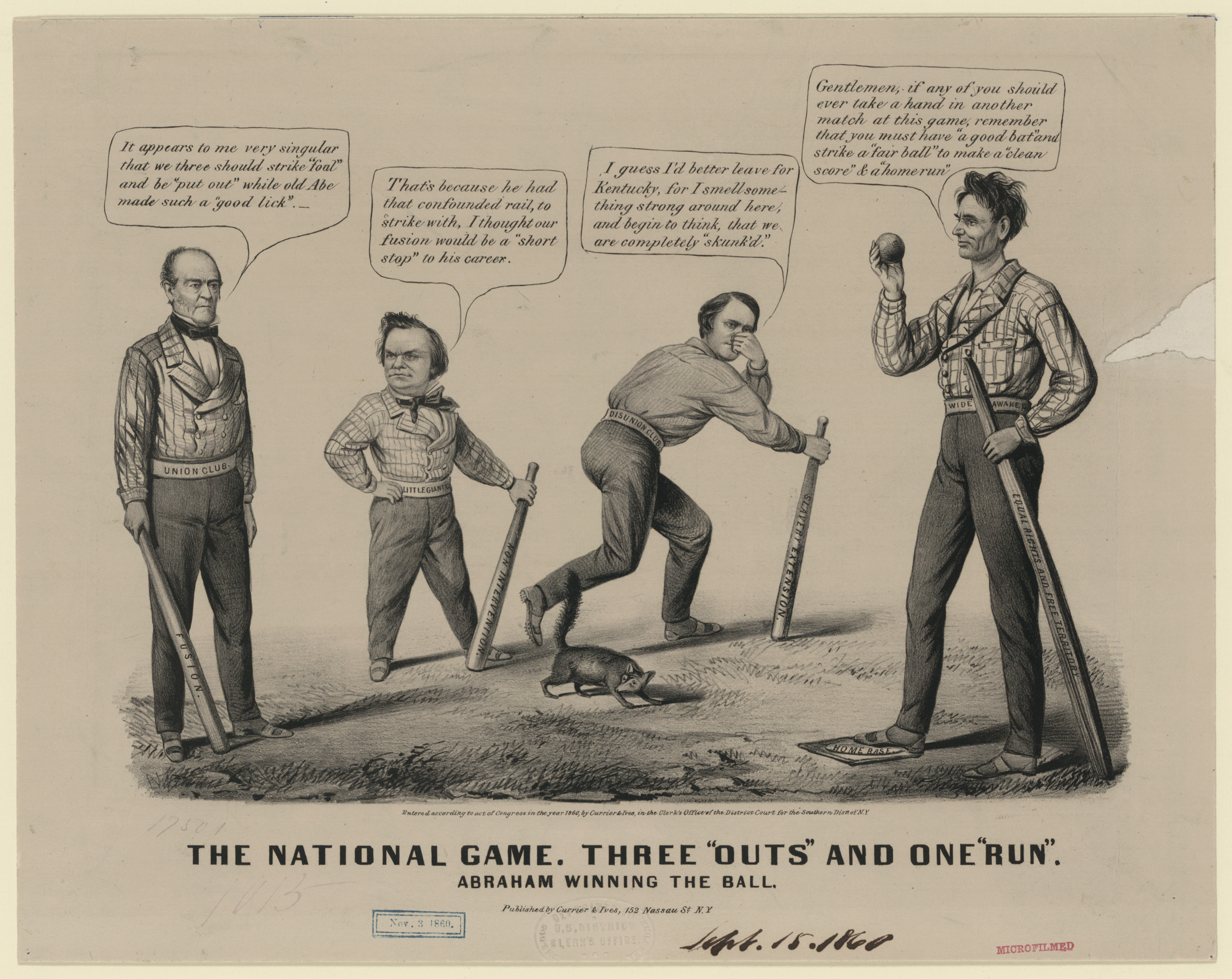
This cartoon includes all of the candidates from the 1860 election, including Stephen Douglas, John C. Breckenridge, John Bell, and Abraham Lincoln. Each candidate has much to say about the results of the election, but Lincoln seemingly flaunts his win as he ‘wins the ball’ as well as the election.​​

“The national game. Three ‘outs’ and one ‘run'”, 1860

In terms of more modern day cartoons, this work from the 2020 election depicts Trump standing near two gravestones, one that says 200,000+ COVID-19 Deaths and the other says Peaceful Transition of Power. 

The gravestones act as a clear reference to President Trump’s claims that President Biden’s win was a fraud as well as the enormous number of people who lost their lives during the pandemic. On top of an already deadly pandemic, President Trump stands near the grave of the newly dead ‘Peaceful Transition of Power’, a keystone of American democracy which was killed during the 2020 election when Trump rejected the results of the election.

In another cartoon, both candidates Trump and Biden look less than ideal in their boxing uniforms, awaiting for one of their arms to be lifted victoriously by annoyed looking Uncle Sam.

The more modern cartoons use less wording, relying more heavily on images to produce their point  rather than speech bubbles. This is made easier through image-centric social media, where wordy things are less likely to be engaged with by audiences. Cartoons and images such as these also easier to be circulated on these different platforms. While these cartoons are in fact different, the fact that they have maintained a popular medium for hundreds of years is testament to their effectiveness in engaging the public in presidential campaigns.
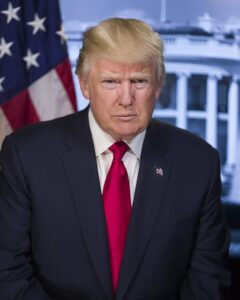
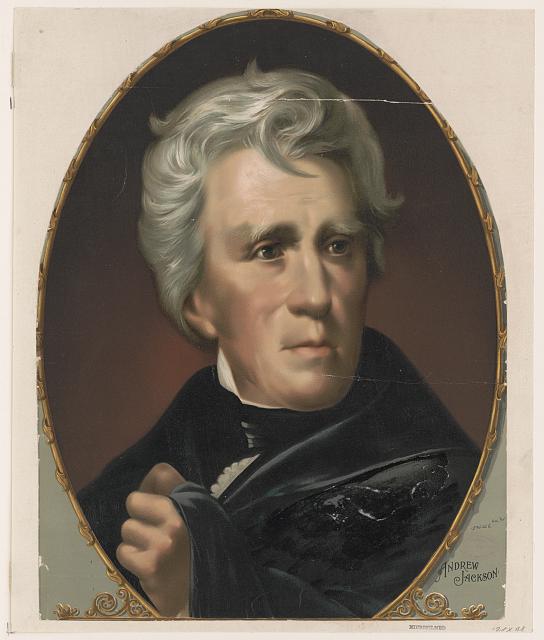

Is Twinning Winning?

Portrait of President-elect Donald Trump, 2016

Andrew Jackson, c1896


In 2017, President Donald Trump compared himself to Andrew Jackson, citing that many people have told him that they have had similar elections. But what made them so similar that the president felt the need to equate them during his visit to Tennessee? How similar are the two really? 

In the election of 1824, Andrew Jackson had won the popular vote and the most electoral college votes, but still ending up losing the presidency to John Quincy Adams. Jackson had the most electoral votes just not the majority, so the outcome of the election was up to the House of Representatives.This is similar to the way in which Hillary Clinton won the popular vote in 2016, but lost the electoral college vote to Donald Trump, ending with her losing the election because of this. 

But what Trump didn’t realize when he made these comments in 2017 was that he would relate to the1824 election a lot more in 2020, especially when he accused the some votes as being corrupt. In the same vein, Andrew Jackson attributed his loss in the 1824 election to what he described as a “corrupt bargain”. This ‘corrupt bargain’ referred to how Henry Clay voted for John Quincy Adams for president when it was taken to the House of Representatives, and then Clay being appointed Adam’s Secretary of State after he became president . This idea of corruption is similar to what Trump claimed when he lost the 2020 election to Biden. Claims of voter fraud and election corruption became Trump’s mantra for the outcome of the 2020 election, and his platform for the 2024 election. 

During the Jackson’s next presidential election in 1828, he had a come back story for the ages after being successfully elected as president despite his loss four years prior. Now, after calling 2020’s election corrupt, will Trump have a similar comeback story to Jackson in the 2024 election?


Fake News

Bush Country, 2000

In just over the hundred years that had passed after the 1876 contested election between Rutherford B. Hayes and Samuel J. Tilden, there wasn’t really any other contested elections that could match that scale, that is, until the turn of the twenty-first century. 


The election of 2000 is one that most people remember as an incredibly close race between Republican George W. Bush and Democrat Al Gore. There were concessions made, taken back, and ballots recounted, leaving the overall general American public just really confused as to who had emerged victorious in the 2000 presidential election. 

What added to this confusion was the people putting out the information to the American people: the news. While Americans waited with bated breath to hear what the remaining state Florida’s votes look like, one news source broke the story that Bush had won. 

Other news channels followed suit, only to ultimately take this back because Florida ended up being too close to call. Since news channels had being using different systems to count the votes, their information was contradictory. So where does that leave us in 2024 with already partisan and conflicting news sources? 

In the 2024 election between President Donald Trump and Vice President Kamala Harris, there have already been tensions over news media. When determining what news network the second presidential debate should be on, Trump argued that he would not participate unless the debate was held on Fox News

Parties aren’t just splitting people apart anymore, they’re splitting the news we receive as well. News audiences have to comb through the information they receive, weeding out the ‘fake’ from the real.

With media contesting elections like we saw the 2000 election, how will we know what to believe in the predictably contested 2024 presidential election? Further, having gone over a hundred years without a contested election, does evolving and ever-present media mean we have to prepare for contested elections to become the norm for American democracy?


Soundtracking Elections

Music has long played an instrumental role in American public life, and it has especially made an underrated impact on American politics. The social effect musicians can have on the general public is truly insurmountable. From songs like Give Peace a Chance by John Lennon to We are the World by U.S.A. for Africa, music has been used as a tool to galvanize the American people to a point of action. In instances of presidential elections, the effect is similar; music is used to arouse support for presidential candidates.

The importance of music in presidential campaigns has become especially evident in the 2024 presidential election. Headlines like More and more artists want Trump to stop using their music dominate the news, as artists fight for their rights over their own music.

Though the use of music has evolved, employing music as a campaign strategy is not a new approach. Earlier campaigns, such as the election of 1876, also utilized music as a campaign strategy. 

The election of 1876 was a heated one between Republican Rutherford B. Hayes and Democrat Samuel J. Tilden. As the election was ramping up, the candidates needed songs to soundtrack their campaigns. Because of this, catchy tunes began to circulate with supporters.

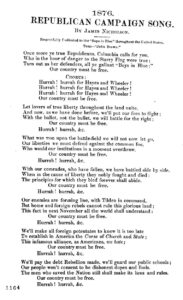
Republican Campaign Song, 1876

One tune, the Republican Campaign Song, was a sheet of lyrics created and distributed by advocates for Hayes. The lyrics of this song expressed support for Hayes and Wheeler’s Republican ticket. The lyrics give reference to battles and the rebellion, pointing to the recent Civil War and secession.


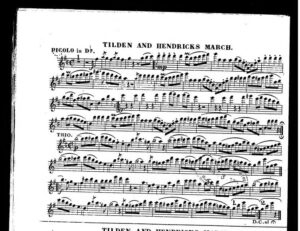
In addition to these tunes meant to be sung by the common man, sheet music was produced for musicians to play as well. One example of this is the Tilden and Hendricks March music. This nineteen page score was most likely played during campaign speeches or parades. Associating music to a specific candidate was a smart way to get more of the senses involved during a presidential election.  


Tilden and Hendricks March, 1876


Now, in a modern day context, politicians aren’t relying on their supporters to write music for them, they are using musicians’ copyrighted songs and applying them to their own campaigns. This, as one could imagine, has been much cause for controversy if done illegally. In fact, over the years, Trump has received many cease and desist orders from artists who don’t want their music associated with the Trump Campaign. And 2024 is no different. Artists like Beyonce and Celine Dion have made public statements barring Trump from using their music, all on top of taking legal action. This evolution of music being made for a candidate like what we see in 1876 to taking a musician’s work without consent in 2024 is truly thought provoking. When has the collision of creativity and politics gone too far?


Sources:

RollingStone, “All the Artis’s Who Don’t Want DonalD Trump Using Their Music,”  RollingStone, August 30m 2024 https://www.rollingstone.com/music/music-lists/all-the-artists-who-dont-want-donald-trump-using-their-music-1235080043/r-e-m-8-1235080077/

Tracy Smith, “A Political Playlist: The Fight over Campaign Songs,” CBS Sunday Morning, September 8, 2024 https://www.cbsnews.com/news/a-political-playlist-the-fight-over-campaign-songs/

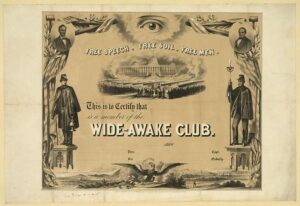
“Free Speech, Free Soil, Free Men”, courtesy of the Library of Congress https://loc.gov/pictures/resource/ppmsca.19788/

Youth involvement in politics is nothing new to us. It seems like at this point of time, especially in the context of the 2024 campaign for the presidential election, the amount of political organizations targeted for young people to join are endless. But when did these sorts of groups come about, and what can they tell us about radical groups today?

The earliest form of grassroots movements began during the election of 1860. The ‘Wide Awakes’ were a group of young men who supported Lincoln’s candidacy for president, and weren’t shy about their campaigning. The group used military tactics, including parading with instruments, in an effort to drum up support (pun intended) for Lincoln.

The impact of the Wide Awakes did not go unnoticed, and even inspired others in the opposing Democratic party to form similar organizations. In an attempt to drown out the noise being made by the Wide Awakes, supporters of the democratic candidate Stephen Douglas founded their own sorts of grassroots organization. Some of these included the Douglas Invisibles, the Bell Ringers, and the Chloroformers.

What set the Wide Awakes apart from these other groups though, is that they used a “military motif”. Such presentation of themselves made them a feared group, and one that seemingly advocated for violence.

Ultimately, their presence in the Lincoln-Douglas election was definitely a contributing factor in precipitating the American Civil War. In fact, Lincoln’s victory was directly correlated to the subsequent state secession. States simply could not accept the results of the election, which eventually lead to much violence. Sound familiar?

To this day, militant political organizations seem to thrive whilst carrying their military-grade weapons, this time semi-automatic rifles, to march in the name of a specific candidate. The most notable of these organizations is the Proud Boys. Now, while the Proud Boys are a militaristic organization similar to the Wide Awakes, I want to emphasize that they have evolved past the mere motif of militarism; the Proud Boys actively incite violence. In fact, the Anti-Defamation League labels the Proud Boys as “a right-wing extremist group with a violent agenda”, something they inevitably confirmed in January of 2021. Just recently in September of 2023, the leader of the Proud Boys was legally found responsible for playing a role in the insurrection and was sentenced to over twenty years in prison.

Seemingly similar to the 1860 election that resulted in the civil war, the Proud Boys incitement of violence at the capitol in 2021 was also over the election results. Several members of the group have been found guilty of storming the capitol while the electoral votes were being counted to confirm Joe Biden’s presidency. Regardless of political party affiliation, what happened on January 6, 2021 was a direct attack on the United States’ democracy.

Thinking about the insurrection in January of 2021 within the context of the 2024 election, I wonder how the Proud Boys and other militant organizations will react if Donald Trump loses the election again? How will violent groups become more organized as they have adapted and learned form the capitol riots? But ultimately, after studying the Wide Awakes’ promotion of violence during the 1860 election, I am left with my scariest question of all; are we headed for another civil war?

Sources

Grinspan, J. (2009). “Young Men for War”: The Wide Awakes and Lincoln’s 1860 Presidential Campaign. The Journal of American History, 96(2), 357–378. http://www.jstor.org/stable/25622297

U.S. Department of Justice. (2023, September 5). Proud Boys Leader Sentenced to 22 Years in Prison for Seditious Conspiracy and Other Charges Related to U.S. Capitol Breach”. Office of Public Affairs https://www.justice.gov/opa/pr/proud-boys-leader-sentenced-22-years-prison-seditious-conspiracy-and-other-charges-related


Almost 200 Years of Mudslinging

1828 was a comeback election for Andrew Jackson.

Having lost to what he described as a ‘corrupt bargain’ in 1824, he became determined to win both the popular vote and the majority electoral college vote, defeating John Quincy Adams this time around. This election would be a tough one for Jackson and his family, though. Not only was Jackson running against the man who had defeated him four years prior, he was running against an anti-Jackson campaign, one that was fueled by rumors put out against him in newspapers and pamphlets.

Jackson had one enemy in particular that sought to destroy both him and his wife’s reputation. In his monthly pamphlet, Truth’s Advocate and Monthly Anti-Jackson Expositor, Charles Hammond published over three hundred pages attacking Andrew Jackson’s politics, personhood, as well as family.

The pamphlet reads, “we deem it proper that the public should be acquainted with the offences of Gen. Jackson, against morals, law, and decency, the commission of which, spreads over his whole life from the seduction of Mrs. Robards to the slander of Mr. Clay” . Hammond’s jab is a reference to the rumor that Andrew Jackson had relations with his now wife Rachel Jackson while she was previously married to Lewis Robards. Calling Rachel Jackson by the last name of another man acted as an innate attack on the Jackson family values, and in turn, Andrew Jackson’s values as a presidential candidate as well as a man.

 Truth’s Advocate and Monthly Anti-Jackson Expositor (June 1828), 235


Further, in a piece titled Groanings within the pamphlet, the legitimacy of Andrew and Rachel Jackson’s relationship is again challenged, this time blatantly accusing the couple of engaging in adultery. The pamphlet reads,

Truth’s Advocate and Monthly Anti-Jackson Expostior (June 1828), 235

“And then about that Mrs. Robards affair–

That too, they’ve told Adams and Clay–

Had it never leaked out, I’ll make bold to de-

clare,

‘Twould not be known to this day.”


By means of combating these attacks on his values, Andrew Jackson positioned himself amid the everyman. With his nickname, Old Hickory, Jackson made himself seem familiar to the American people, something the anti-Jackson campaign had been trying to further him away from. For example, on the ‘Jackson Ticket’, Jackson’s image is replaced by a tree, signifying him as sturdy, rooted, and down to Earth.

 Andrew Jackson, “Jackson ticket. ‘Firm united let us be, rallying round our Hickory tree’” (1828), courtesy Library of Congress

Much like the mudslinging in the 1828 election, modern day elections are no stranger to this kind of abuse. Most recently, as seen in the presidential debate between President Trump and Vice President Harris, name calling and rumors still manage to find a place on the election stage. During the debate, both members used the word ‘weak’, among other things, to describe one another. In addition, moderators questioned President Trump’s on his comments about Harris’s identification as a Black woman. It is interesting how in both the 1828 and 2024 election, women are both at the forefront of criticism.

While 1828 was one of the first elections that political opponents engaged in mudslinging, it is clear that even almost two hundred years later, this same sort of smearing remains, such messiness characterizing what we understand today as simply: politics. In this day and age, though, pamphlets are pushed to the side in exchange for viral twitter rants, as social media created a brand new platform for politicians to engage in mudslinging.

css.php
The views and opinions expressed on individual web pages are strictly those of their authors and are not official statements of Grinnell College. Copyright Statement.