
Grinnell College Logo

HIS 295, Professor Sarah J. Purcell

Author: Jonathan Murphy

Pathways to Contesting an Election: The Vote

Many moving into the 2024 election have been worried about the outcome being contested. Elsewhere   I have looked at some potential structural challenges to the election – via Congress and via the Judiciary – but there is still one element of the electoral process that could majorly play a role in the election, which is the voting process itself.  Under the umbrella of the voting process there are two major areas, one of which has been more resistant to challenges in recent history than the other.  The first is who votes and how, and the second is how the votes are counted.

In the last 50 years (until 2020) the public consciousness has not placed much importance on the issue of who votes.  The assumption is that any 18-year-old citizen has the right to vote, regardless of race or gender.  While who does vote was considered, the ability to vote was assumed.  This has not always been the case, and it is very important to remember that a potential contributor to a contested election is who gets their vote counted.  This is a precedent set by 1876, where massive voter suppression campaigns in the form of violence and regulations designed to prevent black people from voting caused the votes cast to be suspect, forming the basis for the disputes over the election in 1876.  Based on the example of 1876, it is very important to focus on who is allowed to vote, and it is not a solved problem.  For example, many states have started to pass laws that are considered by some to be voter suppression, and the consent decrees created by the Civil Rights Act have started to be weakened.  The campaign to reduce the power of mail in and absentee ballots, when combined with the weakened enforcement of the Civil Rights Act indicates the possibility of a slide back towards a time where universal suffrage was not assumed, which could contribute heavily to a contested election in 2024, just as it did in 1876.

In addition to who votes, the method of counting votes is another potential way to challenge the results of an election.  The clearest example of this was in 2000 in Florida, where frequently changing and unclear voting laws resulted in the judicial challenges to the election and were the grounds on which the Supreme Court decided the election for George W. Bush.  The debate over how a vote is counted is not one that is confined to the 2000 election.  In 2020 there was a lot of noise (and court cases) put forward about voter fraud, which was the underlying concept that caused the election to be considered “contested.”  Combining the continued rhetoric over voter fraud with states like Georgia and elsewhere, where the vote counting process is in flux and changing frequently, the conditions that precipitated a contested election in 2000 and 2020 appear to be present heading into 2024.

While suffrage and the vote counting process is something that, after the Civil Rights movement, many Americans had accepted as automatic, the 2000 and 2020 elections demonstrate just how important paying attention to these processes are in ensuring uncontested elections.  In the extreme case, the election of 1876 serves as a reminder of what can happen when these areas are ignored, meaning that heading into 2024 the rights to vote and have your vote counted need to be defended in order to avoid destabilizing contested elections, and are strong candidates for pathways to a contested election this year.

Pathways to Contesting an Election: The Courts

Another potential path to contesting the 2024 election is through the judiciary, a concept that has been increasing in prevalence in the 21st century.  There are two major ways that the judiciary could be used to contest the election in 2024: through state courts and through the Supreme Court.  Based on both the elections of 2000 and 2024, both have a strong history of being used to contest an election, and some current signs point to their use in the upcoming election.

To begin with, the state courts are extremely likely to play a role in the election.  That a court case about the election will be brought in a state court somewhere seems likely, but the effect these potential cases could have on the outcome of the election cannot be predicted.  Historically, however, state courts have played a major role in plans to contest an election.  In 2000, for example, the challenges to the Florida vote count which eventually were resolved before the Supreme Court were initially brought up in State courts, and in local Federal courts.  Additionally, in 2020 Donald Trump’s campaign filed a number of lawsuits in more than seven states challenging vote counts in those states. Based on these trends, it would not be unexpected to see more local challenges in the 2024 election.  In fact, many states are gearing up to deal with these challenges.  While the cases Trump brought before the courts in 2020 did not substantially affect the outcome of the election, the cases brought in 2000 caused the issue to go before the Supreme Court to be ultimately decided, meaning that local cases in 2024 could have a huge effect on the outcome of the election.  Also, the 2020 lower court cases may not have changed the electoral results, but they did add to the mistrust of the electoral process that fueled other components of the 2020 election, such as challenges in Congress, and violence on January 6th.

The other component of a judicial challenge to the 2024 election could involve the Supreme Court.  The Supreme Court had the final word on the election in 2000, and many consider that a possibility today.  While the court claims to have created zero precedent by deciding Bush v. Gore, the realty is they have set a procedural precedent, leading many Americans to view the court as the natural decider of contested elections.  While this is a departure from previous historical trends, where contested elections were decided in the legislature, it is important to recognize the new trend set up by the 2000 election.  One potential complication to deciding the election in front of the Supreme Court is that the Court is unlikely to want to hear the case, as no decision that the Court makes can satisfy large parts of the country, which could further damage the legitimacy of a court who is already facing a crisis of legitimacy in the public view.

So, while some sort of judicial challenge is likely, it is hard to know what effect court cases could have on the election.  The election of 2000 tells us that cases, both local and before the Supreme Court, can fundamentally alter the outcome of an election, while 2020 tells us how cases in the lower courts (that do not end up having an effect on electoral returns) can contribute to electoral mistrust and other avenues of contestation.  There may not be a silver lining to judicial challenges, but the overall message remains the same: watch what happens in the courts after the 2024 election closely, as it is very possible for it to play a major role in the outcome of the election.

Pathways to Contesting an Election: Congress

The potential outcomes of the 2024 election are a prospect of the utmost importance to many Americans right now.  Many people are feeling as if a contestation of the results is automatic, after what happened in 2020.  Using history as a way of predicting these outcomes, however, is not the answer.  The pressing nature is not a reason to engage in prediction, in fact it probably makes the reasons for avoiding prediction even stronger.  But lessons from the past can still help us to contextualize potential futures.  One of the major ways we can use historical lessons is to take stock of potential options should the election be contested, which is what I will do here.

There are three broad ways of contesting an election, as the past tells us.  To overturn the results, one can attack the electoral count in Congress, in the Courts, or one can attack the voting process itself.  In this post, I will focus on the relevant parts of a Congressional challenge to the electoral count, as seen in previous elections.

One avenue that appears to be a difficult one after the 2020 election is the certification of votes by the Senate itself.  In the 2020 election, Trump placed pressure on Vice President Mike Pence to approve an alternate slate of electors that would elect Trump instead of Biden.  Pence resisted this pressure, reaffirming the pastoral role of the Vice President in the electoral count.  The same pressure is unlikely to exist in 2024, as Kamala Harris will still be the Vice President, making the Vice Presidential avenue of Congressional contestation unlikely, although potentially still possible.  The avenue from 2020 that is likely still on the table is objections to certain state’s electoral slates by individual congresspeople.  In 2020 this failed because most congresspeople did not support rejecting the electoral slates, but this resistance may have changed based on recent rhetoric from many congresspeople.  Still, the amount of support in Congress required to make this avenue successfully challenge an election is worth keeping in mind moving into 2024.

A second possible path to contestation involving Congress is the standard set in 1876.  In 1876 a committee was created to resolve the competition between slates of alternate electors sent in by some states.  This bipartisan committee included members of the Senate, the House, and the Supreme Court (but not in their capacity as justices).  This was considered one of the better compromises that could be put together on short notice and was effective in deciding the election before the inauguration deadline.  It seems possible that some congresspeople would (and did in 2020) favor this solution in the event of a contested election, as state submission of alternate states is a potential concern in the upcoming election, since it has happened before in 1876.  The thing that makes this solution unlikely is that it requires agreement in the legislature, as it is not a procedure that is laid out in any law.  In 1876 it was the solution chosen under the authority of Congress to resolve the electoral dispute, but today the challenge system that was employed in 2020 (dual sponsorship of a resolution to debate a slate of electors) is a procedure written into the Electoral Count Act of 1887, making that the more likely system of resolution in the legislature.

Of course, there is always the possibility that neither candidate gets a majority of the electoral vote, leading to the election being decided in the House of Representatives.  The precedent there is clear, and the procedures to get there relatively strict, restricting this path to a contested election to a very narrow set of circumstances.  Should it happen, however, there would likely be a very political contest, as it is unclear how exactly states will decide their individual votes.   Overall, many of the potential paths to contesting the 2024 election could pass through Congress but it is not a guarantee.

There Has to Be a Better Way: The Role of the Court in Contested Elections

One of the biggest avenues for a challenge to the upcoming 2024 election is looking like the courts, specifically the Supreme Court. Many important decisions for the 2024 election have already been put before the court, for example the case removing Donald Trump from the ballot in Colorado. Additionally, the 2020 election included a number of judicial challenges, and while they were not the biggest thing the public likely remembers as deciding the election, they did play a significant role in preparing for 2024. But neither of these tell why the Court could have the absolute final word on the election and why that may be a scary concept today. For that one must look (as many in the media are) at the election of 2000, and Bush v. Gore, the Supreme Court case which decided the election in favor of George W. Bush in a contentious 5-4 decision.

The 2000 election took the (mostly) unprecedented step of giving the Supreme Court the final word on the electoral process. While members of the Court had previously had influence in settling contested elections (justices were on the deciding commission in 1876), this was the first time that the institution was involved directly. While the court attempted to decide Bush v. Gore without establishing legal precedent, they may not have been successful, and definitely did establish a (non-official) procedural precedent. This means that if there is to be challenge to the upcoming election, it is likely to land before the Supreme Court. On its face this seems like a reasonable venue of decision, as the role of the court is to police the boundaries and settle disputes between branches of government as an impartial body. But there are two points that challenge the conclusion.

The first is that most electoral challenges, such as those involving electoral votes, have their conflict resolution based in the legislative branch, and not the judiciary. This does not cover every possibility, and as such it likely makes sense that the court has jurisdiction, although the court may resent that fact, as they do in the Bush v. Gore opinion.

The second, and much larger issue, is that the court’s legitimacy (as derived from the public) could be very shaky in the upcoming election. In theory the Supreme Court is an impartial legal body without political allegiances, but many worry that this is not reality. Take, for example, the fact that 3/9 justices are Trump appointees, and 6/9 justices were appointed by Trump or either Bush. The theory states that this should not matter, and that the lifetime justices will be impartial in these decisions. This concept may not have held in 2000.   All 5 of the Justices in the majority were appointed by a conservative president, which could indicate decisions based on ideology. While it is possible that the current justices will act impartially, it is even more of an open question, as the recent abandonment of different precedents has many in the public fearing that a so-called “activist court” could be anything but impartial.

While the concerns over impartiality are both real and important, the more pragmatic question is if not the Supreme Court then who? For challenges to the election that are not required to be resolved in Congress, what better avenue is there to settle contested elections? There is no other avenue that is as compelling or robust as the Supreme Court, and as such, one must put their faith in the design of the electoral system and the principles of impartiality in the Court, and hope it works out.

The Electoral Count: Robust or Weak?

While the situation on January 6th, 2021 in which Mike Pence re-asserted the pastoral role of the Vice President in certifying electoral votes was unique, both the Vice President and many others looked to the precedent of 1876 on how to proceed. With this in mind, how did the election of 1876 inform the electoral count in 2021, and what might this tell us about the upcoming election?
The election of 1876, between Republican Rutherford B. Hayes and Democrat Samuel Tilden, had a massive impact on the legacy and continuation of federal reconstruction efforts. More importantly for this discussion, it was a highly contentious election that ended with the election of Hayes being contingent on 20 disputed electoral votes. The dispute came from Florida, Louisiana, South Carolina, and Oregon, who all submitted multiple slates of electors to the Senate in hopes of preventing the election of Hayes. The solution that was chosen by Congress was a bipartisan commission of 15 Senators, Representatives, and Supreme Court justices. Eventually, with inauguration looming, the commission came to a decision, known as another “corrupt bargain” that elected Hayes in exchange for (essentially) the end of federal reconstruction efforts.
The facts of the election of 1876 invite many comparisons to 2021, although the comparison is not perfect. The concept of the electoral count being the place to challenge the results of the election is a major similarity, and the creation of alternate slates of electors unconnected to the vote returns is a major point of comparison.
These comparisons are not new or unique to years after the 2020 election. Instead, they were happening in the moment, and the election of 1876 was a guide for many people on both sides of the 2020 certification. For example, on the morning of Jan. 6th, Vice President Mike Pence, whose job was to oversee the certification, released a letter in which he commits to following the lessons learned from 1876, and to carry out the “largely ceremonial” role that he is assigned. As a lesson from 1876, Pence reasserted his role of not challenging the election, adding new language to the historical script of the electoral certification that helped to shut down challenges to the validity of slates of electors. At the same time, others used 1876 as a template for challenging the election. Minutes before the Senate was placed into an emergency recess and locked down, Republican senator James Lankford of Oklahoma called for the formation of a 15 member electoral commission, the same as the one created in 1876. By attempting to create this commission, it is possible that Lankford and other Republicans hoped to either re-elect Trump, or to create something with which to bargain.
What do these comparisons mean for today? Well, first of all, it can provide some comfort in recognizing that the American electoral system, while imperfect, is resilient, and has endured (potentially larger political) challenges before. Similarly, it is a reminder that electoral challenges are not uncharted territory, and that there exist (somewhat) robust systems to address challenges that worked in 2021, and could work moving into the upcoming election.

Wide Awake or Woke? The Youth Vote in 1860 and 2024

For the Democratic party in the upcoming election, organizing movements and large swells of support have been the biggest signals of hope for Harris’ campaign. In fact, hope is a very appropriate word, as many have been comparing the Harris-Walz campaign’s major public support as reminiscent of the 2008 Obama campaign, and the iconic slogan that went with it: Hope. While this connection is strong (especially because it is a success story that the Harris campaign seeks to emulate), there exists another strong comparison, the election of 1860.

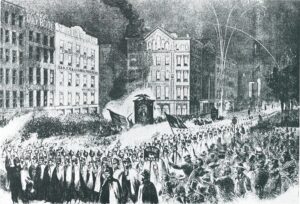
The election of 1860 (in the North) was between Abraham Lincoln, Republican, and Stephen Douglas, Democrat, who were (relatively) pro and anti slavery respectively. In the South the race was between John C. Breckenridge and John Bell. While there are a number of dynamics that make this election highly complicated, in this case the important thing is that Lincoln won the election (both a plurality of the national popular vote, and the required electoral vote majority) without being on the ballot in southern states. While his election precipitated the secession of most slave states, and the Civil War, the important part here is how Lincoln won. A major part of the Republican movement in 1860 was young voters, specifically the Wide Awakes. The wide awakes were a movement of mostly younger voters whose political involvement was a response to the highly partisan politics that preceded the election of 1860. The Wide Awake movement was one characterized by the ways they spread information (promotional materials, social events, even comics), and the militaristic way that they conducted themselves. They were not a movement built on hope (although they did have hope for the future), instead they were a movement built on resistance, as seen in their demonstrations. They marched in the streets wearing uniforms and carrying torches, acting almost as an army, there to resist the policies and aims of the Democratic party.

Wide awakes in uniforms carry torches in a march in Chicago.

Wide awakes in uniforms carry torches in a march in Chicago. Internet Archive Book Images Image from page 9 of “Abraham Lincoln’s political career through 1860” (1860), courtesy of Internet Archive Book Images.

Compare this to the current Harris campaign. Harris is directing significant resources towards the youth vote, as evidenced through the campaigns focus on youth voters during National Voter Registration Day Additionally, the Harris campaign has been using popular methods of communication, similar to the Wide Awakes, to reach younger voters. Instead of cartoons, the Harris campaign has been using social media and memes as outreach, a strategy which (according to polling) has been paying off. While these mechanical similarities connect the Harris Campaign to the Wide Awakes, it is the attitude with which the youth vote is approaching the election. This attitude boils down to what has become the defining slogan of the Harris campaign: “We are not going back.” The slogan has existed in American politics for a long time, and can be seen to have been used in protests after the Supreme Court Dobbs decision, intrinsically linking the phrase to protest and discontent on the part of many voters. While this is not the same as the militarism of the Wide Awakes, it demonstrates that both 2024 and 1860 contained movements based on discontent, rather than hope like 2008.

A person holds up a sign reading “We won’t go back” on the day the Dobbs decision was leaked. Photo courtesy of Miki Jourdan, provided under CC BY-NC-ND 2.0

Why does 1860 matter as a comparison? It provides a foundation for understanding how a candidate can win support in a highly polarized election, and how important the discontent of younger generations can be in deciding an election where institutions (slavery and reproductive rights respectively) are at a turning point.  Will the “woke” reproduce the victory of the Wide Awakes?  Only time will tell.

Trump and Jackson: A Fitting Comparison?

Donald Trump has made it clear that he identifies strongly with Andrew Jackson. In fact, in a visit to Jackson’s plantation in 2017, Trump called himself a “big fan,” and that Jackson was “inspirational.”   And, Trump has recently reaffirmed his support and admiration for Jackson, saying at a rally on Aug 29 that “Andrew Jackson … was treated worse than any other president… although nobody comes close to Trump.”   Aside from the (potential) parallels that one could draw between the two’s personality, why does Trump see himself in Jackson, and what might this comparison tell us about the upcoming election?

There are a number of ways in which the two are alike- in 1824 Jackson ran as an anti-establishment political outsider, known for his status as a war hero, while Trump campaigned on much of the same, although a businessman instead of veteran. Additionally, and more importantly, they both claimed to be victims of a stolen election. In Jackson’s case, he won the popular vote (at least on its face, as I will discuss later), but failed to reach the required number of electoral votes. The decision then went to the House of Representatives, where Jackson claimed a “corrupt bargain” occurred between John Quincy Adams and Henry Clay (the Speaker of the House), causing Adams to win, and Clay to become Secretary of State. Jackson then proceeded to campaign for the next four years on the idea that his election was stolen from him, leading to his election as president in 1828. This parallels Trump’s narrative of the 2020 election, as he claims to have won the popular vote in reality (although he did not), and that the election was stolen from him due to voter fraud on the part of the Democrats. This comparison obviously holds allure for Trump, as the comparison sets him up for a mass swell in support and overwhelming victory in the upcoming election, and gives him a historical figure to identify (and commiserate) with about having an election “stolen” from him.

There are, however, quite a few problems with this comparison. First, of course, Trump didn’t actually have the election stolen from him, but also there are some good arguments that Jackson didn’t either. First, the “corrupt bargain” can not be known to actually have happened. This likely strengthens the comparison between Trump and Jackson, as both based their campaign on supposed government corruption that remains unverified (or dis-proven in Trump’s case).  Even so, the proceedings of the House with regards to electing a president in 1824 followed the guidelines set forth in the Constitution  and the 12th Amendment, so the results are legitimate.

But, more importantly, there is strong evidence that, like Trump, Jackson did not actually win the popular vote in 1824. A project  that re-tallied votes from national newspapers, and accounted for states that did not use the popular vote found that Jackson did not, in reality, earn the popular vote. This arguably strengthens the comparison between Jackson and Trump, as both did not win a contested election or the popular vote, and have been campaigning on that concept heading into the next election.

It appears that the comparison between Trump and Jackson is extremely strong, although based on the above, the comparison may not be a desirable one. If there is a negative connotation with Jackson’s campaign based on the above issues, then why does Trump continue to identify with Jackson? Put simply, with all of the problems with Jackson and his campaign, he still won in 1828, and he won by a lot. If Jackson can do it, Trump’s logic goes, Trump can too. With such strong parallels, the question becomes if Trump will follow Jackson’s pattern, and win the upcoming election. This is not a question that can be truly be answered by history, but it is important to recognize that a campaign that had many of the same broad strokes as the Trump campaign was able to put itself back together after a loss and win with broad support.  Trump hopes that by identifying (and  using the playbook of) Jackson, he can repeat Jackson’s victory in 1828, although whether he will succeed is unknown.

css.php
The views and opinions expressed on individual web pages are strictly those of their authors and are not official statements of Grinnell College. Copyright Statement.