
Author: tiredwombat
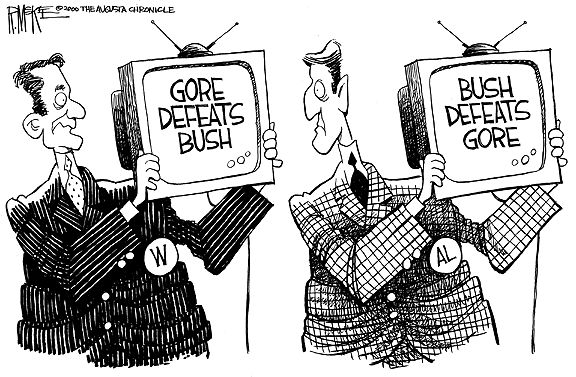
Was the year 2000 a starting point and are we living in the effects of the process of that election? Political cartoons surrounding the actions of the United States Government, and its elected officials are not a new phenomenon. However, cartoonists had a field day with the 2000 election and the back and forth of the media stating who was the winner. Two cartoonists, Cam Cardow of The Ottawa Citizen and Rick McKee of The Augusta Chronicle showed the back and forth of the declaration of the winner of the United States Presidential Election. Cam Cardow’s comic shows, on a print newspaper, Bush and Gore crossed out alternating multiple times with Win at the bottom. The repetition of the Bush and Gore crossed out shows how the media, incorrectly, stated who won the election over and over again. Rick McKee’s cartoon also gets at the same aspect of confusion with two gentlemen (Al Gore and George W. Bush) each holding a television stating that they had lost the election. You can see how confused not only the politicians, but the American people were regarding who would be their next president. These political cartoons help us to further process the events of the election of 2000.
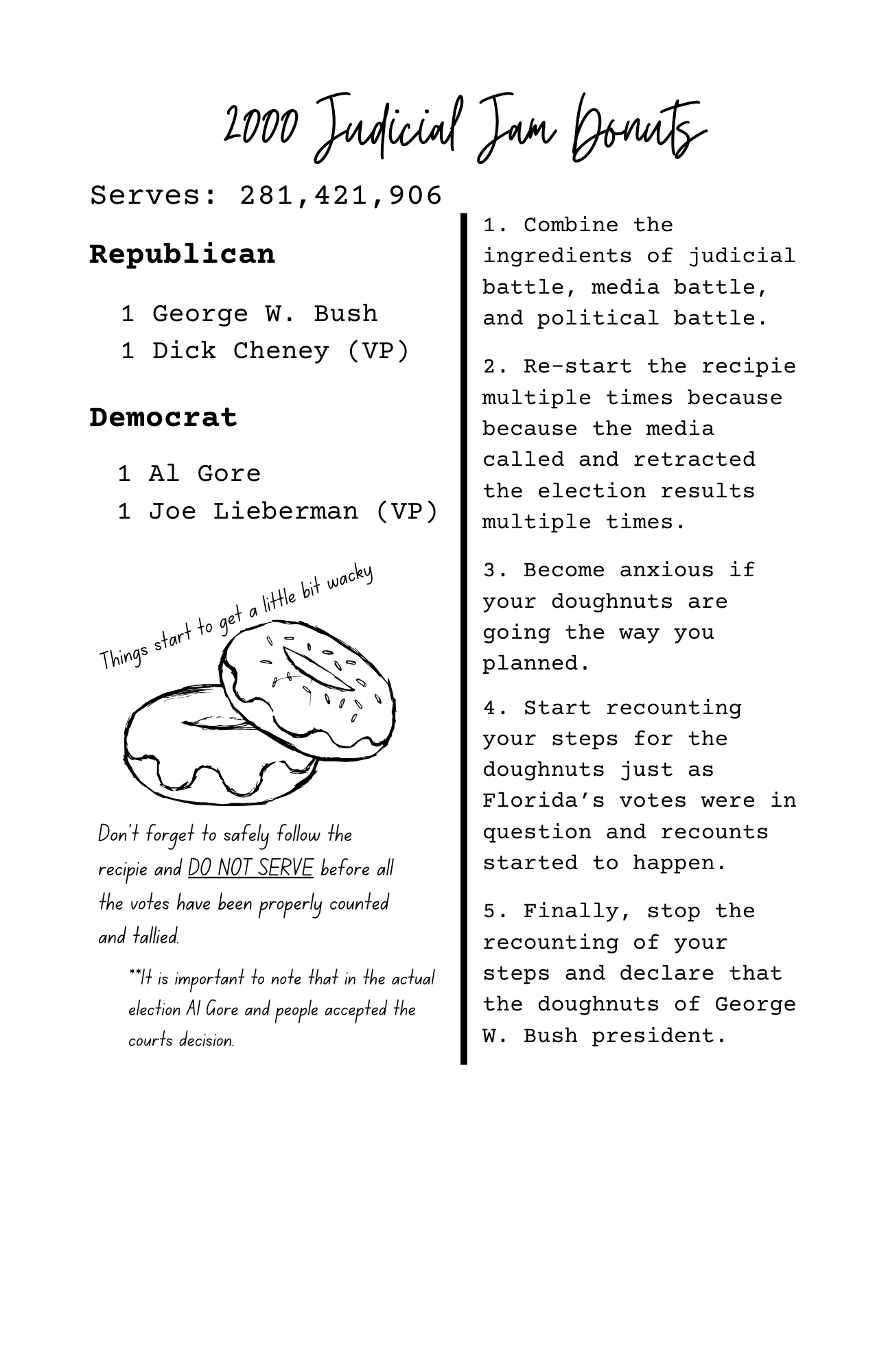
The election of 2000 between Democratic candidate Al Gore and Republican candidate George W. Bush proved to be a media battle, political battle, and judicial battle. As the results came in all eyes turned to Florida it is important to understand the timeline of election night, and next day.
- 8pm EST: CNN, NBC, FOX, CBS, and ABC, among other networks, based on exit polling, stated that Al Gore had won Florida.
- 10 p.m. EST: the statement that Al Gore won Florida was retracted.
- 2:30 a.m. EST: Networks declared George W. Bush the winner of Florida.
- 4:30 a.m EST: Networks retracted the statement that George W. Bush won Florida.
Somewhere on the night of Tuesday, November 7, 2000, Al Gore conceded the election but later withdrew the concession.
Under Florida statute “because the margin of victory was equal to or less than one-half of one percent of the votes cast, an automatic machine recount occurred” (Supreme Court of the United States, No. 00-836). Then Vice President Al Gore submitted a written request for a manual recount of votes in the Florida counties, Volusia, Palm Beach, Broward, and Miami-Dade. This spiraled because the legislature of Florida did not have a standard protocol for the vote recount. Each county was recounting the ballots slightly differently with undervotes where the machine was not able to fully count the vote. However, the Supreme Court of the United States eventually stepped in and stopped the recount in Florida and declared George W. Bush the 43rd president of the United States. The key aspect which differed the 2000 election from the 2020 election was that both candidates publicly, respectfully accepted the results of the election. This was a key aspect in keeping those who voted for the loosing candidate, Al Gore, who were disappointed at the outcome of the election.
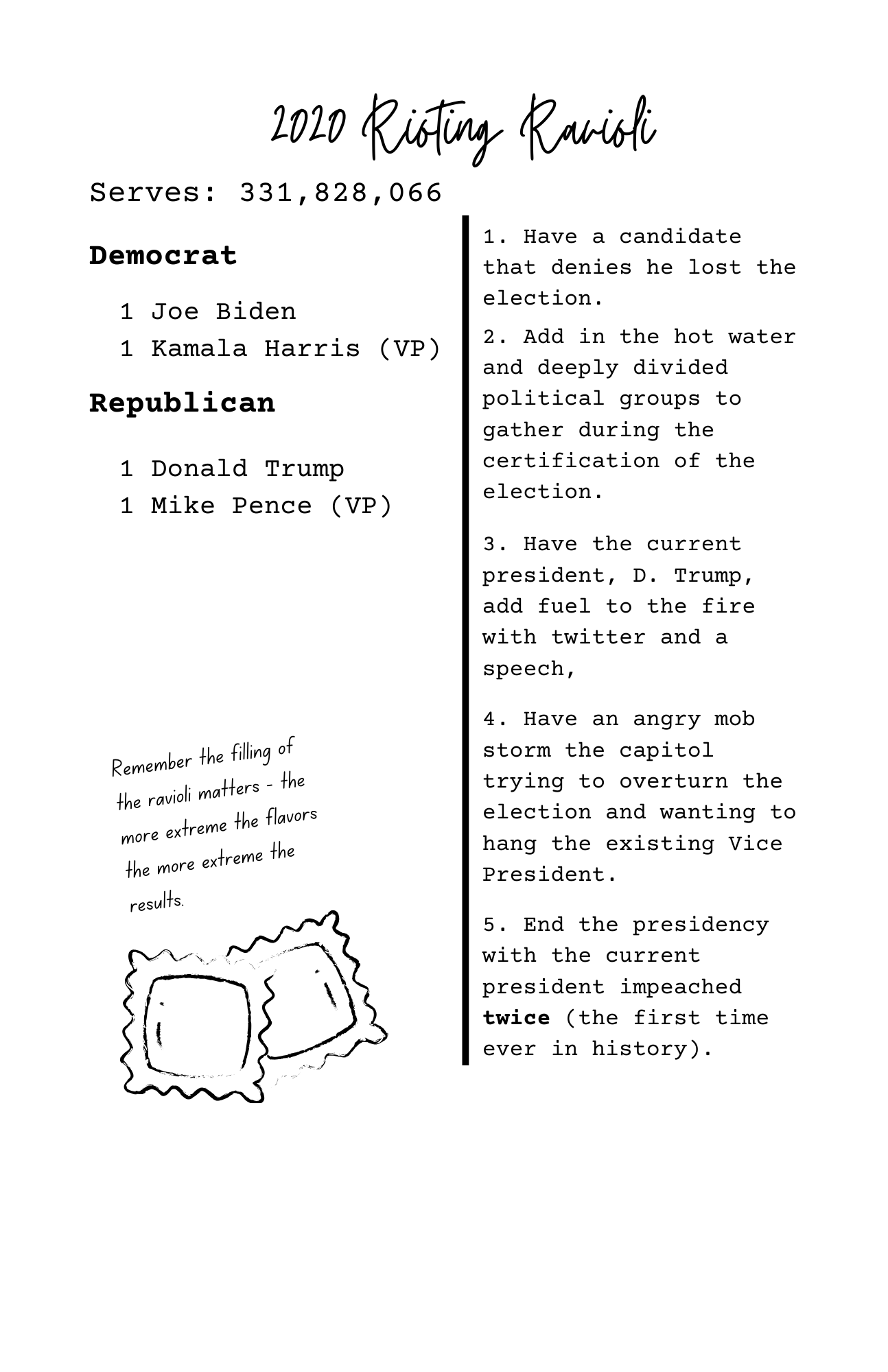
In the 2020 election we also saw recounts, however this time the media focused on Georgia. In the political cartoon by Phil Hands of the Tribune Content Agency you see two election officials presenting Donald Trump with the results of the election and recount. However, this drastically contrasted the 2000 election here the losing candidate, Donald J. Trump, refused to accept his lost (in the cartoon you can see him throwing a hissy fit holding lawsuit papers) which his denial has stretched into 2024. Furthermore you can see political cartoons stating that the 2020 election is the Bush v Gore sequel (Bill Bramhall of the Tribune Content Agency).
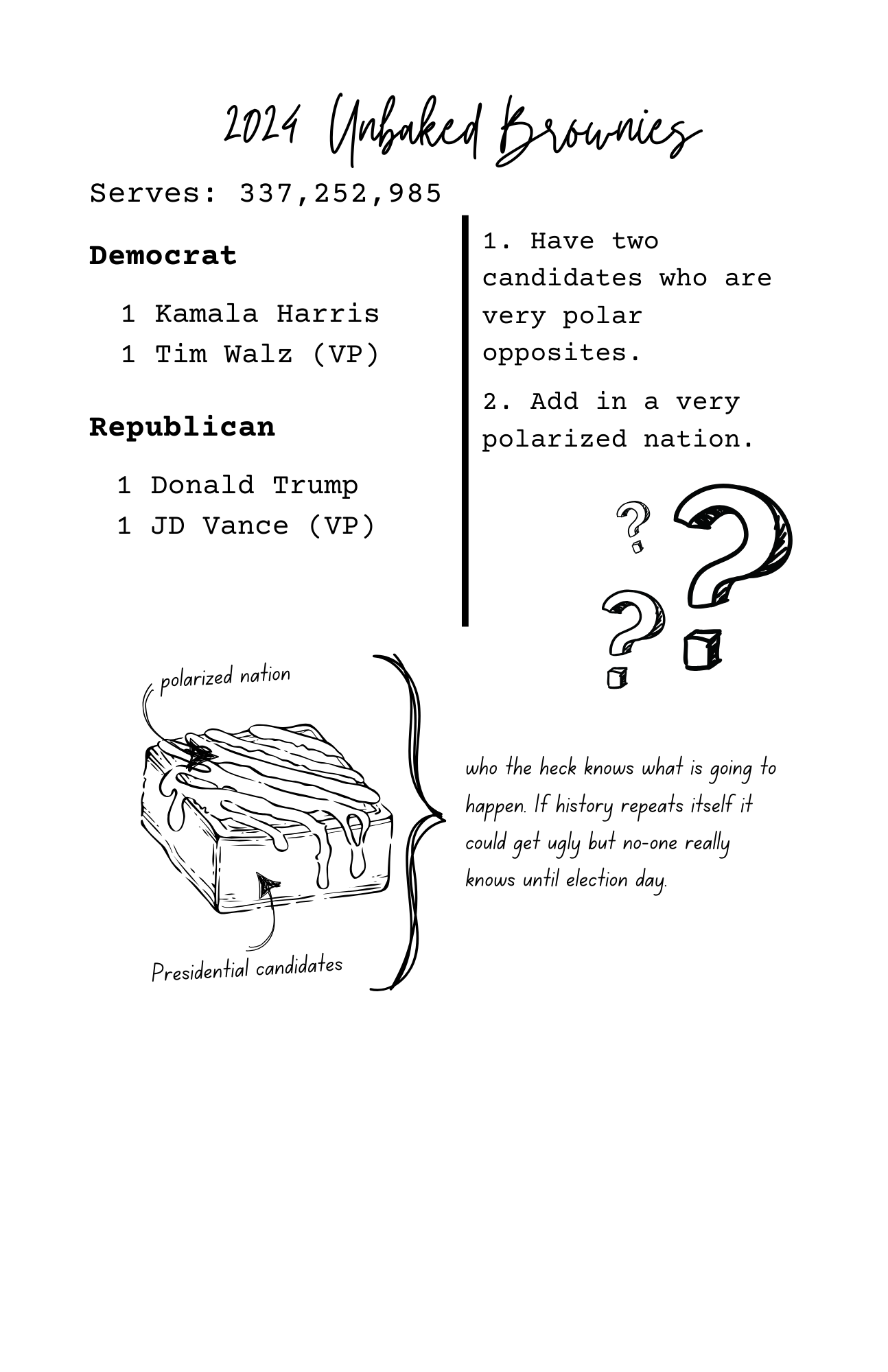
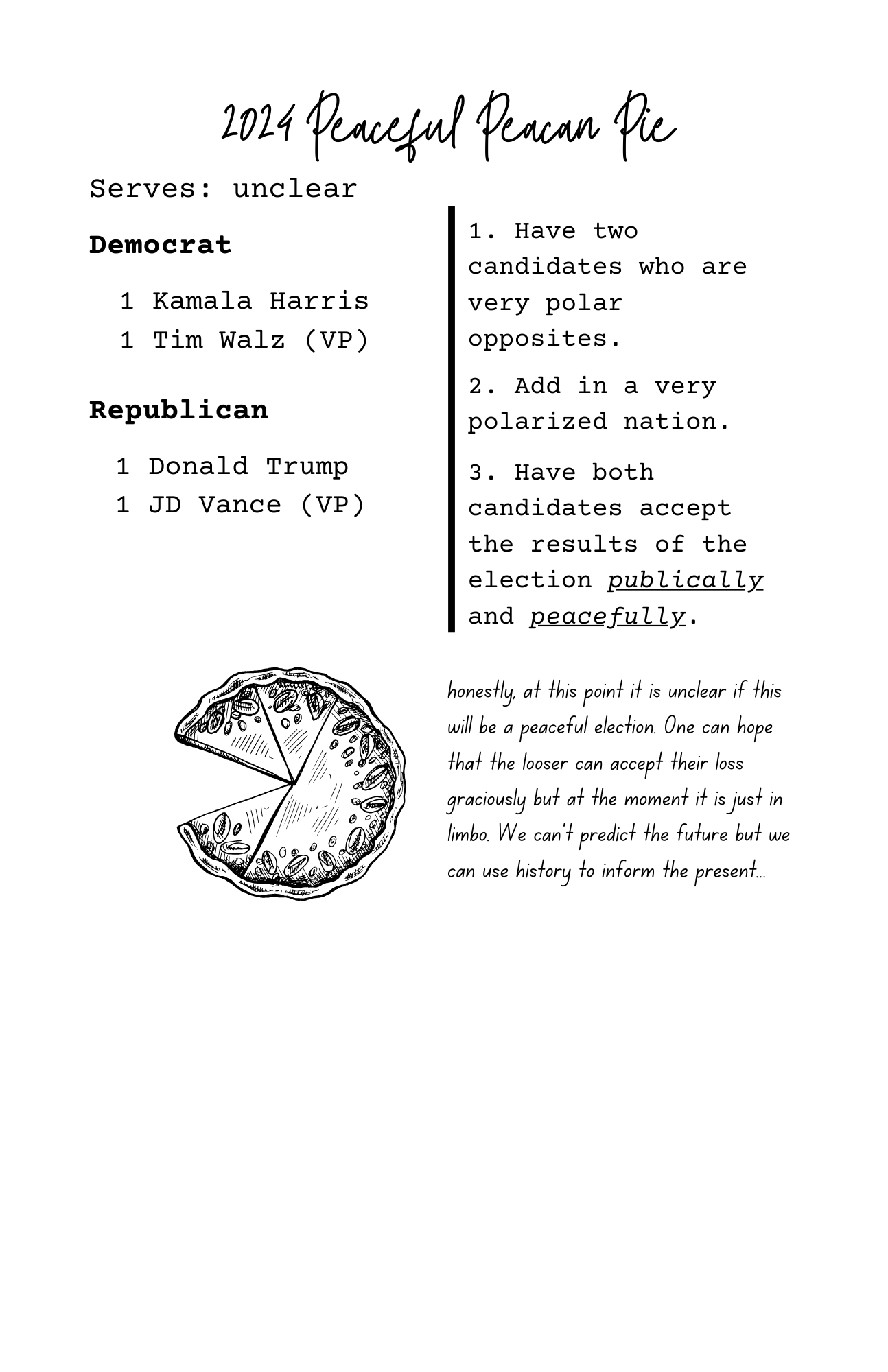
With all of this information one question remains: how will cartoonists capture the 2024 election?
…Will 2024 be the Same?
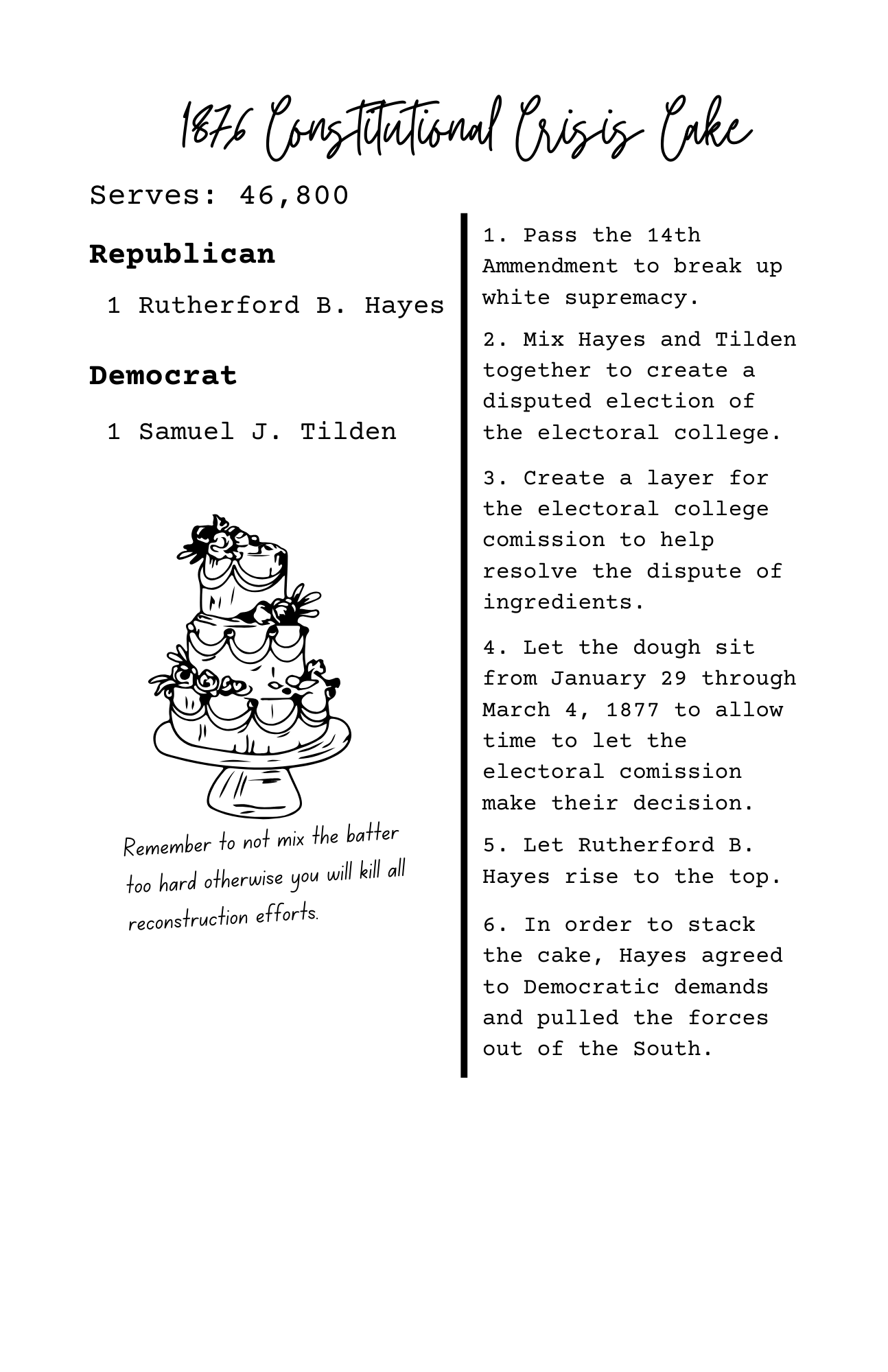
The election of 1876 at the time, seemed to be an election to end all elections. The election candidates were, Rutheford B. Hay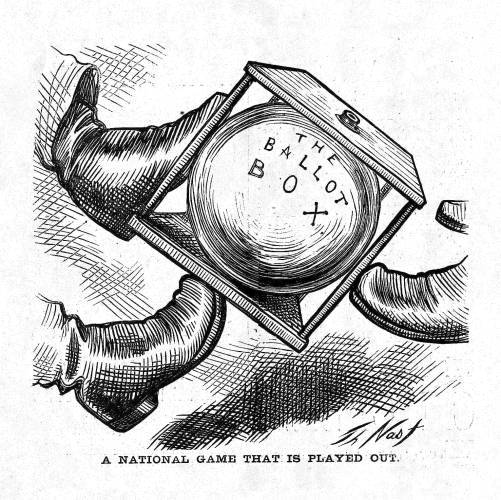 es (Republican) and Samuel J. Tilden (Democrat). However, the turmoil of the election came to head during the counting of the ballots and subsequently affecting the electoral votes. Samuel J. Tilden won the popular vote in the United States but was one electoral vote short of winning the majority, that would make him President of the United States. However, the states of South Carolina, Louisiana, and Florida (19 electoral votes) and 1 electoral vote of Oregon was still in dispute. However, it wasn’t until the United States Congress created the Electoral Commission to break the deadlock between the two candidates. However, there was more than just the electoral votes that triggered this commission. Claims of stolen ballots and electoral fraud was reflected in the political cartoon from Thomas Nast (September 26, 1840 – December 7, 1902) published in Harpers Weekly on December 23, 1876. Thomas Nast, after was considered the father of the American cartoon.
The political cartoon entitled “A National Game that is Played Out” demonstrates how the vote kept getting kicked between the four different states that had disputed electoral votes. The Republican controlled states disagreed with the votes because the Democratic controlled counties had put barriers for black, male voters. These barriers included creating false ballots, parliamentary violence, and violence against black, male voters. However, even within this corruption, to make sure the 1876 election went through they had to let white supremacy win for fear that a president would not be inaugurated on January 20th.
One would think that corruption techniques and claims would remain in the 1800’s but in the 2020 election, there once again was cries of voter fraud. Unlike in 1876 when there were ballot boxes stolen, 2020 had other election “fraud”. The sitting president (Donald Trump) claimed that the election was stolen (this was incorrect – he just didn’t want to admit that he lost) and claiming that dead people voted (how does a dead person vote?). However, the most bizarre claim came from an Arizona election audit team in Maricopa County who would be analyzing the ballots for bamboo fibers in order to make sure that China didn’t submit any ballots in the 2020 election. This investigation was done on the belief by some election officials who were allies to Donald Trump that China smuggled in ballots to interfere and influence the outcome of the 2020 election, which the US Intelligence Department deemed incorrect.
What about the future? Historians cannot predict the future but can use the past to interpret what is going on in the present. Former President Donald Trump, to this day, still believes that he won the 2020 United States Presidential election. Furthermore, he is turning to bully tactics comparable to the 1876 election with poll worker intimidation and intimidation of voters encouraging police to “Watch for the voter fraud, because we win without voter fraud… They’re afraid of you [police] people”. Democracy goes through cycles, and it is important to realize what goes around comes around – what happened in 1876 has and could happen again.
A picture is worth 1000 words.
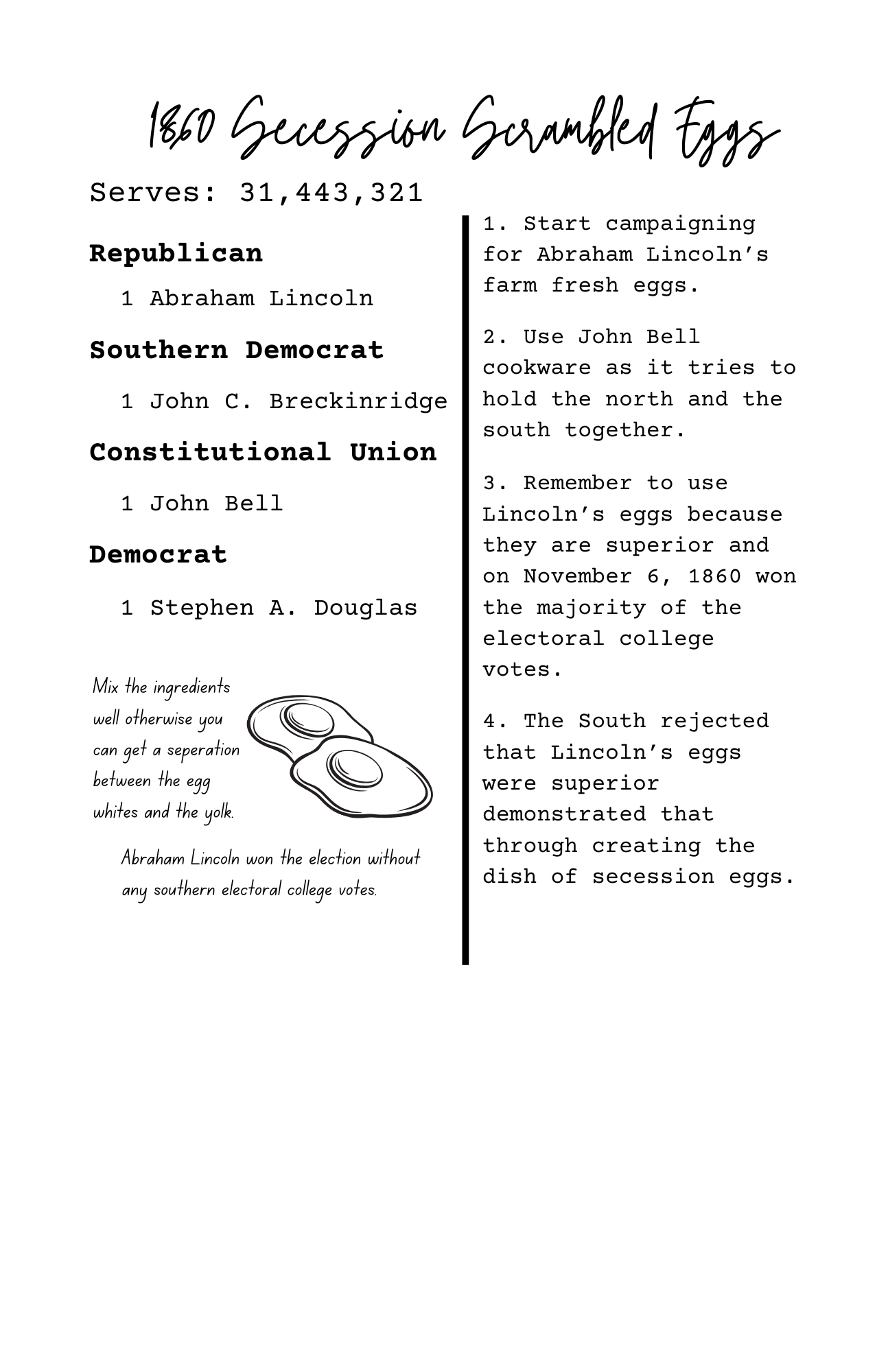
The election of 1800 pulled the United States in both two and four directions, with the North and the South having their own polical race for the presidency. In the North the two candidates were Abraham Lincoln  (Republican) and Stephen Arnold Douglas (Democrat) and in the South the two candidates were John Bell (Constitutional Union) and John Cabell Breckinridge (Southern Democrat).
This political cartoon entitled Dividing the National Map (author unknown) depicts all four candidates (from left to right: Abraham Lincoln, Stephen Douglas, John Breckinridge, and John Bell) vying for presidential control of the United States. This political cartoon was printed in Cincinnati, Ohio, a boarder state, which was in the Union. Eventually, the state of Ohio voted for Abraham Lincoln with 23 electoral votes. John Bell, standing on the ladder, is attempting to glue the country back together. The cartoon puts heavy emphasis on John Bell repairing the nation with a popular glue brand during the 1800’s, Spalding’s. John Bell was briefly secretary of war under William Henry Harrison until Harrison’s death and then resigned due to political tension within the Whig party. However, from 1846 to 1859 Bell was a Senator for Tennessee. John Bell opposed the expansion of slavery to the territories even though he was a slaveholder himself. I think that the addition of the popular glue brand signifies the fate of the United States rests in the hands of the American people. Being a Southern candidate, especially trying to gain support from the boarder states, I think that John Bell was trying to hold the country together while also supporting slavery. He was trying to garner support from the most vulnerable states who could either be pulled towards the North or the South. He originally opposed the secession of the Southern United States, however eventually ended up supporting the Confederacy. Basically, Bell was trying to pose himself as a popular candidate to the southerners that didn’t want to fracture the United States of America into the North and the South.
Photos and cartoons provide universal access to garner opinions on polical issues. This political cartoon allows a glimpse into the political campaigning of the 1860 election. However, today’s day and age we still have political cartoons. These political cartoons allow for expression of personal viewpoints. Even today political cartoons allow for expression of speech while also leaving some room for viewer interpretation. A similar political cartoon, posted in the Philadelphia Inquierer, was from the 2020 presidential election cycle but instead of a map of the United States it was the United States flag with Donald Trump tearing it apart and Joe Biden sewing it back together. The 2020 political cartoon and the 1860 cartoon express similar sentiments (although in 1860 it is four candidates and in 2020 it was two candidates) regarding tearing the country apart and then one candidate bringing it back together.
It is important to understand the past as it informs how we think about the present.
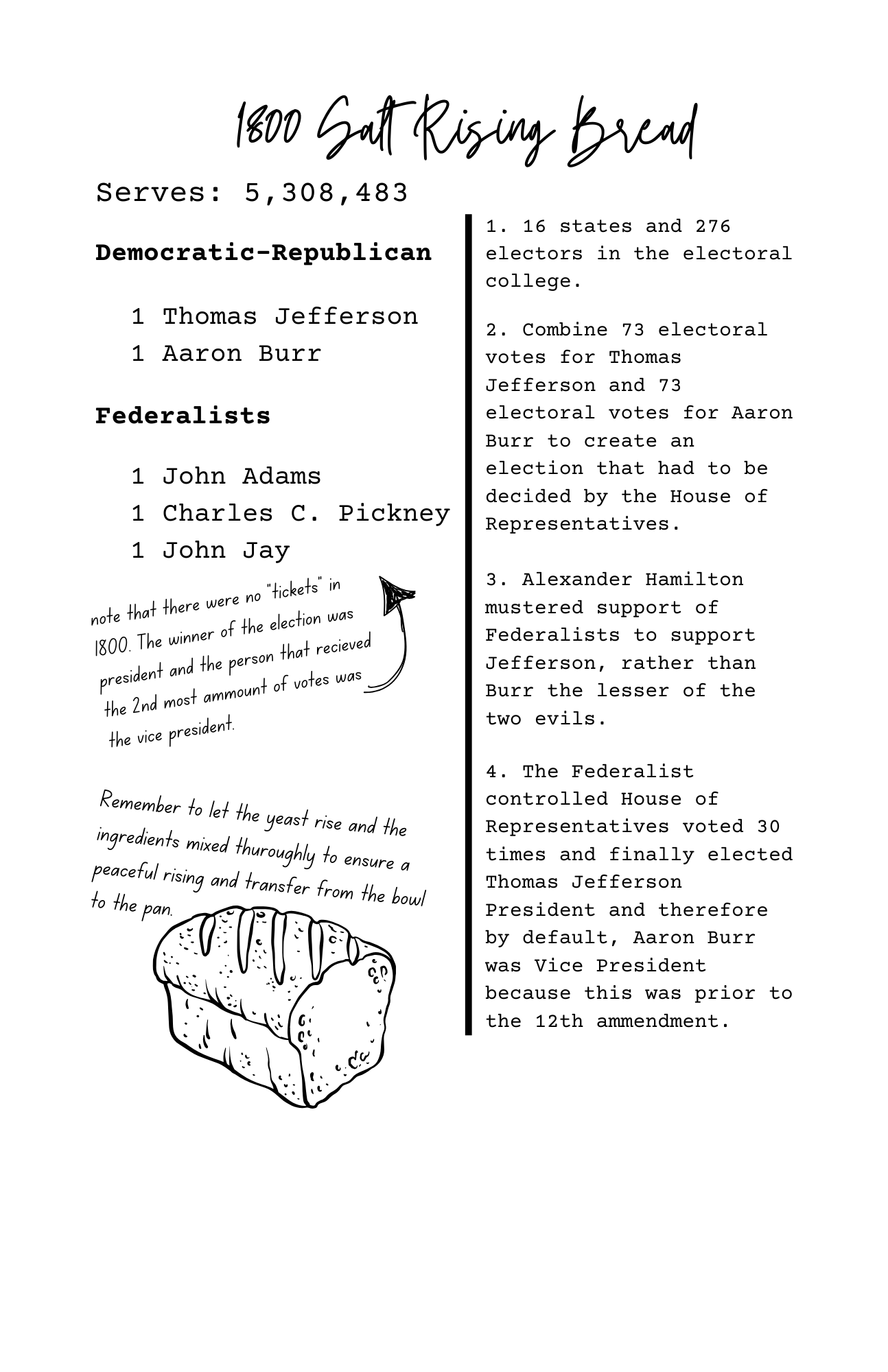
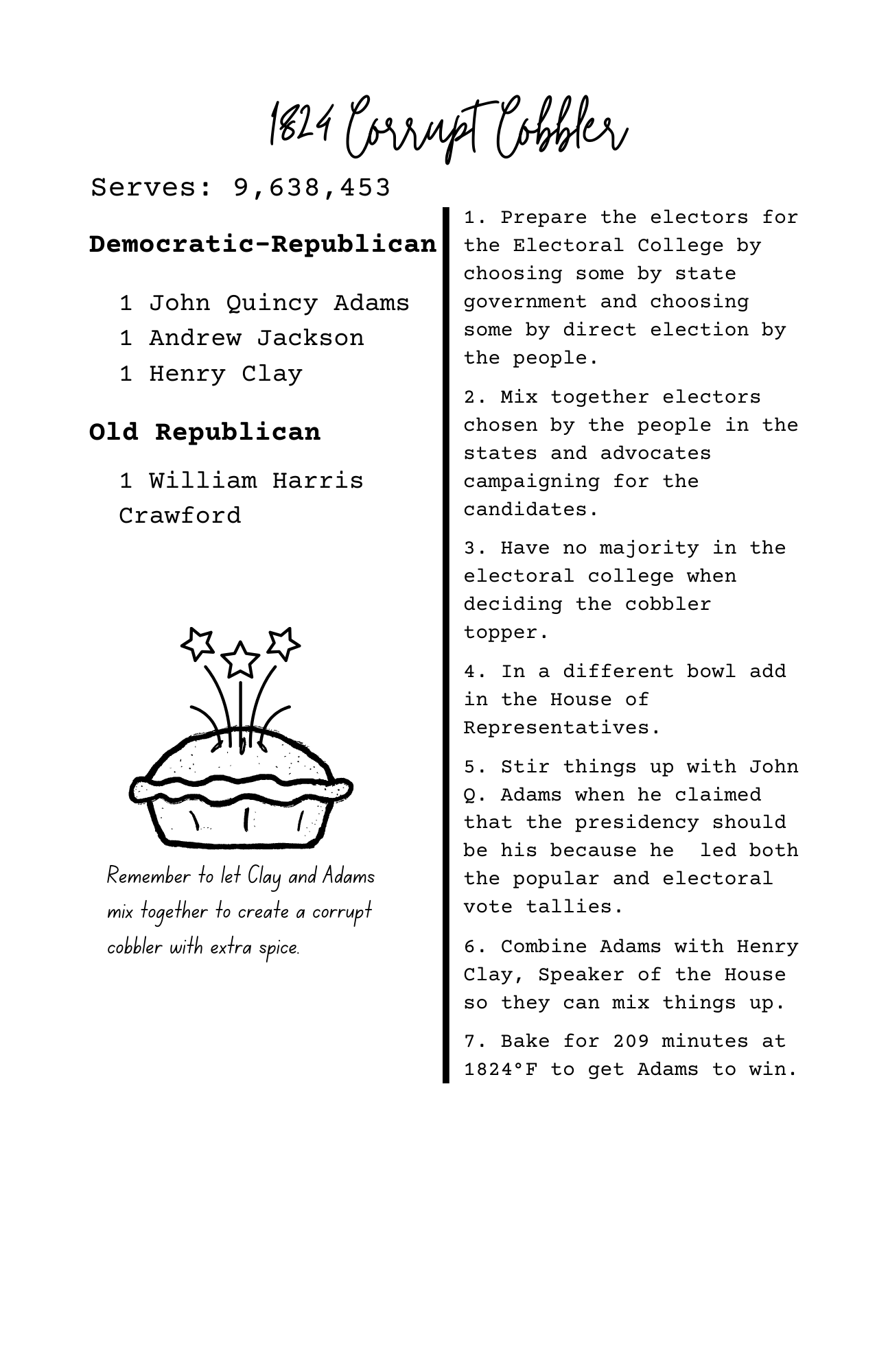
The election of 1800 was quite contested. Prior to the election of 1800, the presidential power remained in the hands of the Federalists. During the election of 1800, was the first time that there was a transfer of power out of the Federalist “political party” to the Democratic-Republicans. This election started with polarized thinking between multiple people within and across party lines. Both political parties believed that the other party was going to “…subvert the government and overthrow the Constitution” (Horn 2000, p. 3). For the 1800 presidential election the Federalist candidates included John Adams (incumbent) and Charles C. Pinckney (minister to France) and the Democratic-Republican candidates included Thomas Jefferson (then current Vice President of the US) and Aaron Burr (Senator from New York).
Within every election there are behind the scenes conversations that impact the election itself. Alexander Hamilton (Federalist) wrote a series of letters to Theodore Sedgwick (Federalist and then current Speaker of the House of Representatives) detailing his thoughts on the election and how to keep the government out of the hands of the Democratic-Republicans (Thomas Jefferson and Aaron Burr). Hamilton states that “To support Adams & Pinckney, equally, is the only thing that can possibly save us from the fangs of Jefferson” (Hamilton to Sedgewick 4 May 1800). This polarization between candidates is still reflected today with the 2024 election. During the Presidential debate on September 10, 2024, Vice President Kamala Harris stated that “[Trump’s] former National Security Advisor has said he is dangerous and unfit. His former Secretary of Defense has said the nation, the Republic, would never survive another Trump term” (Kamala Harris during the 2024 US Presidential Debate). Her statement and the statement of Alexander Hamilton reflect the same sentiment—the other candidate is dangerous. Similarly former President Donald Trump forcefully attacked Vice President Kamala Harris stating that “[she’s] a radical Left-liberal” (Donald Trump during the 2024 US Presidential Debate). The difference between the debate on September 10, 2024, and the letter between Hamilton and Sedgewick was that one was on a public forum and the other was on a private forum.
However, that doesn’t mean that things happen behind the scenes that influence the public outcome. Alexander Hamilton is writing to the Speaker of the House of Representatives who plays great sway in how an election was to be handled if a tie occurred in the Electoral College. Similarly, with a bipartisan immigration bill during President Joe Biden’s administration, former President Donald Trump called some congressmen, including current speaker of the House of Representatives, Mike Johnson to kill the bill as Vice President Kamala Harris noted during Tuesday’s debate. Once again, this demonstrates the behind-the-scenes partisan purpose for getting their political agenda through.