Grinnell College Logo

HIS 295, Professor Sarah J. Purcell

Category: Week 4: 1860 (Page 2 of 3)

The Consequential Election of 1860 and the Lies that Followed

Although powerful figures might have attempted to rewrite history over the past 150 years, the concern of the Election of 1860 and secession was clearly slavery. The Lost Cause Movement in the South was extremely powerful and retrospectively blurred the lines of the truth so far that common knowledge was questioned. The fact that anyone could believe that slavery was not the main cause of the war is a testament to their incredible propaganda soon after the Civil War. 

The political landscape during 1860 was extremely volatile which resulted in clear sectionalism. For the South, the problem of slavery worked hand and hand with their pride and politics. Because of this, they couldn’t support Stephen A. Douglas who believed in popular sovereignty. It was clear that the Democratic party needed to split up, because the disputes were regional and nothing more. With the Democrats severed into the North versus the South, it was evident more conflict was on the way. The 15 years before this election, there was a constant need for political compromise and this election was the hay that broke the camel’s back. The red carpet was laid out for the Republican candidate, Abraham Lincoln. 

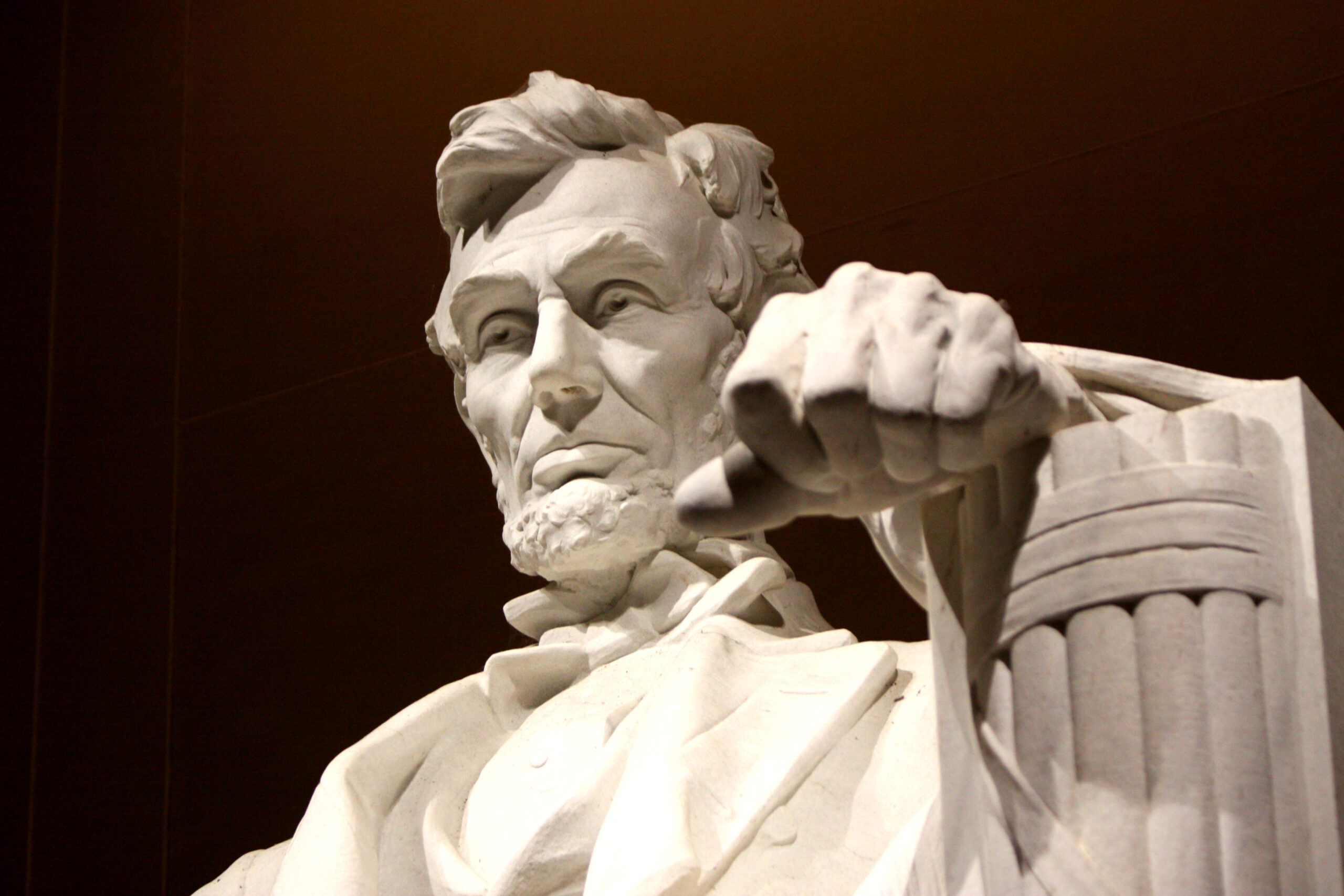
Abraham Lincoln Memorial, courtesy of Gage Skidmore.

This election was the most consequential in US history considering 11 states removed themselves from the Nation as a result. Lincoln was the clear front-runner because of his moderate stance on most topics. For the topic of slavery, he appealed to Northern sentiment that it is immoral and needs to be phased out of the country. He explained his free soil perspective at the Republican National Convention, “the new dogma that the Constitution, of its own force, carries Slavery into any or all of the Territories of the United States, is a dangerous political heresy”(May 18, 1860). He didn’t completely appeal to Abolitionists however, because of the continued racist sentiment the Republican party had but a Free Soil candidate was a better option than a popular sovereignty candidate. Even with such a moderate view on slavery, he didn’t win a single Southern state. For the most part, they preferred the Southern Democrat, John C. Breckinridge. After Lincoln won the election, It was clear that vehemently pro-slavery views of the South would not be realized. 

South Carolina was the first state to take action, and she cited many ideological reasons for secession but once again the main issue was slavery. In the “Declaration of the Immediate Causes Which Induce and Justify the Secession of South Carolina from the Federal Union”, legislators mentioned the Articles of Confederation which showed their desire for stronger state power. The reason they wanted state power was to control the institution of slavery in their way because, “an increasing hostility on the part of the non-slaveholding States to the institution of slavery, has led to a disregard of their obligations”(December 24, 1860). In the Declaration, they even mentioned that the tensions built over the past 25 years but now they finally believe their system was under threat. If the argument that secession and the Civil War arises was for any reason but slavery, one can now understand how far from the truth this is. As the most consequential election in US history, it is vital to comprehend the true reasoning for the North and South’s decisions. 

What Can Harris learn from Lincoln?

In last week’s blog post, I compared the tone of the 1800 and 2024. In these elections, candidates framed the stakes as particularly consequential. The same can be said of the election of 1860. 


In 1860, the nation’s debate around slavery had reached “a boiling point” (UVA Miller Center). The debate around slavery complicated each party’s nomination process. The Democratic convention was so heated, that the party wasn’t even able to make a decision when they initially met; debate between the Northern and Southern delegates about how the party should address slavery was too intense. When the party reconvened six weeks later, Stephen Douglas was eventually nominated. However, Southern democratic delegates were unsatisfied with this choice. These delegates would reconvene and nominate John C. Breckenridge as the Southern Democratic nominee.  


On the Republican side, the convention was also somewhat contested. Entering the convention, William H. Seward was seen as the frontrunner. However, by the third ballot, Abraham Lincoln had captured the nomination. Additionally, John Bell of the Constitutional Union party was elected.


As the campaign heated up, Lincoln was seen as a frontrunner. The divided support of the Democrats paired with the North’s views on slavery gave Lincoln a clear advantage. This perceived advantage made Lincoln the target of dramatic personal attacks. These attacks dramatized how Lincoln’s position on slavery would direct the future of the country. A secessionist in Georgia claimed Lincoln wanted to “force the inter-marriage of black and white children” (UVA Miller Center). 


In the last presidential debate, Trump similarly criticized the future a Harris presidency would create. These critiques often include racial undertones, particularly when Trump critiques Harris’ plans on immigration. 


Like Jefferson in 1800 and Lincoln in 1860, Kamala faces bold attacks against the future of America that could be created by her presidency. Lincoln seemed to follow the mentality adopted by Jefferson when he faced these attacks; he stayed calm and non combative. While it might be difficult for Kamala to appear unfazed by Trump’s attacks – especially in a modern media environment – history seems to encourage such a mentality. 


References: 

“Abraham Lincoln: Campaigns and Elections,” Michael Burlingame, https://millercenter.org/president/lincoln/campaigns-and-elections


“Harris says ‘We’re not going back!’ So did Thomas Jefferson?”, jarviser2, https://his295-fall2024.sites.grinnell.edu/week-3/harris-says-were-not-going-back-thomas-jefferson/

The Election of 1860, Voting for War?

Despite the partisan tense state of our current political landscape, all-out civil war still seems unlikely. The road to a conflict that that pits neighbor against neighbor and state against state seems unfathomable. Of course, it has happened before in American history. Those who lived up to the Civil War may have held similar notions about the unbreakable strength of the Union until it was too late. Was there online one event that made the war inevitable, that broke the country so profoundly that war was inevitable, and if so, with the advantage of hindsight, could we avoid that same trap with the current state of the Union, especially with such an influential election two months away?


Often, the start of the Civil War is seen by historians as April 12th, 1861, the day when Confederate troops fired on Fort Sumpter in South Carolina. Indeed, this first act of violence between the new confederacy and the Union started the war between these two sides. By this time, however, the southern states had already broken from the Union, a profound act of violence itself and one that made conflict inexorable. Even that, however, is not the true line from which America was unable to come back. Rather this blog suggests that the straw election that broke the camels, United States, back was the election of 1860, an election that made conflict all but inevitable.


Bell Everett Campaign Poster 1860 - PICRYL - Public Domain Media Search Engine Public Domain Search

Bell Everett Campaign Poster


The election that made Abraham Lincon the 16th president of the United States was a contentious one, not because of any misconduct in the election itself but rather because of the results, an anti-slavery republican elected president without the support of a single southern state. The words “anti-slavery” and not abolition is a purposeful one. Despite his reputation, when Lincon was elected, he was not an abolitionist; in fact, he saw abolition as just as great a threat to the Union as slavery. This didn’t bring comfort to the South. They saw the Lincons election as a shift in the political tides, a tide that would end the institution of slavery and the southern way of life. This is the moment in which the civil war truly started, in which violence became inevitable. Despite the lofty aspirations of abolitionists, it seems unlikely that slavery would have ended before the 20th century without violence. At the same time, even if the institution of slavery was not directly at risk, the southern states would not allow themselves to be governed by an executive that so fundamentally opposed their core beliefs. While it is disingenuous to claim that in voting or not voting for Lincon, Americans consciously voted for war, it is a truth that the election of 1860 was a line from which, once crossed, America was unable to recover without armed conflict. Of course, this is not to minimize the southern states’ role in escalation both by succeed from the Union and inciting violence but rather to point to how elections, even ones conducted fairly, have the power to rip nations apart.


The election of 2024 could be our could be our contemporary 1860. No matter the outcome, the election will be close. This means that millions of Americans will cast ballots for one candidate and end up with a completely different one in the white house. Duh. That’s how it always works, but like the election of 1860, each candidate has radically different views that, according to some on both sides, threaten one part or another of Americas way of life. It’s not hard to imagine how contentious issues like immigration or abortion could lead to political violence or even interstate conflict. In 2020, just as with the election of 1860, political violence wasn’t on the ballot, and yet the choices made by Americans in the polls led to the January 6th riot just the same, with some help of extremists and a former president, of course.


The past doesn’t determine the future, and no matter who wins the presidency, there are still countless ways to avoid political violence. Still, it can’t be helped, but I wonder if future historians will mark the 2024 election as the start of the second civil war.

The Dangers of Alarmist “Radical” Panic in Political Campaigns: Lessons for Today From the Election of 1860

In Presidential elections, candidates often advertise their policies as being based around the beliefs and desires of their supporters and are seen as representatives of the political party they belong to. While a given political party (e.g., “Party A”) often focuses on how the Presidential candidate chosen from Party A represents their supporters, political parties which stand in opposition to Party A (e.g., “Party B”) will often focus their “attacks” against Party A around what they believe the actions and beliefs held by the demographic of Party A’s supporters say about the “true” goals and ideals of Party A’s presidential candidate. Here is a recent example, which will hopefully make the previous sentence a little clearer:


Ahead of the 2020 Presidential election, The New York Times published an article discussing then incumbent Republican candidate Donald Trump’s allegations that the Democratic candidate, Joe Biden, held ties to “radical left” groups such as Antifa (Anti-fascists). The article went on to juxtapose the beliefs held by these “radical left” groups that Trump had associated with Biden with the actual policies, stances, and statements that the Biden/Harris campaign had provided on those beliefs. For example, one of the primary movements led by Antifa and similar groups is the movement to defund the police, a movement which Joe Biden opposes, with him evening stating that his plan for successful Police reform would require more funding to be put in to Police departments (“Biden Walks a Cautious Line as He Opposes Defunding the Police” (June 8th 2020), The New York Times,).


These kinds of confusing representations of Presidential candidates (often made by the candidate’s opposition) as being advocates for the more “radical” parts of the political party they represent, despite the candidates themselves having expressed opposition to beliefs and policies held by those “radical” parts, is nothing new; and, as you may have guessed, these sorts of misattributions of “radical” views to Presidential candidates can have rather severe consequences. One of the most significant examples of this sort of phenomenon can be seen in what was, arguably, the most significant election in the history of the United States of America: the election of 1860.


The Presidential election of 1860 was exceptionally regional, with essentially two different presidential races occurring in the Northern and Southern United States. Presidential candidates were chosen by the Republican party as well as both parties that emerged from the newly fractured Democratic party: representing the Republican party, Abraham Lincoln of Illinois; representing the Northern Democrats, Illinois Senator Stephen Douglas; and representing the Southern Democrats, incumbent Vice President John C. Breckinridge of Kentucky. Despite not being included on the ballot in any of the Southern states, Lincoln earned 180 electoral votes, with the runner-up, Breckinridge, having earned only 72 votes (The Miller Center, “Abraham Lincoln: Campaigns and Elections”, Michael Burlingame).


In his first inauguration address, Lincoln attempted to reassure an ever-anxious American South that the Federal Government, believed by many Southerners to be representing the interests of Northern states exclusively, would not bring about “bloodshed or violence” in any conflict with Southern states unless such extreme actions were “forced upon the national authority”, and that he had no intentions nor right to “interfere with the institution of slavery in the States where it exists”. However, Lincoln made it clear To ensure that there could be no misinterpretation of what sorts of events would cause a violent approach to be “forced upon the national authority”, and cleverly clarify his position on whether secession was truly possible under the constitution, Lincoln asserted his intentions to “[use] the power confided in [him as president] to hold, occupy, and possess the property and places belonging to the Government” in the case of any attempts by any group to annex any such property or places, as the Confederate States of America, would go on to do a little over a month after this inauguration address, leading to the beginning of the Civil War (First Inaugural Address of Abraham Lincoln (March 4th 1861),  Yale Law School: The Avalon Project)


While Abraham Lincoln has long been known by many as the “Great Emancipator”, his first presidential campaign was notably not based in abolitionist ideals; that is, not interested in actively dismantling the institution of slavery. He was so far removed from the abolitionist movement in 1860, that famed abolitionist and Civil Rights leader, Frederick Douglass, in an 1876 memorial address labeled Lincoln as “preeminently the white man’s President, entirely devoted to the welfare of white men” (An Oration in Memory of Abraham Lincoln (April 14th 1876), Frederick Douglass.). The Republican campaign for Lincoln’s presidency even went so far as to eagerly deny claims that their party subscribed to abolitionist ideals, publicly denounce abolitionist politicians who voiced their support for Lincoln, and attempt to frame the Democratic party as the party committed to threatening “white supremacy” due to their desire to expand the institution of slavery to new states which would therefore increasing the population of non-white enslaved peoples. Why, then, were Southerners seemingly so afraid of Abraham Lincoln’s Presidency that seven states had seceded by February 1st, 1961, remarkably soon after Lincoln’s election on November 6th, 1860 (Britannica, United States History: Secession)?


It can be difficult to find clarity as to why these Southern States felt such urgency, even if looking towards documents such as the Declaration of Secession of South Carolina, the first state to secede: which makes it clear that Lincoln’s presidency is a, if not the, primary cause for their secession, stating that in electing Lincoln, the Northern states have elected a man whose “opinions and purposes are hostile to slavery” and who has declared that “the public mind must rest in the belief that slavery is in the course of ultimate extinction”(South Carolina Declaration of Secession (1860), from the Constitution Center).


At this point, it is important to note that Southern States were not just afraid of abolitionists, but also afraid of anti-slavery politicians who, in refusing to enact slave codes which would protect Southerner’s rights to own slaves in the Constitution, could eventually bring about the abolition of slavery. While Lincoln did not belong to any abolitionist party, he was firmly anti-slavery, thus igniting the fears of Southerners. For example, Lincoln and the Republican party were very firmly opposed to implementing the institution of slavery in then unestablished states and territories. No matter the validity of some Southerners’ belief that Lincoln wanted to abolish slavery nationwide, there was basis for their fear that Lincoln’s presidency would mark the end of the expansion of slavery and, as a result, the addition of more “free states” which could diminish the power slave states held in decisions made by the Federal Government (i.e. fewer slave states relative to the number of free states means lower percentage of representation in the federal government for slave states) (Sally Heinzel, “‘To Protect the Rights of the White Race’: Illinois Republican Racial Politics in the 1860 Campaign and the Twenty-Second General Assembly”, Journal of the Illinois State Historical Society (Vol. 108, No. 3-4, Fall/Winter 2015) ). However, Lincoln’s anti-slavery ideals do not necessarily justify the urgency with which the Southern States responded to his election by seceding, as Lincoln made it clear that he had no intentions of actively pursuing the abolishing of slavery, let alone attempting to abolish slavery in Southern States through violent or forceful means (Adam I.P Smith, “Chapter 3 Beyond the Realignment Synthesis: The Election of 1860 Reconsidered”, America at the Ballot Box: Elections and Political History (2015)) .


To fully understand these States’ extreme responses to Lincoln’s presidency, it can be helpful to look at some of the movements, groups, and events with which Democrats, however incorrectly, aligned Lincoln and the “mainstream” Republican: for example, the Wide Awake movement.

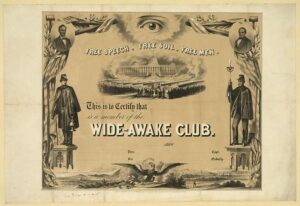
A black and white certificate of membership in the Wide Awake movement

Certificate of Wide Awake Membership
Gavit & Co., Printer. Free speech, free soil, free men. This is to certify that blank is a member of the blank Wide-awake Club. , 1860. [New York: Gavit & Co., 114 Broadway, New York] Photograph. https://www.loc.gov/item/2004665362/.

The Wide Awake movement was a militia-inspired movement which reflected the publics’ interest in militarism and aligned itself with Republican ideals. The members of the movement were mostly young men from non-aristocratic backgrounds. Though criticized by many politicians for their lack of political experience, the Wide Awakes remained very active and politically engaged, reflecting the growing interest of younger generations in U.S politics. While not inherently violent, the Wide Awakes were, as previously mentioned, sort of military “themed”. While the Wide-Awake movement began their activist efforts relatively tamely, focusing on safely escorting Republican candidates through the predominantly Democratic city of Hartford, Connecticut, they quickly changed course. The Wide Awakes organized marches in the late hours of the evening, disturbing the peace of the places in which they marched, and focused their efforts on battleground states and regions, where Democrats and Republicans held equal or mostly equal footing in terms of numbers of supporters. While not inherently violent, the militia-like organization of the Wide Awakes brought about discomfort and fear in many Southerners who feared that the Wide Awakes were a sort of dormant Northern army that could invade Southern states and/or become violent towards Southerners at any point. As historian Jon Grinspan argued in his article about the Wide Awakes, “Young Men for War, published in The Journal of American History, many Southerners viewed the Wide Awakes’ actions as “confirmation of their fears of northern coercion”, demonstrating that the actions of groups that aligned themselves with the Republican party were interpreted as somehow representative of the party’s true aims and goals and, further, that the story of the Wide Awakes “shows that campaign metaphors are not empty hoopla, but rather display the intimate relationship between citizens and their politics” (Jon Grinspan, “‘Young Men of War’: The Wide Awakes and Lincoln’s 1860 Presidential Campaign” (2009), The Journal of American History (Vol. 6, No.2)). In other words, despite no clear indication from Lincoln that he, representing the Northern states, planned to invade and commit violent acts in Southern states, the militaristic actions of Republican party supporters (the Wide Awakes) “spoke louder” than Lincoln’s words (or, perhaps, his silence), bringing about fears of “Northern Aggression” in Southern States which may have contributed to States’ decisions to secede after Lincoln’s election.


The story of the Wide Awakes and their role in convincing some Southerners, despite Lincoln’s lack of expressed intent to take any direct action to abolish slavery or interfere with slave states, that the Federal Government under President Abraham Lincoln would become increasingly aggressive and violent in their quest to abolish slavery and strip Southern states of their autonomy can teach us some important lessons about the dangers that accompany the use of fear-mongering and exaggerated radicalism as a sort of campaign tool used by opposing political candidates. While very different in terms of degree of consequence and conspiracy, the gap between the ideological panic that leads to baseless warnings like that which was seen in the January 9th edition of the Jackson Weekly Mississippian:


“Large bodies of Wide Awakes have been organized with a view to attempt the invasion of South Carolina under the sanction of the Federal flag” (Jon Grinspan, “‘Young Men of War’: The Wide Awakes and Lincoln’s 1860 Presidential Campaign” (2009), The Journal of American History (Vol. 6, No.2)).


And the sort of false rhetoric seen in Donald Trumps’ unfounded allegations of Biden’s alignment with organizations like Antifa, which would no doubt cause extreme alarm in Republican supporters and moderate Democrats, is one which we should be very careful to not bridge.


Works Cited

(In order of first appearance)


“Biden Walks a Cautious Line as He Opposes Defunding the Police” (June 8th 2020), The New York Times,


The Miller Center, “Abraham Lincoln: Campaigns and Elections”, Michael Burlingame


First Inaugural Address of Abraham Lincoln (March 4th, 1861), Yale Law School: The Avalon Project


An Oration in Memory of Abraham Lincoln (April 14th 1876), Frederick Douglass.


Britannica, United States History: Secession


South Carolina Declaration of Secession (1860), from the Constitution Center


Sally Heinzel, “‘To Protect the Rights of the White Race’: Illinois Republican Racial Politics in the 1860 Campaign and the Twenty-Second General Assembly”, Journal of the Illinois State Historical Society (Vol. 108, No. 3-4, Fall/Winter 2015)


Adam I.P Smith, “Chapter 3 Beyond the Realignment Synthesis: The Election of 1860 Reconsidered”, America at the Ballot Box: Elections and Political History (2015)


Jon Grinspan, “‘Young Men of War’: The Wide Awakes and Lincoln’s 1860 Presidential Campaign” (2009), The Journal of American History (Vol. 6, No.2)



Wide Awake or Woke? The Youth Vote in 1860 and 2024

For the Democratic party in the upcoming election, organizing movements and large swells of support have been the biggest signals of hope for Harris’ campaign. In fact, hope is a very appropriate word, as many have been comparing the Harris-Walz campaign’s major public support as reminiscent of the 2008 Obama campaign, and the iconic slogan that went with it: Hope. While this connection is strong (especially because it is a success story that the Harris campaign seeks to emulate), there exists another strong comparison, the election of 1860.

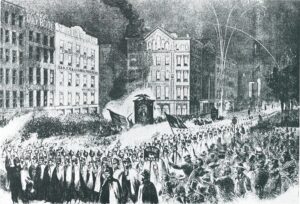
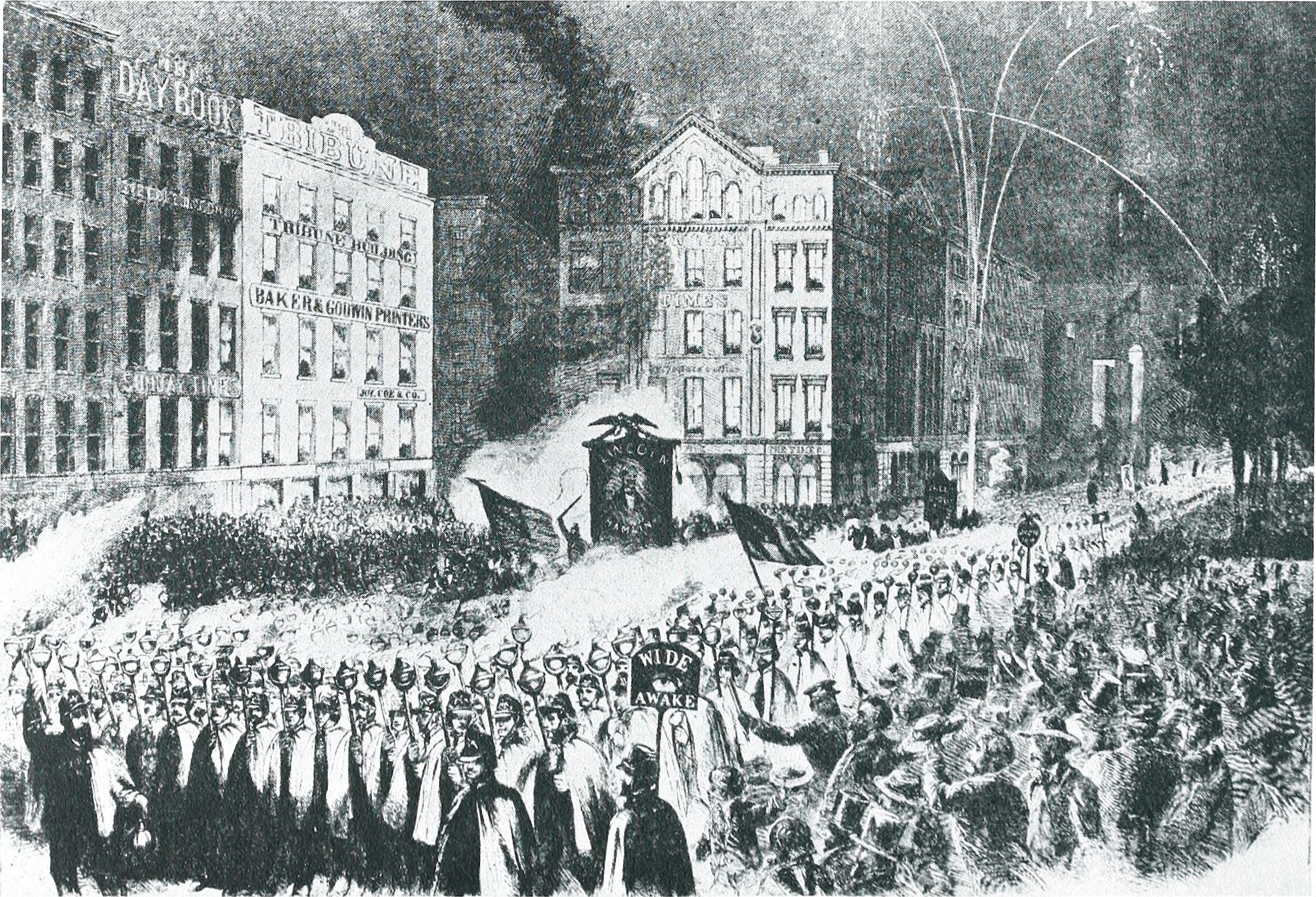
The election of 1860 (in the North) was between Abraham Lincoln, Republican, and Stephen Douglas, Democrat, who were (relatively) pro and anti slavery respectively. In the South the race was between John C. Breckenridge and John Bell. While there are a number of dynamics that make this election highly complicated, in this case the important thing is that Lincoln won the election (both a plurality of the national popular vote, and the required electoral vote majority) without being on the ballot in southern states. While his election precipitated the secession of most slave states, and the Civil War, the important part here is how Lincoln won. A major part of the Republican movement in 1860 was young voters, specifically the Wide Awakes. The wide awakes were a movement of mostly younger voters whose political involvement was a response to the highly partisan politics that preceded the election of 1860. The Wide Awake movement was one characterized by the ways they spread information (promotional materials, social events, even comics), and the militaristic way that they conducted themselves. They were not a movement built on hope (although they did have hope for the future), instead they were a movement built on resistance, as seen in their demonstrations. They marched in the streets wearing uniforms and carrying torches, acting almost as an army, there to resist the policies and aims of the Democratic party.

Wide awakes in uniforms carry torches in a march in Chicago.

Wide awakes in uniforms carry torches in a march in Chicago. Internet Archive Book Images Image from page 9 of “Abraham Lincoln’s political career through 1860” (1860), courtesy of Internet Archive Book Images.

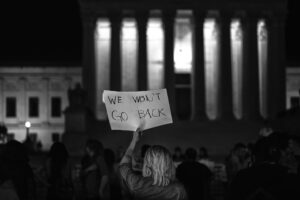
Compare this to the current Harris campaign. Harris is directing significant resources towards the youth vote, as evidenced through the campaigns focus on youth voters during National Voter Registration Day Additionally, the Harris campaign has been using popular methods of communication, similar to the Wide Awakes, to reach younger voters. Instead of cartoons, the Harris campaign has been using social media and memes as outreach, a strategy which (according to polling) has been paying off. While these mechanical similarities connect the Harris Campaign to the Wide Awakes, it is the attitude with which the youth vote is approaching the election. This attitude boils down to what has become the defining slogan of the Harris campaign: “We are not going back.” The slogan has existed in American politics for a long time, and can be seen to have been used in protests after the Supreme Court Dobbs decision, intrinsically linking the phrase to protest and discontent on the part of many voters. While this is not the same as the militarism of the Wide Awakes, it demonstrates that both 2024 and 1860 contained movements based on discontent, rather than hope like 2008.

A person holds up a sign reading “We won’t go back” on the day the Dobbs decision was leaked. Photo courtesy of Miki Jourdan, provided under CC BY-NC-ND 2.0

Why does 1860 matter as a comparison? It provides a foundation for understanding how a candidate can win support in a highly polarized election, and how important the discontent of younger generations can be in deciding an election where institutions (slavery and reproductive rights respectively) are at a turning point.  Will the “woke” reproduce the victory of the Wide Awakes?  Only time will tell.

A Guide to Voting in 1860 (and Helpful Tips for this November)

As the dozens of political texts, emails, and calls I receive daily keep reminding me, the election 2024 presidential election is just 45 days away! Are you registered to vote? Do you have a plan to vote early? Are you voting absentee? Do you know where your polling place is? Do you know what ID you must bring?

Voting is a deeply important way that we, as Americans, get to interact with our government. Please, if you are eligible to vote, make a plan. Vote early if possible! (If you live in Grinnell there will be early voting on Oct. 17 in the Joe Rosenfield ’25 Center from 9 a.m. – 3 p.m).

But this blog is for a history class and this week we are talking about the election of 1860. This is the election that directly preceded (and depending on who you ask, caused) the Civil War. This election is a big deal!

Do you know how you are voting in 1860? Well firstly, unless you are a man, good news—you don’t have to wait in line! Sure, it’s because you can’t vote, but the suffrage movement has only just begun. Further, Black men can only vote in Five states: Massachusetts, Rhode Island, Maine, Vermont, and New Hampshire. Additionally South Carolinians did not vote for president in 1860, as the Legislature still directly picked the state’s electors.

Let’s pretend you can vote though; what’s impacting your decision?

Here in 1860, slavery is at the front of many voters’ minds and there are four candidates. The first candidate, Lincon, is a Republican opposed to expanding slavery into new states and territories. Lincon’s former political rival for Illinois senate, Stephen Douglas, is the Democrat running on popular sovereignty, or the idea that each new state and territory should be allowed to decide if people should be able to legally own other people there. Douglas is, however, not the only Democrat running; John Breckinridge is running as the Southern Democratic candidate on a platform that is more pro-slavery than Douglas. Lastly, John Bell is running as the Constitutional Union candidate. Bell is anti-succession due to slavery, his platform is “the constitution”, and according to Michael Burlingame, his supporters would hand out bells for people to ring at rallies.

There is a lot of commotion in the lead up to the election. You probably saw or heard grassroots protests like the Wide Awakes—groups of young white (and a small number of Black) Republican men who marched through cities and towns with torches in support of Lincon. The Democrats have attempted to create a similar youth movement but have fallen flat. Historian Jon Grinspan argues that, while the Wide Awakes likely did not turn the election for Lincon, they did generate a great deal of youth momentum and enthusiasm for him, so while they probably did not convince you to vote for Lincon, maybe they made you more excited about him.

On November 6th, according to Grinspan, “Thousands of plain-clothed wide awakes policed the polls.” So maybe you gab with a Wide Awake friend before casting your vote for Lincon. Hopefully you remembered to live in a Northern state because Lincon is not on the ballot in the South. After you vote, your vote is read out loud in front of the small crowed gathered. Good job voting! Unfortunately, it seems like you won’t get a sticker.

In 1860 Lincon won the election. The civil war started soon after. Four years later, “In the middle of a devastating civil war,” Michael Burlingame writes, “the United States held its presidential election almost without discussion about any alternatives. No other democratic nation had ever conducted a national election during times of war.” After the election of 1860 we kept voting and slowly began to expand suffrage.

The election of 1860 was complicated and contested election. We don’t have to pretend to vote in this election. Suffrage, while still not universal, has been massively expanded, and yet turnout is down. In 1860 over 80% of eligible voters turned out. In the last presidential election, more Americans voted than ever before, and yet only 66% of eligible voters turned out.

I’m sorry to have to tell you this, but this year, if you are eligible, you must wait in the line, the 2024 election is deeply important. But hey, look on the bright side, now you get a sticker.

This November 5th Americans will once again vote for president. Unlike in 1860, all citizens over 18 can vote, your vote is private, and if you run into any trouble on election day, you can use your phone to call the election non-partisan Election Protection Hotline at 866-687-8683. Make a plan now, double check your voter status, and vote.


The Wide Awakes v. the Woke Mob: How Youth Political Organization is a Weapon & a Threat

By the election of 1860, political campaigning and organization had begun in earnest, although the candidates themselves rarely traveled like we see today. Abraham Lincoln received visitors at his home and relied on a network of political organizers to host rallies in his name, while Stephen Douglas, his opposition, made the unusual move of canvassing for himself. Republicans held speeches in German to appeal to immigrants and got abolitionists like Owen Lovejoy to embrace a more moderate platform to sway votes away from the Democrats, who retaliated by running racist cartoons and threatening secession if Lincoln won. But perhaps no campaigning efforts were to greater effect than demonstrations by the Wide Awakes.

“Who are these Wide Awakes?” you may be asking, and you wouldn’t be alone.

During one of the earliest marches of the Wide Awakes, a drunk New York politician observing them asked the very same question. The Wide Awakes were bands of young men, donned in military-esque costumes, who would march silently through the streets at midnight, stumping for Abraham Lincoln. Most interestingly about this grassroots organizing movement is that they emerged completely independently from the leadership of the Republican campaign, generating a thunderous yet virtually accidental wave of support for Lincoln.

What was so alluring about the Wide Awakes? They provided a fraternity space for the young men — not yet married or with children — to be active, social, and crucially, to feel their own power. The value of feeling like a part of something cannot be overstated; both the Trump and Harris campaigns have sought to cultivate this feeling, in different ways, in order to attract and retain voters to their base. At first glance, Donald Trump’s base may seem more akin to the Wide Awakes. After all, his supporters thrive on militarism, portrayals of masculine dominance, and feeling like a part of something, and this is to say nothing of the fascist militant groups like the Proud Boys that sprung up in his name. But his base did not emerge independently of his campaign — rather, the opposite is true.

The modern equivalent to the Wide Awakes is not a uniform, organized coalition, and their name was created not by their supporters, but by their opponents: the Woke Mob.

See, the unstoppable popularity of the Wide Awakes frightened the Democrats, who tried (and failed) to make their own alternative. The militarism, the mass organization, and in particular the youth support, signaling the changing views of a coming-of-age generation who could destabilize their traditional ideals, made the Wide Awakes a threat. The Democrats responded by belittling the Wide Awakes, attacking in particular their youth — calling them naive about the way politics works and condemning them as infant politicians, signifying the long-standing interrelation between age and political power that these young upstarts threatened to upend.

Compare this to the label of Woke today, which evokes the same kind of fear to modern Republicans that Wide Awakes did to pro-slavery Democrats. Woke is used primarily (although not exclusively) against young, politically active liberals and leftists who challenge the status quo and the modern Republican platform. A mob implies disorganization and violence, the kind of threats against themselves and their politics that Trump’s supporters fear. By decrying certain demographics of voters as weak, naive, or Woke, the supporters of such groups coalesce tighter together into more effective political machines. These aren’t machines in the traditional sense — there’s no central organizer and they aren’t an official collective — but whether it’s woke or weird, labels spread like wildfire.

It’s important to remember that there is no group of people known simply as the Wokes the way the Wide Awakes were named, but there doesn’t need to be: the term ‘Woke Mob’ is wielded against non-Republicans with the aim of creating a political out-group. Countless organizing groups such as Antifa and Black Lives Matter have sprung up under the umbrella of wokeness, the key difference being that it was a label applied to them, not one they chose like the Wide Awakes. Both Antifa and BLM have been branded militaristic — ironic coming from a party supported by white-supremesist militias. Trump has named his enemy; in doing so, he has made the threat they pose to him clear.

But if there is no group of people organizing as a collective Woke Mob, how can they be as effective as the Wide Awakes campaigning for Lincoln?

Remember that those most commonly accused of being woke are young leftists, who have grown increasingly aware of the power of their political voices. Youth political excitement about the presidential campaign had waned by the time Biden took office in 2020, and continued to wane well into 2024. But with the emergence of Kamala Harris, many voters feel represented, or at least like they have the opportunity to be heard, in a way neither the Trump nor Biden campaigns had offered. The majority of the young men involved in the Wide Awakes had come of age during a time of great political upheaval and unpredictability, and rather than be disillusioned, they pushed for a candidate they thought could steer them through the storm. A similar tactic is at play with young voters today — though none believe that one election will solve everything.

But the strength of young, woke voters coalescing behind the Harris campaign only matters if they’ve got something to advocate for, be it a candidate or a change in her policy, and a means by which to spread their views. For the Wide Awakes, it was the printing press. For the Harris campaign, it’s social media.

Newspapers printed details about Wide Awake marches, about local chapters, about stories from other states, drawing more and more young men into the fold. 20,000 Wide Awake uniforms were tailored by one of its founding members and shipped across the country, all in the name of fitting into an aesthetic of masculinity. Once again, there are parallels to Trump’s base, particularly in the form of his signature red hats and in the spread of alt-right rabbit holes. The kind of widespread sharing of information that the Wide Awakes capitalized on is no longer controlled by traditional newspapers; the Harris campaign is the first to use social media to all its advantages.

A crucial part of the Wide Awakes is how they functioned for a candidate but were not originated by the candidate. This mirrors the way young Democrats and leftists use social media to spread their political beliefs, often through capitalizing on trends, memes, and impersonations. Dozens, perhaps hundreds of accounts have sprung up impersonating Harris’s laugh, doing dance remixes of her speeches, or providing fact-checks against both her and Donald Trump. Even @kamalahq, her campaign’s Instagram account handle, was started by someone from her base, totally independent of her campaign leadership. It wasn’t until @kamalahq had a following that the Harris campaign took it over. These accounts simultaneously mock the candidate and endear their followers to her, gaining supporters by the thousands.

A common thread between the Wide Awakes of 1860 and those that are lambasted as the Woke Mob of today is that the energy, vigor, and political awareness of youth has been and continues to be drastically underestimated. From coming of age in a time of political upheaval, to being attacked as a threat and infantilized as a child, to the mediatization of campaigning  prior to the candidate or party’s knowledge, there are a multitude of parallels between the Wide Awakes and what Trump calls the Woke Mob. Decentralized political canvassing that demonstrates the power of the youth vote is a commanding tool — if it can be harnessed.


For further reading:

“‘Young Men for War’: The Wide Awakes and Lincoln’s 1860 Presidential Campaign” by Jon Grinspan, The Journal of American History, 2009, pg. 357-378, https://www.jstor.org/stable/25622297?seq=12

“‘To Protect the Rights of the White Race’: Illinois Republican Racial Politics in the 1860 Campaign and the Twenty-Second General Assembly” by Sally Heinzel, Journal of the Illinois State Historical Society, 1998, pg. 374-406, https://www.jstor.org/stable/10.5406/jillistathistsoc.108.3-4.0374

Youth Political Participation Now and Then


The election of 1860 was a four-way race between Republican Abraham Lincoln, Democrat Stephen Douglas, Southern Democrat John C. Breckinridge, and Constitutional Unionist John Bell. Douglas and Bell represented a more moderate center, and Lincoln and Breckinridge were at each end of the spectrum on slavery policy. Lincoln won the presidency with an overwhelming victory in the North and no support in the South—in many states he was not even on the ballot.

The election of 1860 and Abraham Lincoln’s candidacy galvanized the support of a new group of politically active voters: the Wide Awakes. The Wide Awakes were made up of young white men, particularly those in their teens, twenties, and thirties. Many of them (about a quarter) had not even been eligible to vote in the previous presidential election. These young men were new to politics and operated outside of the traditional campaign structures. They relied on a pseudo-military aesthetic, “popular social events, an ethos of competitive fraternity, and even promotional comic books,” according to Jon Grinspan in “‘Young Men for War’: The Wide Awakes and Lincoln’s 1860 Presidential Campaign” (p. 358).

In modern elections, the youth vote is an important and often elusive one. Before the 2022 midterm elections, there was a flurry of news coverage and political discourse about whether young voters were disaffected and disillusioned, as well as what could be done to engage them with the political and electoral process. A 2022 NPR poll found that only 14% of young voters planned to vote that November. A single month later found the same outlet reporting that young voter turnout was the second highest it had been for a midterm election in the past three decades.


The political engagement of young people is often alarming, unsettling, or even frightening to older voters and those with more power in the party systems or political elites. They often work outside of the traditional systems to garner support, and they sometimes have differing or more extreme values from older voters. However, the election of 1860 and more recent ones, including the 2022 midterms, show the influence of the youth vote in shaping the future of politics. The presence and impact of “wide awake” young people in the 2024 presidential election remains to be seen.

Sources

Jon Grinspan, “‘Young Men for War’: The Wide Awakes and Lincoln’s 1860 Presidential Campaign,” The Journal of American History 96, no. 2 (2009): 357–78, http://www.jstor.org/stable/25622297.

Michael Burlingame, “Abraham Lincoln: Campaigns and Elections,” University of Virginia Miller Center, https://millercenter.org/president/lincoln/campaigns-and-elections.

Image credits: https://www.flickr.com/photos/internetarchivebookimages/14594018200/

“Free Speech, Free Soil, Free Men”, courtesy of the Library of Congress https://loc.gov/pictures/resource/ppmsca.19788/

Youth involvement in politics is nothing new to us. It seems like at this point of time, especially in the context of the 2024 campaign for the presidential election, the amount of political organizations targeted for young people to join are endless. But when did these sorts of groups come about, and what can they tell us about radical groups today?

The earliest form of grassroots movements began during the election of 1860. The ‘Wide Awakes’ were a group of young men who supported Lincoln’s candidacy for president, and weren’t shy about their campaigning. The group used military tactics, including parading with instruments, in an effort to drum up support (pun intended) for Lincoln.

The impact of the Wide Awakes did not go unnoticed, and even inspired others in the opposing Democratic party to form similar organizations. In an attempt to drown out the noise being made by the Wide Awakes, supporters of the democratic candidate Stephen Douglas founded their own sorts of grassroots organization. Some of these included the Douglas Invisibles, the Bell Ringers, and the Chloroformers.

What set the Wide Awakes apart from these other groups though, is that they used a “military motif”. Such presentation of themselves made them a feared group, and one that seemingly advocated for violence.

Ultimately, their presence in the Lincoln-Douglas election was definitely a contributing factor in precipitating the American Civil War. In fact, Lincoln’s victory was directly correlated to the subsequent state secession. States simply could not accept the results of the election, which eventually lead to much violence. Sound familiar?

To this day, militant political organizations seem to thrive whilst carrying their military-grade weapons, this time semi-automatic rifles, to march in the name of a specific candidate. The most notable of these organizations is the Proud Boys. Now, while the Proud Boys are a militaristic organization similar to the Wide Awakes, I want to emphasize that they have evolved past the mere motif of militarism; the Proud Boys actively incite violence. In fact, the Anti-Defamation League labels the Proud Boys as “a right-wing extremist group with a violent agenda”, something they inevitably confirmed in January of 2021. Just recently in September of 2023, the leader of the Proud Boys was legally found responsible for playing a role in the insurrection and was sentenced to over twenty years in prison.

Seemingly similar to the 1860 election that resulted in the civil war, the Proud Boys incitement of violence at the capitol in 2021 was also over the election results. Several members of the group have been found guilty of storming the capitol while the electoral votes were being counted to confirm Joe Biden’s presidency. Regardless of political party affiliation, what happened on January 6, 2021 was a direct attack on the United States’ democracy.

Thinking about the insurrection in January of 2021 within the context of the 2024 election, I wonder how the Proud Boys and other militant organizations will react if Donald Trump loses the election again? How will violent groups become more organized as they have adapted and learned form the capitol riots? But ultimately, after studying the Wide Awakes’ promotion of violence during the 1860 election, I am left with my scariest question of all; are we headed for another civil war?

Sources

Grinspan, J. (2009). “Young Men for War”: The Wide Awakes and Lincoln’s 1860 Presidential Campaign. The Journal of American History, 96(2), 357–378. http://www.jstor.org/stable/25622297

U.S. Department of Justice. (2023, September 5). Proud Boys Leader Sentenced to 22 Years in Prison for Seditious Conspiracy and Other Charges Related to U.S. Capitol Breach”. Office of Public Affairs https://www.justice.gov/opa/pr/proud-boys-leader-sentenced-22-years-prison-seditious-conspiracy-and-other-charges-related


United States? More Like Divided States.

A picture is worth 1000 words.

The election of 1800 pulled the United States in both two and four directions, with the North and the South having their own polical race for the presidency. In the North the two candidates were Abraham Lincoln (Republican) and Stephen Arnold Douglas (Democrat) and in the South the two candidates were John Bell (Constitutional Union) and John Cabell Breckinridge (Southern Democrat).

This political cartoon entitled Dividing the National Map (author unknown) depicts all four candidates (from left to right: Abraham Lincoln, Stephen Douglas, John Breckinridge, and John Bell) vying for presidential control of the United States. This political cartoon was printed in Cincinnati, Ohio, a boarder state, which was in the Union. Eventually, the state of Ohio voted for Abraham Lincoln with 23 electoral votes. John Bell, standing on the ladder, is attempting to glue the country back together. The cartoon puts heavy emphasis on John Bell repairing the nation with a popular glue brand during the 1800’s, Spalding’s. John Bell was briefly secretary of war under William Henry Harrison until Harrison’s death and then resigned due to political tension within the Whig party. However, from 1846 to 1859 Bell was a Senator for Tennessee. John Bell opposed the expansion of slavery to the territories even though he was a slaveholder himself. I think that the addition of the popular glue brand signifies the fate of the United States rests in the hands of the American people. Being a Southern candidate, especially trying to gain support from the boarder states, I think that John Bell was trying to hold the country together while also supporting slavery. He was trying to garner support from the most vulnerable states who could either be pulled towards the North or the South. He originally opposed the secession of the Southern United States, however eventually ended up supporting the Confederacy. Basically, Bell was trying to pose himself as a popular candidate to the southerners that didn’t want to fracture the United States of America into the North and the South.

Photos and cartoons provide universal access to garner opinions on polical issues. This political cartoon allows a glimpse into the political campaigning of the 1860 election. However, today’s day and age we still have political cartoons. These political cartoons allow for expression of personal viewpoints. Even today political cartoons allow for expression of speech while also leaving some room for viewer interpretation. A similar political cartoon, posted in the Philadelphia Inquierer, was from the 2020 presidential election cycle but instead of a map of the United States it was the United States flag with Donald Trump tearing it apart and Joe Biden sewing it back together. The 2020 political cartoon and the 1860 cartoon express similar sentiments (although in 1860 it is four candidates and in 2020 it was two candidates) regarding tearing the country apart and then one candidate bringing it back together.

« Older posts Newer posts »
css.php
The views and opinions expressed on individual web pages are strictly those of their authors and are not official statements of Grinnell College. Copyright Statement.