Grinnell College Logo

Contested U.S. Presidential Elections (Fall 2024)

HIS 295, Professor Sarah J. Purcell

Page 4 of 10

The Supreme Court’s Crescendo of Control

America was built on the idea that one branch of the government should not have too much power. The Presidential election between George W. Bush and Al Gore showed that the Supreme Court has the ability to overstep that boundary. This election was so close and it depended on some debates in a few states, but Florida was the main focus. Florida was the difference between winning and losing for these candidates, and that showed when Al Gore planned to concede after he thought he lost Florida. After he found out reporting was incorrect he found this second wind, and Gore planned to fully fight for his chance to become President. 


As mentioned before, the Supreme Court had other ideas. In Florida, the difference between votes was so small that a recount was mandated by the Florida Election Code. The margin of error in this election was evident and something so minuscule like problems with the physical ballot completely changed the results of the election. This ballot was later coined the butterfly ballot and the victor from this scandal was George W. Bush through the proxy of Pat Buchanan. The ballot was set up so that each candidate was on either side of the ticket with the place to punch a hole in the middle. The Democrats naively agreed to this format which ended up costing them the election. Another one of their mistakes was the emphasis they put on the need to recount in certain counties that would favor them. They did this for practicality’s sake and to speed the process up, but the Supreme Court would make their decision based on similar principles. 


The Supreme Court stepped in and decided that the Florida Supreme Court was handling the recount improperly. The Supreme Court said that the ballots were not treated the same under the equal protection clause from the 14th Amendment. Since the Gore camp picked specific counties and the Florida Supreme Court allowed differential interpretations of undervotes, the Supreme Court said this recount was unconstitutional. It was still evident that there was something wrong and the results were unclear, but the court did nothing to facilitate a fair and full recount because they didn’t find it practical. The time concerns of the election were certainly on the minds of the justices just like in 1876 when a winner wasn’t decided until the last moment. It seemed that in this scenario the court decided this election because they didn’t want the uncertainty to continue. The Supreme Court’s decision to overrule democracy and determine the winner in the executive branch during the 21st century was an important signifier of the shift of power in this country.  

Y2K, Not Just a New Century, a New Political World

This week I watched the vice-presidential debate between JD Vance and Tim Walz. On social media, many called it the first “normal” debate or something similar. What does “back to normal” mean? 2012 and 2008 had fairly  “normal” elections, in terms of debates, media coverage, and civility. So what I think most people think when they mention “normality”, are the days before the super polarization that we see today. 

The place where this new “not normal” began is in 2000. Coming into that election, the Democrats hoped to extend their stay in the White House after eight years of Bill Clinton. The obvious choice to succeed him was his V.P., Al Gore. Running against Gore was the son of the man Clinton defeated in 92’, George W. Bush, governor of Texas. That night was probably the most climatic night in American history as no one knew what was going on. All eyes were on the Sunshine State of Florida. One moment it looked like Bush would win, but then the media rescinded their call of Florida for the Republicans and Gore his concession. What followed was an extensive legal and media fight over the recounting of ballots in Florida, which became one of the most controversial decisions issued by the Supreme Court. In a 5-4 ruling, the Supreme Court stopped the recount, stating that the recounting went against the equal protection clause of the 14th Amendment and Bush would be the 42nd president.

I’m not proposing the thesis that the 2000 presidential election of Bush v. Gore, and the subsequent court fight, is the reason the United States is the way it is today. If you talked to anyone who was alive before 2000, they would likely attest that without the internet and 24-hour news coverage, there was still polarization on public issues, albeit on a smaller or less intense scale. This is probably best demonstrated by Newt Gingrich, who led the impeachment of President Bill Clinton. The 2000 election can be seen, in my view, as a marker on the map of American political history, a fracture in the fabric of our political atmosphere. 2000 was not a complete change but a beginning of a new chapter in American politics.

What changed from the 1990s to today? Well, first there is less bipartisanship among the average voters. From 2020, the Washington Post reported a decrease in ticket-splitting in House races. This is when voters vote for multiple parties on the same ballot such as voting for Harris for President and a Republican for Senate or the House, “… only 16 House districts saw split results in 2020 — 10 fewer than split their vote in 2012, the year with the next-fewest such districts.” (Bump, 2021) This pattern is not contained to the House. If we look at the current make-up of the Senate compared to the Congress that was in session 1999-2001, the one that served just prior to the 2000 presidential election, we saw nineteen states in which there was a member from both the Republican and Democratic parties compared to the current Congress which only has 4. This is a trend that looks to decrease next month when Democrats might lose seats in West Virginia and Montana, leaving only two states with both parties represented in the Senate. On the national level, elections have become closer, which is not surprising to most, but from 1948 to 2000 the average national popular vote margin between the Democratic and Republican candidates was 9.915% but from 2000 to 2020 that margin has shrunk to only 3.375%. To be fair, 1992 and 1996 would probably have been closer if it were not for third-party candidate Ross Perot. In the media, this is demonstrated by the concept of red for Republicans and blue for Democrats because of its use in the overwhelming amount of media coverage in 2000. Before that election, it “wasn’t cemented on the national psyche until the year 2000.” (Enda, 2013). If the 2000 presidential election tells us anything based on this information, there was definitely something or multiple variables that changed our political world in the 1990s and the 2000s that we should not overlook today.


References:

Bump, P. (2021, February 19). 2020 saw the least split-ticket House voting in decades. Washington Post. Retrieved from https://www.washingtonpost.com

Bush v. Gore | Miller Center. (2020). Miller Center. Retrieved from https://millercenter.org/contested-presidential-elections/bush-v-gore

Enda, J. (2013, November 17). When Republicans were blue and Democrats were red. Smithsonian Magazine. Retrieved from https://www.smithsonianmag.com

Members of the U.S. Congress. (n.d.). Retrieved from https://www.congress.gov/members

Presidential Election Margin of Victory | The American Presidency Project. (n.d.). Retrieved from https://www.presidency.ucsb.edu/statistics/data/presidential-election-mandates


What was the Brooks Brothers riot and why does it matter 24 years later?

24 years ago, 2 weeks after the aftermath of the 2000 presidential election, a swarm of mostly middle-aged white Republican men staged a protest at a meeting of election workers in Miami-Dade County, Florida. They were led by Republican staffers. Their intention was to shut down the ongoing recount of ballots. They were successful; the recount was stopped early and, eventually, the Supreme Court would decide in Bush’s favor. The protest would later become known as the Brooks Brothers Riot, referencing the business clothing that most protesters were dressed in. 

I chose to write about this event because as a 21 years old self-proclaimed political-junkie, I had not heard about the Brooks Brothers Riot until this class. In the aftermath of the January 6th insurrection, the Brooks Brothers riot can almost be seen as foreshadowing the more violent protests that would come two-decades later.

In researching the Brooks Brothers riot, I found a ominous piece in the Guardian forewarning about the dangers that could follow the 2020 election. This article discusses how preemptive warnings about the election “being stolen” or “voter fraud” from Donald Trump in 2020 was creating a “vigilante far-right” army. This phenomenon feels just as, if not more, present in 2024. Political violence is also seemingly on the rise, with two assassination attempts on Donald Trump since July.

In comparing the Brooks Brothers riot and the January 6th insurrection, there is an apparent difference on the level of government targeted. While the January 6th insurrection targeted then Vice President Mike Pence and Congress, the Brooks Brothers rioters targeted a local election authority. Such localized riots present a distinct type of threat to democracy. 

While the defense against the January 6th rioters was insufficient (resulting in the death of multiple police officers in the immediate aftermath of the attack) local election entities are likely even more defenseless. As the election narrative intensifies and focuses on a handful of swing states, local authorities should take caution and secure election processes wherever possible.

Fake News

Bush Country, 2000

In just over the hundred years that had passed after the 1876 contested election between Rutherford B. Hayes and Samuel J. Tilden, there wasn’t really any other contested elections that could match that scale, that is, until the turn of the twenty-first century. 


The election of 2000 is one that most people remember as an incredibly close race between Republican George W. Bush and Democrat Al Gore. There were concessions made, taken back, and ballots recounted, leaving the overall general American public just really confused as to who had emerged victorious in the 2000 presidential election. 

What added to this confusion was the people putting out the information to the American people: the news. While Americans waited with bated breath to hear what the remaining state Florida’s votes look like, one news source broke the story that Bush had won. 

Other news channels followed suit, only to ultimately take this back because Florida ended up being too close to call. Since news channels had being using different systems to count the votes, their information was contradictory. So where does that leave us in 2024 with already partisan and conflicting news sources? 

In the 2024 election between President Donald Trump and Vice President Kamala Harris, there have already been tensions over news media. When determining what news network the second presidential debate should be on, Trump argued that he would not participate unless the debate was held on Fox News

Parties aren’t just splitting people apart anymore, they’re splitting the news we receive as well. News audiences have to comb through the information they receive, weeding out the ‘fake’ from the real.

With media contesting elections like we saw the 2000 election, how will we know what to believe in the predictably contested 2024 presidential election? Further, having gone over a hundred years without a contested election, does evolving and ever-present media mean we have to prepare for contested elections to become the norm for American democracy?


There Has to Be a Better Way: The Role of the Court in Contested Elections

One of the biggest avenues for a challenge to the upcoming 2024 election is looking like the courts, specifically the Supreme Court. Many important decisions for the 2024 election have already been put before the court, for example the case removing Donald Trump from the ballot in Colorado. Additionally, the 2020 election included a number of judicial challenges, and while they were not the biggest thing the public likely remembers as deciding the election, they did play a significant role in preparing for 2024. But neither of these tell why the Court could have the absolute final word on the election and why that may be a scary concept today. For that one must look (as many in the media are) at the election of 2000, and Bush v. Gore, the Supreme Court case which decided the election in favor of George W. Bush in a contentious 5-4 decision.

The 2000 election took the (mostly) unprecedented step of giving the Supreme Court the final word on the electoral process. While members of the Court had previously had influence in settling contested elections (justices were on the deciding commission in 1876), this was the first time that the institution was involved directly. While the court attempted to decide Bush v. Gore without establishing legal precedent, they may not have been successful, and definitely did establish a (non-official) procedural precedent. This means that if there is to be challenge to the upcoming election, it is likely to land before the Supreme Court. On its face this seems like a reasonable venue of decision, as the role of the court is to police the boundaries and settle disputes between branches of government as an impartial body. But there are two points that challenge the conclusion.

The first is that most electoral challenges, such as those involving electoral votes, have their conflict resolution based in the legislative branch, and not the judiciary. This does not cover every possibility, and as such it likely makes sense that the court has jurisdiction, although the court may resent that fact, as they do in the Bush v. Gore opinion.

The second, and much larger issue, is that the court’s legitimacy (as derived from the public) could be very shaky in the upcoming election. In theory the Supreme Court is an impartial legal body without political allegiances, but many worry that this is not reality. Take, for example, the fact that 3/9 justices are Trump appointees, and 6/9 justices were appointed by Trump or either Bush. The theory states that this should not matter, and that the lifetime justices will be impartial in these decisions. This concept may not have held in 2000.   All 5 of the Justices in the majority were appointed by a conservative president, which could indicate decisions based on ideology. While it is possible that the current justices will act impartially, it is even more of an open question, as the recent abandonment of different precedents has many in the public fearing that a so-called “activist court” could be anything but impartial.

While the concerns over impartiality are both real and important, the more pragmatic question is if not the Supreme Court then who? For challenges to the election that are not required to be resolved in Congress, what better avenue is there to settle contested elections? There is no other avenue that is as compelling or robust as the Supreme Court, and as such, one must put their faith in the design of the electoral system and the principles of impartiality in the Court, and hope it works out.

Oops!… the Election is Contested Again

The election of 2000 showed for the first time in over a century that US presidential elections were not the pillars of stability they had been perceived of in the 20th century but instead, messy, contentious things ripe with strife and ambiguity. What’s more, the election of 2000 proved even more contentious with the fact that for the first time since the automobile was invented, the popular vote and the electoral vote went in different ways, meaning the candite who eventually sat in the White House during the term, a very chaotic and dramatic time in American History, was not the leader the majority of the country had wanted. It is the ways that the response to contentious elections differs after 100 years that might provide insight into the current election, one almost guaranteed to be contentious.


There are two main ways in which contested elections are responded to. There are the processes of justice, those inner state functions that attempt to make sense of the conflicting results and come to a central conclusion so a president can be inaugurated by January. Then there is the court of public opinion, a much less impartial but still important part in shaping the results of contested elections. Ultimately, power resides where the people think it does, and so the perception of an election being fair is vastly important for the health of democracy.


In terms of the process of adjudication within the government itself, there is a shift in who the responsibility falls to in resolving contested elections. In 1800, 1824, and 1876, it was Congress who took the burden. Whether it was with a corrupt bargain or a secret congress committee, it was the legislative branch that ultimately decided the president when the vote was unclear. In 2000, however, it was the judicial branch that had the responsibility to resolve the issue. Through a series of local and supreme court cases, the recount of Florida, something that, if fully done, would have, in all likelihood, changed the results of the election, was suppressed. So, while these judges did not directly pick the president like Congress in past elections, they did so indirectly with their rulings.


The media and lay perception of the elections have also shifted between the last contested election in 1876 and 2000. The shift from local print media to national television journalism marked a huge shift in how elections were portrayed and consumed by the public. This is not an idol change; the media, in calling the election early for Bush and in their dramatization and flawed coverage of the recount, made the internal and frankly boring process of something as simple as a recount a widely watched and partisan thing. Since then, the rise of the internet has democratized information, meaning anyone with a phone and a mouth can spread information, be it accurate or not. While this is by no means a universally bad thing, it did lead to the disinformation and radical extremism that caused the January 6th insurrection, when misinformation caused the perception that the election was contested despite it being rather clear.


What can be learned from the shifting patterns of how contentious elections are decided and covered will be useful in the likely contentious 2024 election. Ultimately, it will more than likely come down to the courts to decide the election, and the media, now digital and widespread spread, will without a doubt also make those inner workings very public and provide countless opinions on the results. Despite the tone of this blog, this shift towards judicial decisions and media transparency might not be a great evil. In fact, it is a more democratic system than the election being decided in backroom deals by corrupt congressmen. It is messy and headache-enduing, but that is pretty par for the course for American politics. 

How Election Night Reporting Changed Perceptions of Election Result Legitimacy in the 2000 U.S. Presidential Election


A 2020 study from the Voting Rights Lab reported that 52% of respondents expect an election winner to be announced within three days of the election, and that results announced a week or more after the election would cause the majority of those polled to question the legitimacy of said results (Voting Rights Lab (2020); accessed from: Bergeron-Boutin et al., MIT Election Lab (2020)). In their search for a quick relaying of election results, the American people often turn to the mainstream media (e.g. CNN, CBS, ABC, FOX) and election night reporting which broadcasts results that are, as many politicians and members of the media are quick to tell you, are always unofficial projections and not necessarily representative of what the result will be after all of the votes are counted (Bipartisan Policy Center (2024)). While the media’s reporting of election results is not inherently misleading, issues can arise when those reported results are misunderstood as being more final and less unofficial than they really are; and these sorts of misunderstandings are not uncommon, with a survey conducted by the Pew Research Center in 2020 revealing that only 44% of the Americans polled were fully aware that the media projects the winner of each state when “they [the media] feel confident based on vote returns and other information” as opposed to projecting the winner when state officials have certified the results or when a specified critical percentage of votes in that state have been counted (Mitchell et al., Pew Research Center (2020)).


If you are thinking: “hm, I feel like expectations for quick election results could interfere with co-existing expectations for these quickly reported results to be accurate”, you are right.

In fact, the contestation of the U.S. Presidential Election of 2000 – an election that Thomas Mann, former Senior Fellow in Governance Studies at the Brooking Institution, a political research organization, described as an election that “no work of fiction could have possibly captured the extraordinary twists and turns [of]” (Thomas E. Mann, Brookings Institution (2001))– began, in many ways, with the overzealous and unverified reporting of Election Day results (David Folkenflik, National Public Radio Website (2020)).


Polls conducted in the lead up to the 2000 U.S. Presidential election indicated that the race would be exceptionally close, a side effect of many different factors: including the perceived differences in levels of charisma in the two major party candidates (the Vice President at the time, Al Gore, as the Democratic party’s candidate, and the then Governor of Texas George Bush as the Republican party’s candidate); the recent impeachment scandal in the Clinton administration and George W. Bush’s newly publicized DUI charges (Gary L. Gregg II, The University of Virginia Miller Center); and a general shift in both parties towards a less divisive and more moderate middle ground, which made it more likely that the division of votes in the 2000 election would sway away from the historical voting patterns of individual voters and state electorates. The confluence of these factors and more made it so the presidential race, in certain states, – Florida, for example, which would become the primary arena for the contestation of the election results – was exceptionally close and, therefore, more prone to being swayed by the miscounting of votes, issues with certain ballots, and the, albeit, small number of votes cast for third party candidates Ralph Nader and Pat Buchanan (Gerald M. Pomper, Political Science Quarterly (2001)).


Given the inconclusive results from pre-election day polls, it did not come as a surprise that the phrase “too close to call” was a common refrain heard during Election Day (Tuesday November 7th, 2000) broadcasts across the major news networks. But around 8 PM, the major networks, based on information from the Voters News Service (VNS) which was itself based on exit polls at polling places, reported a critical number of electoral votes (25) for Al Gore (Democrat) from the then un-declared state of Florida–-suggesting that a decisive conclusion to these indecisive election results was in sight. However, at around 9:31, members of George Bush’s (Republican) campaign, believing that the remaining votes that were still to be counted in Florida would cause the state to “flip” and be declared for Bush instead of Gore, implored Bush to publicly dispute the 8:00 PM declaration of Florida for Gore. Ostensibly in response to the claims made by Bush and his campaign, the networks that had originally called Florida for Al Gore retracted their previous statements and re-declared Florida as being “too close to call”. At around 2:30 AM on Wednesday November 8th, 2000, after receiving results from other states as well as updated results based on the 96% of votes that had been counted in Florida, the major networks declared the state of Florida and, with it, the Presidential Election for George Bush. Believing that the media reports were true, Al Gore almost immediately called Bush to concede and congratulate him on his win–a “sportsmanlike” move that, after being reported by the media the next day, proved to have important impacts on many people’s perceptions of the election results and the legitimacy of the later contestation of them. As Gore was on his way to publicly concede, more votes from Florida were counted, which diminished George Bush’s lead in the state by a critical margin, pushed the Florida results into the realm of uncertainty, and paved the way for contestation of the final election results (CNN “Bush v. Gore: ‘Too Close to Call'”, (2015); Chronology: November 7th- December 18th 2001 from “Bush v. Gore: The Court Cases and the Commentary on JSTOR” (2001), E.J Dionne and William Kristol  ).


In the aftermath of these confusing, shifting, and indecisive media reports in the early hours of November 8th, the United States witnessed an unprecedented, contested election with great historical significance. While the media obviously had no direct role in deciding the final results of the election– which ended up being the product of a highly controversial Supreme Court Decision in which Gore’s requested recount of votes in Florida was halted, allowing George Bush to officially be declared as the winner of the 2000 Presidential Election (“Bush v. Gore: The Court Cases and the Commentary on JSTOR” (2001), E.J Dionne and William Kristol )— the confusion caused by their premature, unofficial declaration that Bush had won the election influenced many people’s perceptions of Al Gore, as it caused them to believe that Gore’s calls for a recounting of votes in Florida were the illegitimate attempts of a “sore-loser” to challenge Bush’s legitimate election win; a perception which, as proven by the willingness of the Florida State Legislature to recount votes as well as beliefs about the “true” results of the election held by both Republican and Democrat politicians involved in the election (CNN “Bush v. Gore: ‘Too Close to Call'”, (2015)), is largely if not wholly inaccurate (U.S. Congressional Hearing: Election Night Coverage By The Networks in 2000 (2001)).


Since the 2000 Election, the mainstream media has taken considerable action to prevent what happened on November 7th and 8th (2000) from happening again (U.S. Congressional Hearing: Election Night Coverage By The Networks in 2000 (2001)), but the race to be the first network to call the election continues to influence how these major news networks go about their Election Night Reporting (Daniel Okrent, The Brennan Center (2020)). While there are many, arguably more important, lessons to be learned from the 2000 Presidential Election that extend far beyond issues involving media coverage and how election results are reported (i.e. regarding the popular vote vs. the electoral college vote; voter disenfranchisement; discriminatory voting practices; and the scope of the Supreme Court’s power), it is important to, as we approach the 2024 Election, be reminded of the true unofficial nature of, what is, for many, the first election results that they hear.


Sources


(in order of first appearance)


Voting Rights Lab (2020)


Bergeron-Boutin et al., MIT Election Lab (2020)


Bipartisan Policy Center (2024)


Mitchell et al., Pew Research Center (2020)


Thomas E. Mann, Brookings Institution (2001)


David Folkenflik, National Public Radio Website (2020)


Gary L. Gregg II, The University of Virginia Miller Center


Gerald M. Pomper, Political Science Quarterly (2001)


CNN “Bush v. Gore: ‘Too Close to Call'”, (2015)


Chronology: November 7th- December 18th 2001 from “Bush v. Gore: The Court Cases and the Commentary on JSTOR” (2001), E.J Dionne and William Kristol  


U.S. Congressional Hearing: Election Night Coverage By The Networks in 2000 (2001)


Daniel Okrent, The Brennan Center (2020)

The Election of 2000: An entanglement of Politics, the Courts and The Media

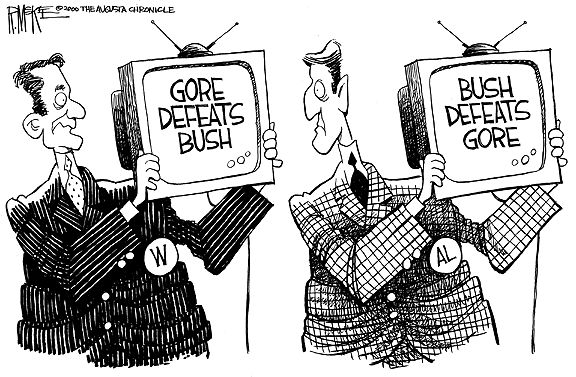
Was the year 2000 a starting point and are we living in the effects of the process of that election? Political cartoons surrounding the actions of the United States Government, and its elected officials are not a new phenomenon. However, cartoonists had a field day with the 2000 election and the back and forth of the media stating who was the winner. Two cartoonists, Cam Cardow of The Ottawa Citizen and Rick McKee of The Augusta Chronicle showed the back and forth of the declaration of the winner of the United States Presidential Election. Cam Cardow’s comic shows, on a print newspaper, Bush and Gore crossed out alternating multiple times with Win at the bottom. The repetition of the Bush and Gore crossed out shows how the media, incorrectly, stated who won the election over and over again. Rick McKee’s cartoon also gets at the same aspect of confusion with two gentlemen (Al Gore and George W. Bush) each holding a television stating that they had lost the election. You can see how confused not only the politicians, but the American people were regarding who would be their next president. These political cartoons help us to further process the events of the election of 2000.

The election of 2000 between Democratic candidate Al Gore and Republican candidate George W. Bush proved to be a media battle, political battle, and judicial battle. As the results came in all eyes turned to Florida it is important to understand the timeline of election night, and next day.

  • 8pm EST: CNN, NBC, FOX, CBS, and ABC, among other networks, based on exit polling, stated that Al Gore had won Florida.
  • 10 p.m. EST: the statement that Al Gore won Florida was retracted.
  • 2:30 a.m. EST: Networks declared George W. Bush the winner of Florida.
  • 4:30 a.m EST: Networks retracted the statement that George W. Bush won Florida.

Somewhere on the night of Tuesday, November 7, 2000, Al Gore conceded the election but later withdrew the concession.

Under Florida statute “because the margin of victory was equal to or less than one-half of one percent of the votes cast, an automatic machine recount occurred” (Supreme Court of the United States, No. 00-836). Then Vice President Al Gore submitted a written request for a manual recount of votes in the Florida counties, Volusia, Palm Beach, Broward, and Miami-Dade. This spiraled because the legislature of Florida did not have a standard protocol for the vote recount. Each county was recounting the ballots slightly differently with undervotes where the machine was not able to fully count the vote. However, the Supreme Court of the United States eventually stepped in and stopped the recount in Florida and declared George W. Bush the 43rd president of the United States. The key aspect which differed the 2000 election from the 2020 election was that both candidates publicly, respectfully accepted the results of the election. This was a key aspect in keeping those who voted for the loosing candidate, Al Gore, who were disappointed at the outcome of the election.

In the 2020 election we also saw recounts, however this time the media focused on Georgia. In the political cartoon by Phil Hands of the Tribune Content Agency you see two election officials presenting Donald Trump with the results of the election and recount. However, this drastically contrasted the 2000 election here the losing candidate, Donald J. Trump, refused to accept his lost (in the cartoon you can see him throwing a hissy fit holding lawsuit papers) which his denial has stretched into 2024. Furthermore you can see political cartoons stating that the 2020 election is the Bush v Gore sequel (Bill Bramhall of the Tribune Content Agency).

With all of this information one question remains: how will cartoonists capture the 2024 election?

Accepting Defeat: What would have happened if Al Gore had responded to the Election of 2000 like Donald Trump responded to the Election of 2020?

The 2000 Election between Al Gore and George HW Bush was the first election to be contested in over 100 years, but it wasn’t the last. Twenty years later, in 2020, Donald Trump claimed that the election was stolen and disputed the outcome. Despite both disputing the immediate election outcomes, Al Gore and Donald Trump had vastly different reactions to their eventual loss and the proceedings between election day and inauguration.

Many issues complicated the election of 2000, but in the end, it all came down to issues in Florida. There were plenty of issues with Florida, but there are three that stick out. First, issues with the ballots lead to inaccurate counting of votes and voter confusion. Second, conflicts of interest with election officials, including the Florida Secretary of State. Finally, premature reporting of election night results from the press. All of these problems led to a recount in Florida, which was complicated by a lack of regulation regarding how to determine voter intent. It is also worth noting that the Florida Secretary of State was Jeb Bush, the brother of HW Bush.

On election night, the press first said Gore won, then they backtracked and said it was too close to call, then they said Bush won, and finally they again said it was too close to call. Gore was minutes away from conceding the election, but his concession speech was narrowly intercepted and the long process of recounts began.

Trump had less grounds to contest the election, but both Trump in 2020 and Gore in 2000 suggested that the election was inaccurate due to issues with voting machines. After the 2020 election, Trump allies claimed that Dominion voting machines were faulty, but in 2023 this claim was proven false. In 2000 the ballots in Florida were voted by punching a piece of paper out to represent your vote, unfortunately, some of the paper bits ‘chads’ did not fully punch out as a result leading to those votes not being counted. The ballots were also designed in a confusing layout that could easily confuse voters.

Just as Gore was a sitting Vice President at the time of the 2000 election, Trump was a sitting President, but Gore did not use his power as Trump did. Following the Supreme Court’s ruling on the election of 2000, Gore gave a concession speech, thanked his supporters, and peacefully transferred power. Trump on the other hand never gave a concession speech, rallied his supporters, and incited an insurrection.

It is also important to look at what Trump and Gore are doing now. Trump is running for president for the third time, this time with a new running mate after his former Vice President, Mike Pence, refused to endorse him. Al Gore on the other hand has not run for office since 2000, advocates for climate-smart policy making, and spends most of his time on his regenerative farm in rural Tennessee.

Should Al Gore have reacted more like Donald Trump? Personally, I think his reaction was to be expected, and acted in a way that preserved the electoral process. Gore expressed disappointment in the final rulings on his election, but he never did anything to go above the law. If Gore had thrown a fit and rallied his supporters, he likely still would not have won, but he may have divided the nation and contributed to growing political division.

If there is one thing any future presidential candidate can learn from both Gore and Trump it is to stand up for yourself but never forget that no matter who you are, you are never above the law.

2000 Was Unfair, and Not for the Reason You’re Thinking of

How do you count ballots? Do they count if the machine doesn’t fully remove the hole? Do they count if a voter originally marked the wrong spot and then marked another, leaving two bullets filled? Which count of the votes is the final one? Do concessions have legal weight? Questions like these are widely believed to be those that determined the presidential election in 2000, and have as such gotten plentiful heartfelt discussion.

However, there is one other key factor that impacted the result of the election in the pivotal state of Florida which gets far too little discussion: ‘countless’ people turned away at the polls and wrongfully removed from the voter registration rolls. There is also reason to believe that those impacted were disproportionately voters of color, making this a civil rights problem of multiple levels, with both the right of people to vote and the right of people to be free from discrimination on the basis of race being infringed upon. Testimonies from poll workers and anecdotal stories from voters confirm both of these occurrences, as well as telling a story of polling places that were not even open for the whole legally established period for voting. Numbers also reflect voter disenfranchisement that disproportionately impacted Black voters, with them being more than ten times as likely to have their ballots rejected, even when controlling for the differences in county voter systems. The difference between rejection rates for Black voters compared to others means there were nearly ninety thousand excess rejected ballots from Black voters, beyond what should be expected, indicating a possible violation of the Voting Rights Act. In an election decided by 537 votes in the state, a state whose result determined the president, if the rejections of even one in every hundred of these ballots were illegal or misplaced that could have changed the result of the election, and as such the course of American history.

Throughout this country’s history, suppression of the voices of minority groups has been an enduring sin. In 2000, this was still the case. Even in the modern day, we as a society must make every effort possible to ensure we do not repeat these same moral failings, we must work to ensure that everyone has an equal right to vote regardless of race. 2000 acts as a reminder that this is not a given and that during the lifetimes of every single member of our nation’s Congress, these rights have been impaired. 

« Older posts Newer posts »
css.php
The views and opinions expressed on individual web pages are strictly those of their authors and are not official statements of Grinnell College. Copyright Statement.