
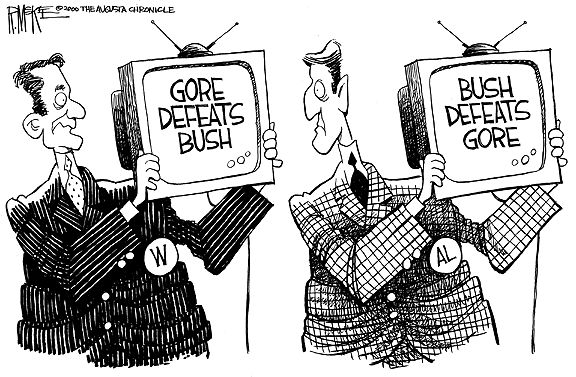
Was the year 2000 a starting point and are we living in the effects of the process of that election? Political cartoons surrounding the actions of the United States Government, and its elected officials are not a new phenomenon. However, cartoonists had a field day with the 2000 election and the back and forth of the media stating who was the winner. Two cartoonists, Cam Cardow of The Ottawa Citizen and Rick McKee of The Augusta Chronicle showed the back and forth of the declaration of the winner of the United States Presidential Election. Cam Cardow’s comic shows, on a print newspaper, Bush and Gore crossed out alternating multiple times with Win at the bottom. The repetition of the Bush and Gore crossed out shows how the media, incorrectly, stated who won the election over and over again. Rick McKee’s cartoon also gets at the same aspect of confusion with two gentlemen (Al Gore and George W. Bush) each holding a television stating that they had lost the election. You can see how confused not only the politicians, but the American people were regarding who would be their next president. These political cartoons help us to further process the events of the election of 2000.
The election of 2000 between Democratic candidate Al Gore and Republican candidate George W. Bush proved to be a media battle, political battle, and judicial battle. As the results came in all eyes turned to Florida it is important to understand the timeline of election night, and next day.
- 8pm EST: CNN, NBC, FOX, CBS, and ABC, among other networks, based on exit polling, stated that Al Gore had won Florida.
- 10 p.m. EST: the statement that Al Gore won Florida was retracted.
- 2:30 a.m. EST: Networks declared George W. Bush the winner of Florida.
- 4:30 a.m EST: Networks retracted the statement that George W. Bush won Florida.
Somewhere on the night of Tuesday, November 7, 2000, Al Gore conceded the election but later withdrew the concession.
Under Florida statute “because the margin of victory was equal to or less than one-half of one percent of the votes cast, an automatic machine recount occurred” (Supreme Court of the United States, No. 00-836). Then Vice President Al Gore submitted a written request for a manual recount of votes in the Florida counties, Volusia, Palm Beach, Broward, and Miami-Dade. This spiraled because the legislature of Florida did not have a standard protocol for the vote recount. Each county was recounting the ballots slightly differently with undervotes where the machine was not able to fully count the vote. However, the Supreme Court of the United States eventually stepped in and stopped the recount in Florida and declared George W. Bush the 43rd president of the United States. The key aspect which differed the 2000 election from the 2020 election was that both candidates publicly, respectfully accepted the results of the election. This was a key aspect in keeping those who voted for the loosing candidate, Al Gore, who were disappointed at the outcome of the election.
In the 2020 election we also saw recounts, however this time the media focused on Georgia. In the political cartoon by Phil Hands of the Tribune Content Agency you see two election officials presenting Donald Trump with the results of the election and recount. However, this drastically contrasted the 2000 election here the losing candidate, Donald J. Trump, refused to accept his lost (in the cartoon you can see him throwing a hissy fit holding lawsuit papers) which his denial has stretched into 2024. Furthermore you can see political cartoons stating that the 2020 election is the Bush v Gore sequel (Bill Bramhall of the Tribune Content Agency).
With all of this information one question remains: how will cartoonists capture the 2024 election?




Leave a Reply
You must be logged in to post a comment.