
Grinnell College Logo

HIS 295, Professor Sarah J. Purcell

Author: instantclamour

Trump Portrays Himself as a Strongman. At What Cost?

Former President Donald Trump has repeatedly compared himself to Former President Andrew Jackson, in some ways imitating the post-election behavior of Jackson. Donald Trump’s rhetoric of mass deportations also reeks of Andrew Jackson’s initiation of the ‘Trail of Tears’, the forced relocation of a hundred thousand Native Americans. Trump’s use of ‘Palestinian’ as a slur is also reminiscent of the antebellum rhetoric of 1960, when antislavery politicians were derogatorily referred to as ‘Black Republicans’ and another racist, derogatory term I cannot repeat here.

This pattern of comparing himself to people he sees as ‘strongmen’, even if those people are deeply controversial, speaks to Trump’s goal of being seen as a ‘savior’ figure for the country. Another piece of proof that he aims to be a ‘strongman’ is his promise to be a dictator for a day. This all adds up to a throughline of a desire to take unprecedented amounts of power to do what he sees as necessary to, supposedly, save the soul of the country.

However, despite claims to the contrary, Trump’s aims are to ‘save’ a country for specific groups of people, at the expense of others. For example, he has tried to paint an image of Christians as a targeted group within the country, a move that has led to his campaign having a deep connection to one particular religious group. Further, his America that is ‘great again’ would be without millions of undocumented immigrants, especially from Central America, who he plans to deport en masse. This shows how he has the desire to be a strongman, but his view of that entails alienating and expelling groups that makeup parts of the core of this country to supposedly improve the lives of the straight white Christian majority that he sees as the true America–something that would impact the lives of those who do not make up the majority group in a very different way than is implied by rhetoric such as ‘Make America Great Again’.
A Disturbing Return of Rhetoric

Last Friday, Donald Trump went to Aurora, Colorado in the latest effort of his to highlight a supposed issue of widespread migrant crime. While there, he repeated false claims that the city is overrun with migrants who are Venezuelan gang members and have taken over apartment buildings. Trump has made similar claims regarding the migrant community–this time Haitians–in Springfield, Ohio–who he falsely claimed were eating people’s pets. All of this is a part of the overriding argument that there is a migrant crime crisis in our country, and as such we should deport millions and restrict pathways to legal immigration.

But these claims are false. The mayor of Aurora said “There are no apartment complexes under gang control”, residents of the supposedly gang-controlled apartment buildings disputed the line, and the governor of Ohio called the claims ‘garbage’. In fact, since the Civil War, immigrants have never been incarcerated at a higher rate than native-born citizens, with recent data showing immigrants are incarcerated at less than half the rate. On the contrary, immigrants are significantly more likely to be the victims of crimes than those born in the country.

This rhetoric is not without consequence. The city of Springfield ground to a halt following Trump, his running mate JD Vance, and other Republicans promoting this conspiracy theory as hospitals had to lock down and schools had to close due to bomb threats, while the migrants in the city had to consider moving for their own safety. Meanwhile, xenophobia in Aurora has been a roadblock to opportunities and housing for migrants.

Claims of migrants being a risk to the safety of the country are nothing new. The Know Nothing movement in the mid-19th century was a party with membership of only White, protestant men, whose party positions were primarily centered around anti-immigrant sentiment. While at the time focused on Irish immigrants, the view of immigrants among Know Nothings is reminiscent of that of Trump and his allies in the modern day, as they try to ‘other’ a new group of immigrants, framing them as a risk to the livelihood of ‘true Americans’. This parallel to antebellum rhetoric shows how problematic and extreme this rhetoric is, even if it is unlikely to literally lead to a second Civil War.

2000 Was Unfair, and Not for the Reason You’re Thinking of

How do you count ballots? Do they count if the machine doesn’t fully remove the hole? Do they count if a voter originally marked the wrong spot and then marked another, leaving two bullets filled? Which count of the votes is the final one? Do concessions have legal weight? Questions like these are widely believed to be those that determined the presidential election in 2000, and have as such gotten plentiful heartfelt discussion.

However, there is one other key factor that impacted the result of the election in the pivotal state of Florida which gets far too little discussion: ‘countless’ people turned away at the polls and wrongfully removed from the voter registration rolls. There is also reason to believe that those impacted were disproportionately voters of color, making this a civil rights problem of multiple levels, with both the right of people to vote and the right of people to be free from discrimination on the basis of race being infringed upon. Testimonies from poll workers and anecdotal stories from voters confirm both of these occurrences, as well as telling a story of polling places that were not even open for the whole legally established period for voting. Numbers also reflect voter disenfranchisement that disproportionately impacted Black voters, with them being more than ten times as likely to have their ballots rejected, even when controlling for the differences in county voter systems. The difference between rejection rates for Black voters compared to others means there were nearly ninety thousand excess rejected ballots from Black voters, beyond what should be expected, indicating a possible violation of the Voting Rights Act. In an election decided by 537 votes in the state, a state whose result determined the president, if the rejections of even one in every hundred of these ballots were illegal or misplaced that could have changed the result of the election, and as such the course of American history.

Throughout this country’s history, suppression of the voices of minority groups has been an enduring sin. In 2000, this was still the case. Even in the modern day, we as a society must make every effort possible to ensure we do not repeat these same moral failings, we must work to ensure that everyone has an equal right to vote regardless of race. 2000 acts as a reminder that this is not a given and that during the lifetimes of every single member of our nation’s Congress, these rights have been impaired. 

Alternate Slates of Electors, But Are They False?

The election of 1876 saw claims of mass fraud, leading to four states sending two separate slates of electors to Congress to decide between. In fact, without considering these states with conflicting slates of electors, no candidate received the necessary majority of electoral votes to win the presidency. Therefore, Congress had been passed the responsibility to decide the election, though in a different way than in 1824. Specifically, Congress had to in some way form a consensus around which slate of electors was legitimate. In doing so, they formed a commission which decided in favor of Republican Rutherford B. Hayes. However, the gridlock that led to this commission was partially centered around disputes over whether the president of the Senate could himself choose which electors should be counted.

In the election of 2020, many similar dynamics were also at play. As in 1876, allies of Donald Trump, one of the candidates for president, submitted alternate slates of electors to Congress from states that had very close electoral results. Then, also as in 1876, the Republicans tried to use the president of the senate, the vice president, of their party to certify the electoral slates that supported their candidate. However, unlike in 1876, there was no actual evidence of fraud that could impact the result of the election in 2020, with 2020 not having masses of votes thrown out in a way that changed the outcome of the election, as happened in favor of Hayes in 1876.

The presidential election of 1876 can be used as a comparison point for the 2020 election, for both good and bad. The Hayes team’s claims of fraud, leading to their throwing out ballots, were based on intimidation and violence in post-Civil War southern states, backed up by electoral returning boards. However, in 2020, there were no credible allegations of widespread fraud, with such claims being shot down by officials at all levels of government. Further, many of those involved in this scheme have been criminally charged and are awaiting trial for their involvement, due to the illegitimacy of the slates. This illustrates that, while there is precedent for having alternate slates of electors and attempting to change the results of an election, that precedent relies on facts of irregularities and fraud that did not exist in 2020.

The Demonizing Racial Rhetoric of 1860–Wait, 2024?

While the times were much different, many parallels can be drawn between the elections of 1860 and 2024. One of the starkest such comparisons is the rhetoric among certain politicians regarding racial minority groups. Sally Heizel writes in the Journal of the Illinois State Historical Society how many people, such as Illinois senator Trumbull, were in opposition to the expansion of slavery but only out of a desire to prevent Black people from getting land that they believed should be given to white men. Specifically, antebellum Illinois Republicans opposed the free movement of Black people within the country

Just like in 1860, modern Republicans are opposing the free movement of Black people legally in the United States. The most timely and pertinent example of this is the recent events in Springfield, Ohio, where Haitian immigrants, legally in the U.S., are being falsely accused by the Republican Presidential and Vice Presidential nominees of being illegally in the country, stealing the jobs of locals, and eating people’s pets. This rhetoric, intended to sway national opinion in favor of stricter laws regarding immigration, is based on falsities, as was even admitted by Vice Presidential nominee JD Vance. However, it can still serve its purpose, as many took the implicit call to action and issued dozens of bomb threats that shut down schools and government buildings across Springfield, with some threats even being targeted specifically at the Haitian community. Some Haitians in the community have even had to consider moving, the ultimate goal of this strategy of 19th century racism.

Further similarities between the racial rhetoric of 1860 and 2024 can be seen by the use of false racial descriptors. In 1860, the Democrats called their opponents “Black Republicans”, among other, more vulgar terms, meant to negatively portray them as beholden by the supposed interests of Black people. Meanwhile, in 2024, The Republican presidential nominee frequently uses the term ‘Palestinian’ as a slur against his opponents he sees as too favorable towards Palestinian rights.

These ties between the rhetoric of the 1860s and 2020s illustrate the deeply fragile environment we live in today, as this rhetoric in the 1860s was a prelude to one of the deadliest race-centered conflicts in world history, and was at a time before the Constitution even recognized the rights of racial minorities to vote. While this is deeply concerning, hope is not lost, and if people can manage to fight off racial hatred in our country we can avoid the worst.

How The Election of 1824 Relates to Modern Days

Many have drawn parallels between Andrew Jackson and Donald Trump. Although separated by 200 years, Jackson and Trump share many qualities, the most notable being their refusal to accept their presidential election results. According to David Brown, a history professor and author of a biography of Andrew Jackson, Jackson and Trump are the only two major American presidential candidates to challenge the results of an election. David Brown points out in this Time magazine piece that even Richard Nixon, someone generally viewed as a highly corrupt and self-interested figure, bucked calls from within his party to contest his electoral defeat. Brown writes that Jackson, like Trump, set the groundwork for his claims that the election was rigged against him before it was even certain he would lose. In the 1824 election that Andrew Jackson contests, there were four major candidates, resulting in Andrew Jackson winning merely a plurality of both the popular vote and electoral college, sending the race to a contingent election in the House. In Trump’s 2020 election, his opponent did win a majority in the electoral college, but Trump and his allies still tried to overturn the results in Congress. However, the claims by both Jackson and Trump that their elections were stolen from them are without evidence at best and blatant lies at worst.

But it isn’t just unsubstantiated claims of election fraud that unites Trump and Jackson. They also share several other traits. Most prominently, both Jackson and Trump ran on a populist message, and both have a tendency to resort to conspiracy theories to gin up public opinion. Additionally, both men ran for president in the immediate subsequent election to the one in which they lost and claimed fraud. The eventual administration of Andrew Johnson also expanded the purview of executive power and initiated the forceful relocation of hundreds of thousands of people, as Donald Trump hopes to do in a second term.

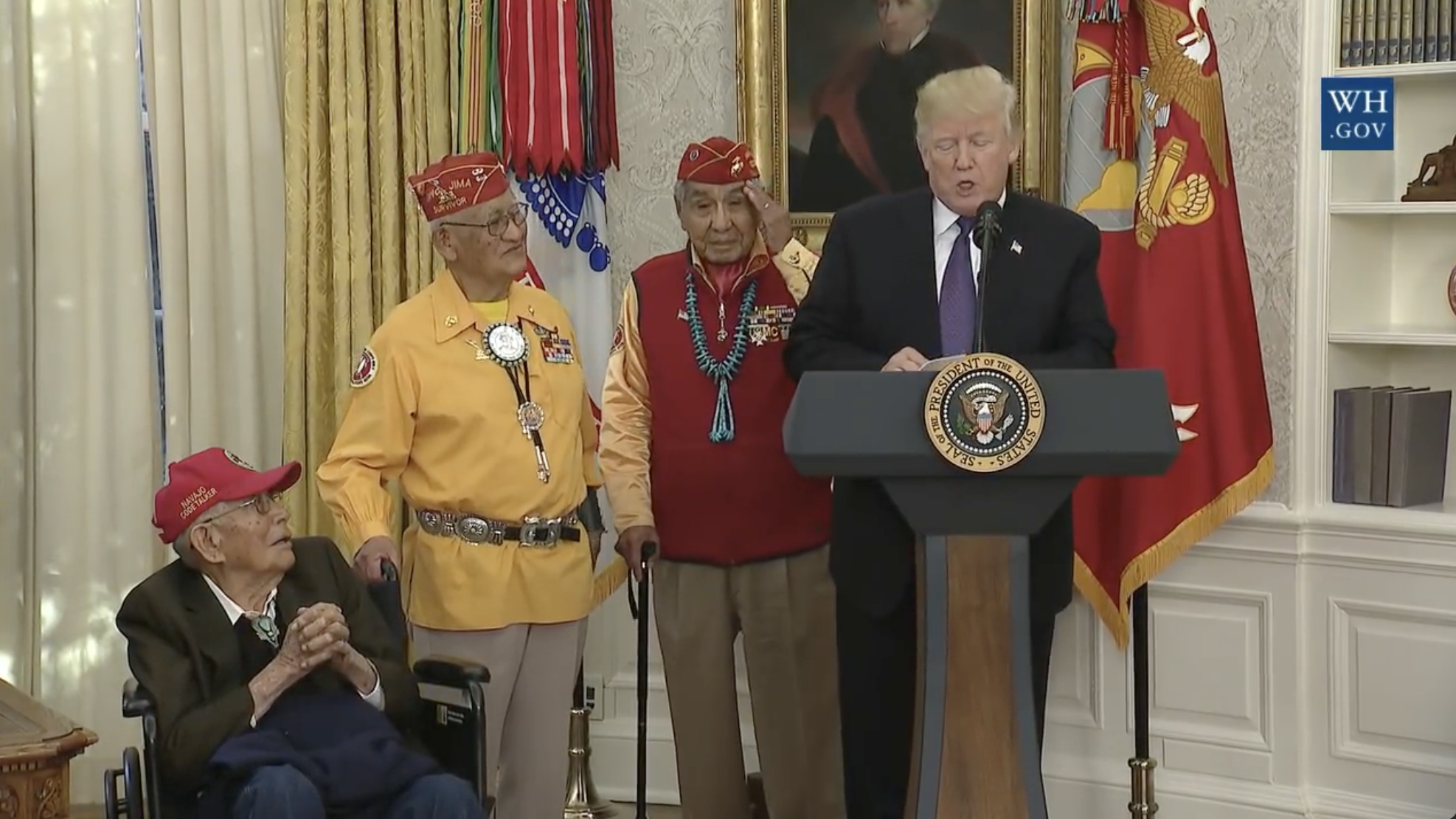
These similarities are not lost on Donald Trump, who compares himself to Andrew Jackson and claims Jackson was unfairly persecuted. Close current and former aides to Donald Trump see Jacksonian populism, as a guide for Trumpian populism to follow, as shown by the positive views of Jackson from Rudy Giuliani, Steve Bannon, and Tom Cotton, and the prominent placement of Andrew Jackson’s presidential portrait within the Oval Office. One noteworthy example of Trump’s admiration for Jackson is from when he held an event honoring Native American code talkers. At this event meant to honor pivotal American veterans, Trump speaks with a portrait of Andrew Jackson–the signatory of the Indian Removal Act which led to deadly events such as the Trail of Tears–behind him. This contrast is shown in the image of the event below.

President Trump Hosts an Event Honoring the Native American Code Talkers, The White House, 27 November 2017 (Screenshot from video)

css.php
The views and opinions expressed on individual web pages are strictly those of their authors and are not official statements of Grinnell College. Copyright Statement.