Grinnell College Logo

HIS 295, Professor Sarah J. Purcell

Category: Week 3: 1800 and 1824 (Page 2 of 3)

Conspiracies, Election Fact or Fiction?

One of the greatest travesties of the last century was the sinking of the Titanic. It might be one of the most preventable tragedies. When the ship sank in the Atlantic, it only carried enough lifeboats for a third of the passengers leaving them to survive in the freezing Atlantic with nothing more than a lifejacket and dramatically presented in the award winning film “Titanic.” How does this relate to elections? Well, let’s talk about an election that sank the entire era of political goodwill and a major party in the process, the election of 1824.

Let’s start with the basics: the parties and the candidates. The election of 1824 was quite unique. There was only one major party, “Democratic-Republicans” as we call them today. As a result, the previous election in 1820 was uncontested and Monroe won every electoral vote. This period before the 1824 election is known as the “Era-of-Good Feelings” because of this non-competitive atmosphere. In 1824 there were four candidates of note. William Crawford, the very articulate former Treasury Secretary, preferred by Thomas Jefferson and probably front runner if not for suffering a stroke the summer before. There was Henry Clay, the savvy long-time Speaker of the House, who knew D.C. like the back of his hand. Next, John Quincy Adams, the Secretary of State, the son of president and founding father John Adams, not as charismatic as others but a skilled diplomat and mastermind of the Monroe doctrine. Lastly, there was the ”Hero of New Orleans,” former general, controversial figure, and, at that time,  Senator Andrew Jackson.

The good part is the election itself. No one candidate won on election night in 1824. The Electoral College vote was so split no one candidate received an outright majority. The closest anyone got was Jackson with 99 electoral votes and who won the popular vote. Many Americans would have no idea what should happen in that case or even if there was a way to handle it. In the case of a tie in the Electoral College the decision goes to the House of Representatives and as with everything in the U.S. government, that process is not what it seems. Instead of each member getting a vote, there is one vote for each state. Another thing that might not be obvious is that the House was not to vote on all four candidates but only the top three leaving Clay out. This led to a great irony: the Speaker at that time was the same Clay. Guess what Adams does? He cut a deal with Jackson for Adams to receive the most votes. In what is now known as the “corrupt bargain,” Clay traded the votes for the prestigious Secretary of State position in Adams’ cabinet causing Jackson and his supporters to scream in fury over the apparent cheating. The bargain might have made Adams president but it allowed Jackson to sweep into power in 1828 and win a second term as well.

Is the commonly recounted story a lie? Yes, Adams won, but maybe it wasn’t a corrupt bargain at all. Maybe it was just a democracy at work. The Miller Center at UVA (Hogan, 2024) suggests that instead, Clay supported Adams because of “Jackson’s qualifications [president]…[and] commitment to the “American System.” Similarly, I want to come clean about the Titanic. It’s true there weren’t enough lifeboats. However, even if the Titanic had enough lifeboats it probably wouldn’t have mattered in the end. The last lifeboat was released at 2:05am, 15 minutes before the sinking (Diekmann, 2024). 

Maybe we sometimes want to convince ourselves that there is a juicy conspiracy where there is just an election and processes of the government making a decision. This tells us that we shouldn’t get too carried away or convinced by conspiracies like with couches and pets in Ohio. They might be more interesting or make us feel justified in our preferences. However, most things have a more reasonable (and maybe boring) explanation. Let’s try to assume and hope that most people are trying to do the best they can and have faith that democracy will still function this time as it did then. 

References:

This source is from Margaret A. Hogan, no date found,  last retrieved 9/13/2024.

https://millercenter.org/contested-presidential-elections/corrupt-bargain

This source is from William Nester, no date found,  last retrieved 9/13/2024.

https://www-jstor-org.grinnell.idm.oclc.org/stable/pdf/j.ctt1ddr80h.11.pdf?refreqid=fastly-default%

This source is from Caitlynn Dieckmann, no date found, last retrieved 9/13/2024.

https://urj.uccs.edu/index.php/urj/article/view/491/243

How Trump and Jackson’s grievance-centered campaigns are alike and, more importantly, how they differ.

A comparison between Donald Trump and Andrew Jackson is often made by both the media and the 45th president himself. It’s not hard to see why; both presidents ran on populist platforms, both with an anti-establishment slant, and both appealed to white Americans’ fear of non-white outsiders. As of 2020, another similarity has arisen between the two presidents, notably a grievance they both shared with an election they lost, which they chose to center in their re-election efforts. Jackson’s grievance was the corrupt bargain, a conspiracy he claimed occurred in the 1824 election between his political rivals that kept him from the presidency and allowed those who participated in it to get ahead politically. Trump’s grievance was with the results of the 2020 election. Unlike Jackson, he places the blame not on any few individuals but instead on the election machine itself, claiming that his political enemies rigged the system, causing the voting to be miscounted and him to be robbed.

Both of these men, in their bids for re-election after a loss, used their grievances as a central point in their campaigns. What’s more, both Jackson and Trump, unwilling to accept their losses, stayed in the public sphere, officially and unofficially setting up their next campaigns. This strategy worked for Jackson; the people rallied around him and validated his grievance despite the lack of proof. He won the next election in a landslide victory, nearly doubling voter turnout as the people tried to right a “wrong” that had been done to him. Jackson had the advantage of the election he questioned, which was already contested. Because no candidate in the 1824 election was able to get a majority of the electoral votes, the decision went to the House. This system of a powerful few in control of the country stunk to many of elitism, a flavor of government not popular with the recently enfranchised non-property-owning white men. Therefore, despite the fact, or potentially not the fact (see Ratcliffe), that Jackson won the popular vote, the representatives of states he had won still voted against him. Therefore, even if no corrupt bargaining occurred, Jackson’s claims seem somewhat plausible given the unexpected and somewhat calculated results and the fact that once he became president, Adam did appoint Speaker of the House Clay to a high-ranking cabinet position, the very bargain Jackson accused the two of making.

Trump, on the other hand, despite the 60+ cases raised against the 2020 election results, has almost no grounds on which to build his grievance. There has been no evidence of election tampering nor any reason besides his claims to believe there has been, and while parts of Trump’s base still believe his 2020 grievances, the results of the 2022 midterms have made it apparent that election denying is a wildly unpopular position. According to CNN, nearly every election denier running in a swing state lost in 2022. Of course, the results of the 2024 election will show if Trump’s centered campaign ultimately proves successful or not, but based on the results already and the way in which Trump has somewhat conceded that he did lose the last election, it has become apparent that the similarity between the two presidents might end in rhetoric and not success.

The Elections of 1800 and 1824: Glimpses of the Modern Political Climate in Contested Elections from the Past

Research published in 2022 by the Pew Research Center has shown that many Americans today are becoming increasingly disillusioned with the current political system and, particularly, what many perceive as a rise in partisan politics (Pew Research Center Report Regarding Rising Partisan Hostility in the U.S.). While it may not be reassuring, it can be comforting to know that the U.S. political system is not only no stranger to alleged corruption and extreme polarization, but has been able to operate under these stressors from as early as 1800 (John J. Turner, “The Twelfth Amendment and the First American Party System” (1973)). There are perhaps no better sources with which to demonstrate the constancy of these stressors in U.S. politics than first-hand accounts of the state of the nation during and in the aftermath of two notoriously contentious elections which occurred early in the nation’s history: the elections of 1800 and 1824.

From the Election of 1800: Letter from Charles Pinckney to Thomas Jefferson (February 9th, 1801), National Founders Archive

In a letter from South Carolinian Democratic Republican Charles Pinckney (not to be confused with his cousin Charles Cotesworth Pinckney, a member of the opposing Federalist political faction) to then presidential candidate, Thomas Jefferson, speaks to the state of the US political system during the contentious election of 1800 (Letter from Charles Pinckney to Thomas Jefferson (February 9th, 1801), National Founders Archive). The letter was written on February 9th, 1801, just ahead of a vote in the House of Representatives which would break the tie between Thomas Jefferson and John Adams in the votes of the electoral college and decide the election. While the political party system had not yet been implemented, the lines of division and lack of trust that people recognize between major US political parties today were certainly present. Democratic Republicans, believing that “big-government” Federalist policies were too similar to those seen in a monarchy system, did not trust Federalists to protect the nation, while Federalists believed that the high levels of state independence, lack of national bank, and expressed intention to support France in their brewing conflict with the British (characteristic of a Democratic Republican political approach) would eventually lead to a dissolution of the union. This letter reveals glimmers of those conflicts, with Pinckney expressing his extreme concern with the possibility of a Federalist “trick” leading to the reelection of Federalist incumbent John Adams rather than Jefferson, a leading Democratic Republican.  In this letter, Pinckney, who had just arrived in New York on his way to Washington, states that the severity of his anxiety has inspired him to “risk” his injured arm in order to “be on with [Jefferson] as quick as possible”.

Pinckney closes out the letter by informing Jefferson of his plans to be with him in Washington by the next week and voicing his hope that the “Voice of [the] country” will be heard and that, because of the country’s voice being heard, its wishes to see Jefferson as President will come to fruition. This closing statement further reflects his strong belief that to elect Jefferson as president was, not only the best choice for the future of the United States, but also that Jefferson was the candidate that the nation itself preferred, despite the fact that the will of much of the nation was notably not directly represented in the voting that occurred in both the electoral college and the House of Representatives (Jack N. Rakove, “Presidential Selection: Electoral Fallacies”, Published in Volume 119, Issue 1 of Political Science Quarterly (2004)).

Pinckney’s sense of duty and urgency is indicative of just how dire politicians from both factions believed the election of 1800 to be. In his short letter to Jefferson, Pinckney encapsulates the magnitude of the election of 1800 in the eyes of Americans at the time as well as the severe fracturing between Democratic Republicans and Federalists at the core of the first contentious presidential election in US history.

From the election of 1824: Letter from Andrew Jackson to William Berkeley Lewis (February 14, 1825), Library of Congress

The election of 1824 marked the end of an era in the History of the United States known as the “Era of Good Feelings” (1815-1825). During this era, American citizens were finally able to turn their attention away from European affairs and pay it, in full, to what was happening in their home country – a country which, in 1820, at least appeared to be a nation united under one political party: the Democratic Republicans (Britannica, “Era of Good Feelings”). The Democratic Republican party’s dominance in 1820 was, in many ways, the result of long-term effects stemming from the presidential election of 1800: a bitter battle between the two dominant political groups at the time, the Federalists and Democratic Republicans, which ended in Thomas Jefferson’s presidency (Democratic Republican). The election of 1800 also spurred the formation and ratification of the 12th amendment which facilitated what we know as “party politics”, by allowing the Presidential and Vice Presidential candidates from the same party to essentially run as a “package-deal”, and set guidelines for protocols in the event that no candidate received a critical majority of the votes in the electoral college (John J. Turner, “The Twelfth Amendment and the First American Party System” (1973)). When the state delegates in the electoral college cast their votes in the election of 1824, they were faced with a choice between five different members who were all, at least nominally, members of the Democratic Republican party: William H. Crawford of Georgia, Andrew Jackson of Tennessee, Henry Clay of Kentucky, and John Quincy Adams of Massachusetts (Statistics from the Election of 1824, “The American Presidency Project”, Published by the University of California at Santa Barbara).

While Jackson won the popular vote of the American people as well as the most electoral votes of the five men, with Quincy Adams having the second most popular and electoral votes, he did not win the 131 electoral votes necessary to win the election (Chapter 6: “The Corrupt Bargain” from William Nester’s The Age of Jackson and the Art of American Power 1815-1848 (Copyright 2013)). So, as was established with the ratification of the 12th amendment in the aftermath of the contested election of 1800, the election was thrown to the House of Representatives through which each state delegation would be able to vote (John J. Turner, “The Twelfth Amendment and the First American Party System” (1973)). While the 12th amendment allowed for the top three candidates with the most electoral votes to be included in the tie-breaking vote, Henry Clay, the candidate with the third most electoral votes, decided to drop out of the election in order to use his influence as Speaker of the House to bolster John Quincy Adams’ chances of defeating Andrew Jackson.

Despite all being members of the same party, a few of the five men had serious misgivings about some of their opponents’ character and ability to successfully lead a nation. Much of these misgivings were either directed towards or held by General Andrew Jackson, a divisive figure known primarily for his military prowess. Perhaps most notable among Andrew Jackson’s conflicts with political adversaries was the shared animosity between him and Henry Clay. This animosity reached a fever-pitch of sorts when, after being endorsed by Clay as Speaker of the House, John Quincy Adams won the tie-breaking vote in the House of Representatives and, consequently, the presidency despite having received less electoral and popular votes than Jackson. However, it was not Clay’s endorsement of John Quincy Adams alone that inspired great anger among Andrew Jackson and his supporters, but rather Quincy Adams’ later appointment of Clay to the office of the Secretary of State. Jackson and his supporters, understandably, did not view Clay’s appointment following his endorsement of John Quincy Adams to be a coincidence, but rather an instance of political malfeasance which would go on to be known as the “Corrupt Bargain” (Chapter 6: “The Corrupt Bargain” from William Nester’s The Age of Jackson and the Art of American Power 1815-1848 (Copyright 2013)). In a letter to his friend and advisor Major William Berkeley Lewis, Jackson pondered if not only the nation, but the world, “[had] ever witnessed such a bare faced corruption” before Clay and John Quincy Adams’ alleged, and still unsubstantiated, “Corrupt Bargain”. Earlier in that same letter to Major Lewis, Jackson described Clay as “the Judas of the West”, emphasizing the extreme nature of the betrayal he believed to have occurred  (Letter from Andrew Jackson to William Berkeley Lewis (February 14, 1825), Library of Congress).

With the intense political climate of the present-day United States, and the fears and uncertainty that this climate can inspire, it can be hard to fathom that the United States has endured, and could continue to endure, the kinds of partisanship and animosity we currently see between political parties and politicians. However, a brief look into the history of U.S. politics can show us that the nation has endured many perilous events that, arguably, posed a greater threat to our democratic system than any trials and tribulations we have seen in the past two decades. While the perspective one can gain from learning about these past events may not bring peace of mind, or some form of guidance with which to navigate issues in the present-day, it can hopefully provide some semblance of assurance that our democracy has the ability to survive in and adapt to the increasingly rocky landscape that is U.S. politics.

Sources

In order of first appearance:

  1. Pew Research Center Report Regarding Rising Partisan Hostility in the U.S.
  2. John J. Turner, “The Twelfth Amendment and the First American Party System” (1973)
  3. Letter from Charles Pinckney to Thomas Jefferson (February 9th, 1801), National Founders Archive
  4. Jack N. Rakove, “Presidential Selection: Electoral Fallacies”, Published in Volume 119, Issue 1 of Political Science Quarterly (2004)
  5. Letter from Andrew Jackson to William Berkeley Lewis (February 14, 1825), Library of Congress
  6. Britannica, “Era of Good Feelings”
  7. Statistics from the Election of 1824, “The American Presidency Project”, Published by the University of California at Santa Barbara
  8. Chapter 6: “The Corrupt Bargain” from William Nester’s The Age of Jackson and the Art of American Power 1815-1848 (Copyright 2013)

Almost 200 Years of Mudslinging

1828 was a comeback election for Andrew Jackson.

Having lost to what he described as a ‘corrupt bargain’ in 1824, he became determined to win both the popular vote and the majority electoral college vote, defeating John Quincy Adams this time around. This election would be a tough one for Jackson and his family, though. Not only was Jackson running against the man who had defeated him four years prior, he was running against an anti-Jackson campaign, one that was fueled by rumors put out against him in newspapers and pamphlets.

Jackson had one enemy in particular that sought to destroy both him and his wife’s reputation. In his monthly pamphlet, Truth’s Advocate and Monthly Anti-Jackson Expositor, Charles Hammond published over three hundred pages attacking Andrew Jackson’s politics, personhood, as well as family.

The pamphlet reads, “we deem it proper that the public should be acquainted with the offences of Gen. Jackson, against morals, law, and decency, the commission of which, spreads over his whole life from the seduction of Mrs. Robards to the slander of Mr. Clay” . Hammond’s jab is a reference to the rumor that Andrew Jackson had relations with his now wife Rachel Jackson while she was previously married to Lewis Robards. Calling Rachel Jackson by the last name of another man acted as an innate attack on the Jackson family values, and in turn, Andrew Jackson’s values as a presidential candidate as well as a man.

 Truth’s Advocate and Monthly Anti-Jackson Expositor (June 1828), 235


Further, in a piece titled Groanings within the pamphlet, the legitimacy of Andrew and Rachel Jackson’s relationship is again challenged, this time blatantly accusing the couple of engaging in adultery. The pamphlet reads,

Truth’s Advocate and Monthly Anti-Jackson Expostior (June 1828), 235

“And then about that Mrs. Robards affair–

That too, they’ve told Adams and Clay–

Had it never leaked out, I’ll make bold to de-

clare,

‘Twould not be known to this day.”


By means of combating these attacks on his values, Andrew Jackson positioned himself amid the everyman. With his nickname, Old Hickory, Jackson made himself seem familiar to the American people, something the anti-Jackson campaign had been trying to further him away from. For example, on the ‘Jackson Ticket’, Jackson’s image is replaced by a tree, signifying him as sturdy, rooted, and down to Earth.

 Andrew Jackson, “Jackson ticket. ‘Firm united let us be, rallying round our Hickory tree’” (1828), courtesy Library of Congress

Much like the mudslinging in the 1828 election, modern day elections are no stranger to this kind of abuse. Most recently, as seen in the presidential debate between President Trump and Vice President Harris, name calling and rumors still manage to find a place on the election stage. During the debate, both members used the word ‘weak’, among other things, to describe one another. In addition, moderators questioned President Trump’s on his comments about Harris’s identification as a Black woman. It is interesting how in both the 1828 and 2024 election, women are both at the forefront of criticism.

While 1828 was one of the first elections that political opponents engaged in mudslinging, it is clear that even almost two hundred years later, this same sort of smearing remains, such messiness characterizing what we understand today as simply: politics. In this day and age, though, pamphlets are pushed to the side in exchange for viral twitter rants, as social media created a brand new platform for politicians to engage in mudslinging.

The Electoral College: Better or Worse Since 1800?

Think to yourself, do you know who the Electoral College is made up of? Do you know how to become an elector? Do you know how to find out? Personally, up until a few months ago, I had no idea how to become an elector and only found out after accidentally becoming one. Now, when I reflect on the Electoral College of the past, I want to know if it was more straightforward in the past or present.

There is no federally mandated system for selecting presidential electors, so the choice is left to the states. As seen here a pamphlet listing candidates for Elector in 1800 was circulated by the Republican Party of Virginia which made the choices very clear to voters. In 1800, only two states, Virginia and New Hampshire, selected electors through general election. All other states had other systems for selecting electors, generally through appointment by state legislators. It is important to note that in 1800, electors were effectively unbound and could (and did) vote for whatever candidate they wanted, regardless of the popular vote in their state.

Only after the Electoral College failed massively was it restructured with the 12th amendment which factored in political parties and allowed electors two separate votes, one for President and one for VP. After it failed in 1800 and again in 1824, voters began to become frustrated by the lack of direct representation and the Electoral College evolved more.

By 1824, eighteen out of twenty-four states selected electors through general election, and by 1828 only two states selected electors through different methods. Today, most states elect multiple slates of electors through various processes. For example, The Iowa Democratic Party selected electors in two stages. First, district-level electors are voted on by delegates at district conventions, then two additional electors are chosen “at large” by delegates at the state convention. The Iowa Republican Party on the other hand does not have a clear selection plan outlined per their bylaws, it appears that the Republican Party of Iowa selects electors through nomination by a small nomination committee.

Undeniably, the process for selecting electors still varies from one state to another, but given that the selection process for electors has become less accessible for the average citizen, is that acceptable? Electors now serve a more ceremonial role in deciding the election as most states do not split up their electoral votes, so it is possible to argue that there is little significance. At the same time, our modern electoral college is so dissimilar to the original process set up by the founding fathers, that it has evolved into a completely different process.

1824 and 2024: Should We Expect a More Mobilized Republican Party?

The election of 1824 saw Andrew Jackson, John Quincy Adams, Henry Clay, and William Crawford interlocked in a terse competition for the presidency, resulting in a presidential term for Adams and a bitter defeat for Jackson. However, the 1824 election has been rife with controversy, contempt, and accusations that Adams and Clay engaged in a ‘corrupt bargain’ that handed Adams’ the presidency when it should’ve gone to Jackson. It’s difficult to know if this bargain ever really happened, but the story goes that Henry Clay, who was the speaker of the house at the time, promised his support to Adams’ run for the presidency and, after Adams’ victory, Clay would be appointed as the secretary of state. This ‘bargain’ was only possible because none of the candidates received a majority of the votes in the electoral college, sending the election into the house of representatives. 

Despite Adams winning the presidency, Andrew Jackson did win the popular and electoral votes. To him, this political loss seemed more like a conspiracy. This resulted in a hatred for Clay, whom he referred to as “the Judas of the West” in a letter advisor and friend William Berkeley Lewis sent on February 14th, 1825. The letter is accessible through the Library of Congress’s digital collections, specifically within the Andrew Jackson Papers’ selection. In this letter, Jackson is sharing the news to Lewis about Clay’s upcoming appointment as Secretary of State. He ends the letter claiming that “[n]o imputation will be left as [the senate’s] door”. Jackson went on to win the election of 1828. 

Scholar’s have brought into question on how completely Jackson won the popular vote, such as Donald Ratcliffe, in his paper “Popular Preferences in the Presidential Election of 1824”, published in the Journal of the Early Republic, as well as the existence of the corrupt bargain, however the effects of the undemocratic perception of the election of 1824, legitimate or not, had a serious impact on future elections. According to the article, “Corrupt Bargain” from UVA’s Miller Center, by Margaret Hogan, the number of voters in the presidential election doubled from 1824 to 1828 and Andrew Jackson won the presidency in a landslide election. 

Jackson’s loss during the 1824 election mobilized voters and drastically increased voter turnout, which could have parallels to the upcoming 2024 election 200 years later. Former president Donald Trump lost the 2020 election to now president Joe Biden, however his loss was colored by accusations of fraud and conspiracy, resulting in many claims that the election was stolen. Although these accusations were widely proven to be wrong, as seen in this AP article fact checking the former president’s claims, that doesn’t mean that they won’t have any impact on the 2024 election. Trump’s story, true or not, certainly calls back to Jackson’s alleged election snub. It’s important to acknowledge that we are living in different times and different circumstances than Jackson did, with expanded communication through social media and a very defined two-party system. History cannot dictate what happens next, but it can provide context, so I wouldn’t be surprised if as we see November 5th approach, we also see Trump supporters and the Republican party become louder and more mobilized. 


Trump and Jackson: A Fitting Comparison?

Donald Trump has made it clear that he identifies strongly with Andrew Jackson. In fact, in a visit to Jackson’s plantation in 2017, Trump called himself a “big fan,” and that Jackson was “inspirational.”   And, Trump has recently reaffirmed his support and admiration for Jackson, saying at a rally on Aug 29 that “Andrew Jackson … was treated worse than any other president… although nobody comes close to Trump.”   Aside from the (potential) parallels that one could draw between the two’s personality, why does Trump see himself in Jackson, and what might this comparison tell us about the upcoming election?

There are a number of ways in which the two are alike- in 1824 Jackson ran as an anti-establishment political outsider, known for his status as a war hero, while Trump campaigned on much of the same, although a businessman instead of veteran. Additionally, and more importantly, they both claimed to be victims of a stolen election. In Jackson’s case, he won the popular vote (at least on its face, as I will discuss later), but failed to reach the required number of electoral votes. The decision then went to the House of Representatives, where Jackson claimed a “corrupt bargain” occurred between John Quincy Adams and Henry Clay (the Speaker of the House), causing Adams to win, and Clay to become Secretary of State. Jackson then proceeded to campaign for the next four years on the idea that his election was stolen from him, leading to his election as president in 1828. This parallels Trump’s narrative of the 2020 election, as he claims to have won the popular vote in reality (although he did not), and that the election was stolen from him due to voter fraud on the part of the Democrats. This comparison obviously holds allure for Trump, as the comparison sets him up for a mass swell in support and overwhelming victory in the upcoming election, and gives him a historical figure to identify (and commiserate) with about having an election “stolen” from him.

There are, however, quite a few problems with this comparison. First, of course, Trump didn’t actually have the election stolen from him, but also there are some good arguments that Jackson didn’t either. First, the “corrupt bargain” can not be known to actually have happened. This likely strengthens the comparison between Trump and Jackson, as both based their campaign on supposed government corruption that remains unverified (or dis-proven in Trump’s case).  Even so, the proceedings of the House with regards to electing a president in 1824 followed the guidelines set forth in the Constitution  and the 12th Amendment, so the results are legitimate.

But, more importantly, there is strong evidence that, like Trump, Jackson did not actually win the popular vote in 1824. A project  that re-tallied votes from national newspapers, and accounted for states that did not use the popular vote found that Jackson did not, in reality, earn the popular vote. This arguably strengthens the comparison between Jackson and Trump, as both did not win a contested election or the popular vote, and have been campaigning on that concept heading into the next election.

It appears that the comparison between Trump and Jackson is extremely strong, although based on the above, the comparison may not be a desirable one. If there is a negative connotation with Jackson’s campaign based on the above issues, then why does Trump continue to identify with Jackson? Put simply, with all of the problems with Jackson and his campaign, he still won in 1828, and he won by a lot. If Jackson can do it, Trump’s logic goes, Trump can too. With such strong parallels, the question becomes if Trump will follow Jackson’s pattern, and win the upcoming election. This is not a question that can be truly be answered by history, but it is important to recognize that a campaign that had many of the same broad strokes as the Trump campaign was able to put itself back together after a loss and win with broad support.  Trump hopes that by identifying (and  using the playbook of) Jackson, he can repeat Jackson’s victory in 1828, although whether he will succeed is unknown.

How The Election of 1824 Relates to Modern Days

Many have drawn parallels between Andrew Jackson and Donald Trump. Although separated by 200 years, Jackson and Trump share many qualities, the most notable being their refusal to accept their presidential election results. According to David Brown, a history professor and author of a biography of Andrew Jackson, Jackson and Trump are the only two major American presidential candidates to challenge the results of an election. David Brown points out in this Time magazine piece that even Richard Nixon, someone generally viewed as a highly corrupt and self-interested figure, bucked calls from within his party to contest his electoral defeat. Brown writes that Jackson, like Trump, set the groundwork for his claims that the election was rigged against him before it was even certain he would lose. In the 1824 election that Andrew Jackson contests, there were four major candidates, resulting in Andrew Jackson winning merely a plurality of both the popular vote and electoral college, sending the race to a contingent election in the House. In Trump’s 2020 election, his opponent did win a majority in the electoral college, but Trump and his allies still tried to overturn the results in Congress. However, the claims by both Jackson and Trump that their elections were stolen from them are without evidence at best and blatant lies at worst.

But it isn’t just unsubstantiated claims of election fraud that unites Trump and Jackson. They also share several other traits. Most prominently, both Jackson and Trump ran on a populist message, and both have a tendency to resort to conspiracy theories to gin up public opinion. Additionally, both men ran for president in the immediate subsequent election to the one in which they lost and claimed fraud. The eventual administration of Andrew Johnson also expanded the purview of executive power and initiated the forceful relocation of hundreds of thousands of people, as Donald Trump hopes to do in a second term.

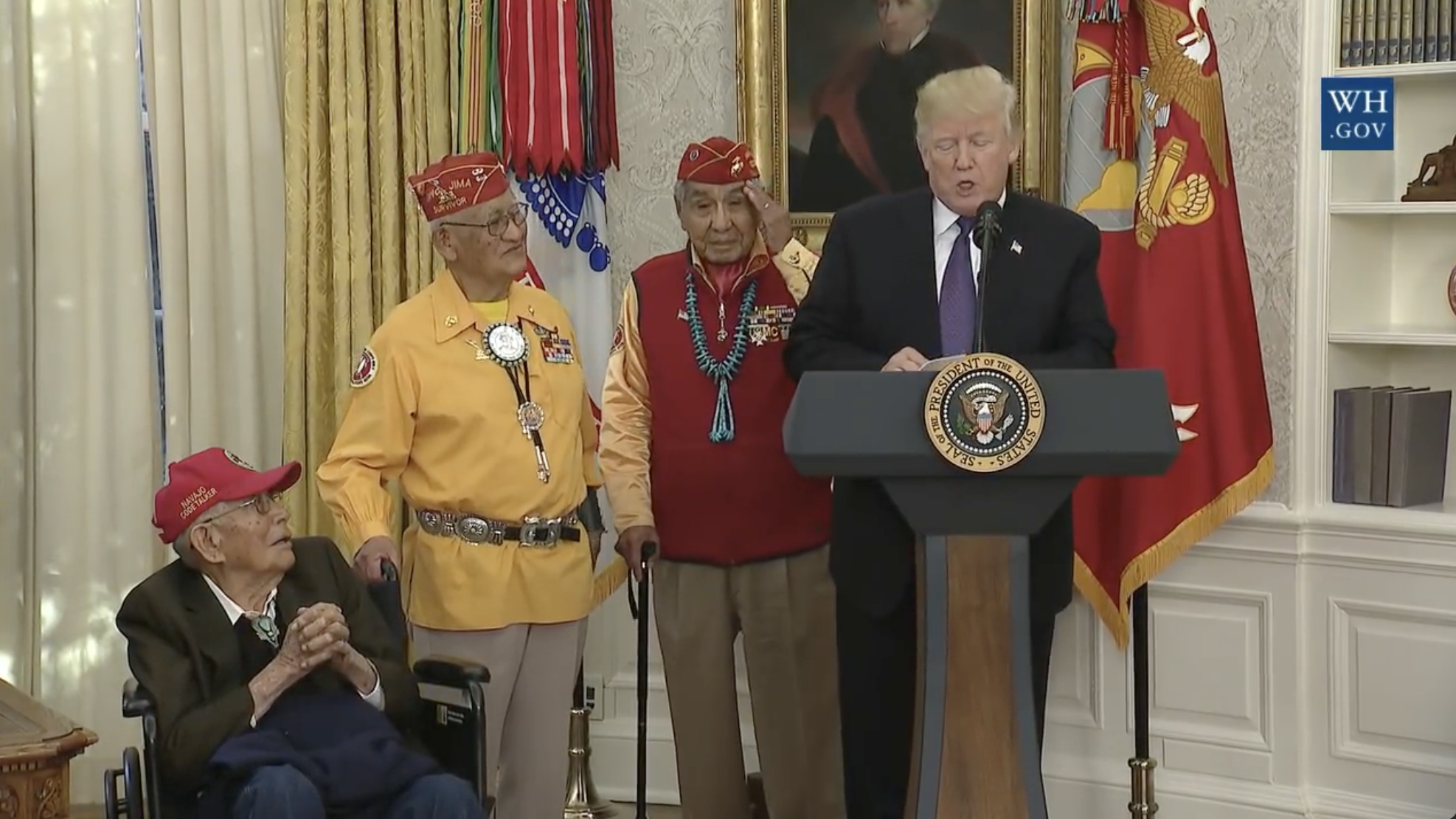
These similarities are not lost on Donald Trump, who compares himself to Andrew Jackson and claims Jackson was unfairly persecuted. Close current and former aides to Donald Trump see Jacksonian populism, as a guide for Trumpian populism to follow, as shown by the positive views of Jackson from Rudy Giuliani, Steve Bannon, and Tom Cotton, and the prominent placement of Andrew Jackson’s presidential portrait within the Oval Office. One noteworthy example of Trump’s admiration for Jackson is from when he held an event honoring Native American code talkers. At this event meant to honor pivotal American veterans, Trump speaks with a portrait of Andrew Jackson–the signatory of the Indian Removal Act which led to deadly events such as the Trail of Tears–behind him. This contrast is shown in the image of the event below.

President Trump Hosts an Event Honoring the Native American Code Talkers, The White House, 27 November 2017 (Screenshot from video)

The Year the Unity Died

In December of 1800, Alexander Hamilton, a framer and honored member of the Federalist party, wrote to his friend Harrison Gray Otis, a fellow Federalist, about his preference for Thomas Jefferson, the unofficial leader of the Democratic-Republicans, over Aaron Burr, another Democratic-Republican. Yes, lots of fancy jargon, let us take a step back for a moment.

Simply said, in 1800, there were two political parties that dominated the American political scene; the Democratic-Republicans, who stood for smaller federal government and more freedom to the people, and the Federalists, who stood for stronger federal government and a more elitist structure of society. Now, the idea that our ancestors had some distant and modified version of our current “two-party” system might not seem chocking, however, one must remember that before 1789, the idea of political parties, or factions as they called them, was seen as a threat not only to democracy but also to the survival of the republic. Humans being human quickly became divided however, into the two parties mentioned above, and this almost innocent idea that the country would be able to function under the leadership of one united government trickled down. Even though the existence of political parties was very much present and known throughout the 1790’s, the electoral process was still functioning under the idea that there would be no political parties. More specifically, there was no procedure for a president and a vice-president to run together on a same ticket. Instead, the candidate with the majority votes would be elected president and the candidate with the second most votes would be vice-president. Today, this system would be nothing but a funny thought experiment (picture it: Harris-Trump, Make America Not Go Back Again?) but one can clearly see how this system was thought out with the intension of staying clear of political parties.

Now that the context has been established, we may return to the impact the election of 1800 had on the rise of political parties. This dissonance between the electoral system and the political parties finally came to a head when Thomas Jefferson and Aaron Burr, both of the same party but strongly against one another, were ultimately going to end up being voted into office together. While the election process was long and cumbersome (that is another story for another time), the “enemy pair” did end up being voted in together, which lead to the birth of the 12th amendment. Shortly, the 12th amendment stated that the president and vice-president would be voted in together on the same ticket. This amendment is seen by many as being the catalyst towards the party system in the United States.

Hamilton and Otis were far from knowing that their political party would soon cease to exist, but what they were even further from knowing is that the election system they had built would disappear and leave room for the rise of very strong factions, everything they had ever feared. That is how I would recommend remembering the election of 1800, the election of 1800 is the year the unity died.

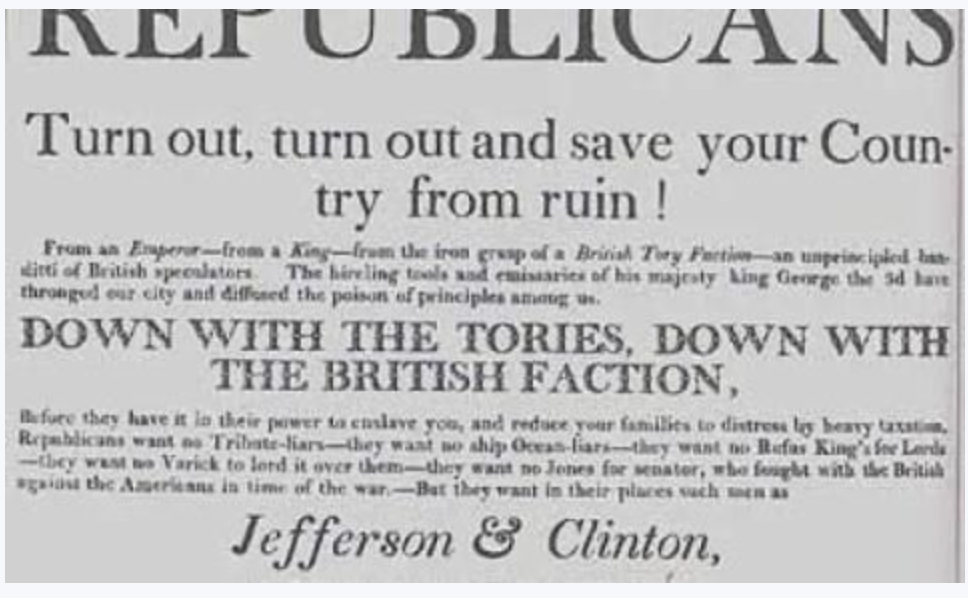
Jefferson and Clinton grouped ticket for the election of 1804. Image from the Ronald Reagan Presidential Museum and Library.

200 Years After 1824: What Andrew Jackson Can Tell Us About the Campaign of Donald Trump

Two candidates, two elections, 200 years apart. What can Andrew Jackson’s unsuccessful bid for president in 1824 tell us about Donald Trump’s campaign in 2024?

The election of 1824 was as contested as they come. With five major candidates vying for the White House, this election was rife with allegations of corruption and factioning in the Democratic-Republican party. After John C. Calhoun dropped out to run for vice president, the presidency became a four-man race: John Quincy Adams, Henry Clay, William Crawford, and Andrew Jackson. No single candidate garnered enough electoral votes to be elected president outright, although Jackson had won a solid plurality of the popular vote and 99 electoral votes, shy of the 131 needed to win. In line with the 12th amendment, the election was thrown to the House of Representatives, where only the top three candidates were considered, leaving Henry Clay as the odd man out.

Now it was down to three. Although William Crawford worked deals on the side to get partisan support and Andrew Jackson relied on his widespread popularity, John Quincy Adams was elected president on the very first ballot. Accusations abounded from Jackson and his supporters, accusing Adams and Clay of forming a corrupt bargain, although there is no evidence to suggest any such bargain occurred. Jackson accused Clay, “the Judas of the West,” of throwing his supporters behind Adams. Clay was the Speaker of the House and held a fair amount of sway even when he was out of the presidential race. What would Clay get in return? When Adams appointed Clay as his Secretary of State, Jackson’s fury only grew.

From the moment he lost the 1824 election, Jackson began campaigning for 1828, using the notion that the election had been stolen as his sword, and his status as a nontraditional politician as his shield. Nontraditional is perhaps too mild of a descriptor for Andrew Jackson — he was highly controversial for his repeated violations of the Constitution and laws, including executing British soldiers in Florida (which was not a US territory at the time), and he hated his brief stint as a senator, despising the politicking and time it took to make progress. Although a very wealthy slaveowner, he aligned himself with the newly-enfranchised working-class white men, using his victory at the Battle of New Orleans to style himself as a hero of the people. His supporters held rallies, barbecues, parades, concerts, and more to rustle support among rural voters who might not feel as seen by the traditional political elite, paving the way for him to win in a landslide in 1828. Old Hickory was thus able to paint himself simultaneously as the victim of a stolen election and as a strong, masculine leader in one of the first truly Populist campaigns in American history.

Sound familiar yet?

Two hundred years later, in the 2024 election, Donald Trump has begun drawing parallels between himself and Andrew Jackson. He’s referred to Jackson as the most heavily criticized and attacked president besides himself. He refuses to admit that he lost the 2020 election. And he didn’t wait long to start campaigning for 2024.

Perhaps the most striking parallel between Trump and Jackson — and thus, one of Trump’s motivations for aligning himself with such a controversial figure — is how both styled themselves as victims of a fraudulent election and simultaneously as undefeatable pillars of strength. While no evidence supports Jackson’s allegations of a corrupt bargain, an overwhelming amount of evidence confirms that the 2020 election was legitimate and Trump lost. But by painting himself as a man of the people, despite being a wealthy businessman nowhere near the sphere of working-class people he tries to influence, Trump’s outrage becomes his base’s outrage. His victimization becomes their victimization. His strength becomes their strength.

After Jackson lost the 1824 election, he called on the people to act, saying he “relied wholly on them to guard themselves… [and] correct any outrage” to rectify what he believed to be an injustice against him. But despite the fervor of popular support he enjoyed, none of Jackson’s supporters ever rioted or stormed any political buildings in his name. Jackson would likely have not appreciated the comparison to Trump: after all, Trump lost the popular vote, then won the presidency anyway, which is exactly how John Quincy Adams earned Jackson’s ire.

Trump is far from a lifelong politician. Like Jackson, he has no patience for the nitty-gritty of lawmaking. Like Jackson, he entered politics as an unconventional character, a larger-than-life persona who’s staunchly anti-political correctness. And despite Jackson’s repeated and egregious violations of both the Constitution and laws, his crimes did not impede his election as president, a feat Trump with his 34 counts of falsifying business records hopes to repeat. Trump’s style of leadership is attractive to his voters in the same way Jackson’s image as a successful military general and hardline politician (and racist) was embraced by white, working-class men; the lure of masculinity, of portrayals of strength, of beliefs and attacks that are far from standard, draw on the values of his voters in ways that obscure some of his faults.

It remains to be seen whether Trump will win or lose the 2024 election, but he has already laid the groundwork to claim fraud should he lose. Unlike Jackson, whose 1828 win was overwhelming, Trump has lost the popular vote twice, and his man-of-the-people mask is increasingly at odds with his business and political interests. What we can learn from Jackson’s campaign is the ways in which victimization of a dominant group, be it a party, race, religion, or gender, can be weaponized into political support — and how to accept the results of an election, even when you disagree with the outcome.

For further reading:

“The Corrupt Bargain” from The Age of Jackson and the Art of American Power, 1815-1848 by William Nester, 2013, p. 88-100, https://www.jstor.org/stable/j.ctt1ddr80h.11?seq=7

« Older posts Newer posts »
css.php
The views and opinions expressed on individual web pages are strictly those of their authors and are not official statements of Grinnell College. Copyright Statement.