
HIS 295, Professor Sarah J. Purcell
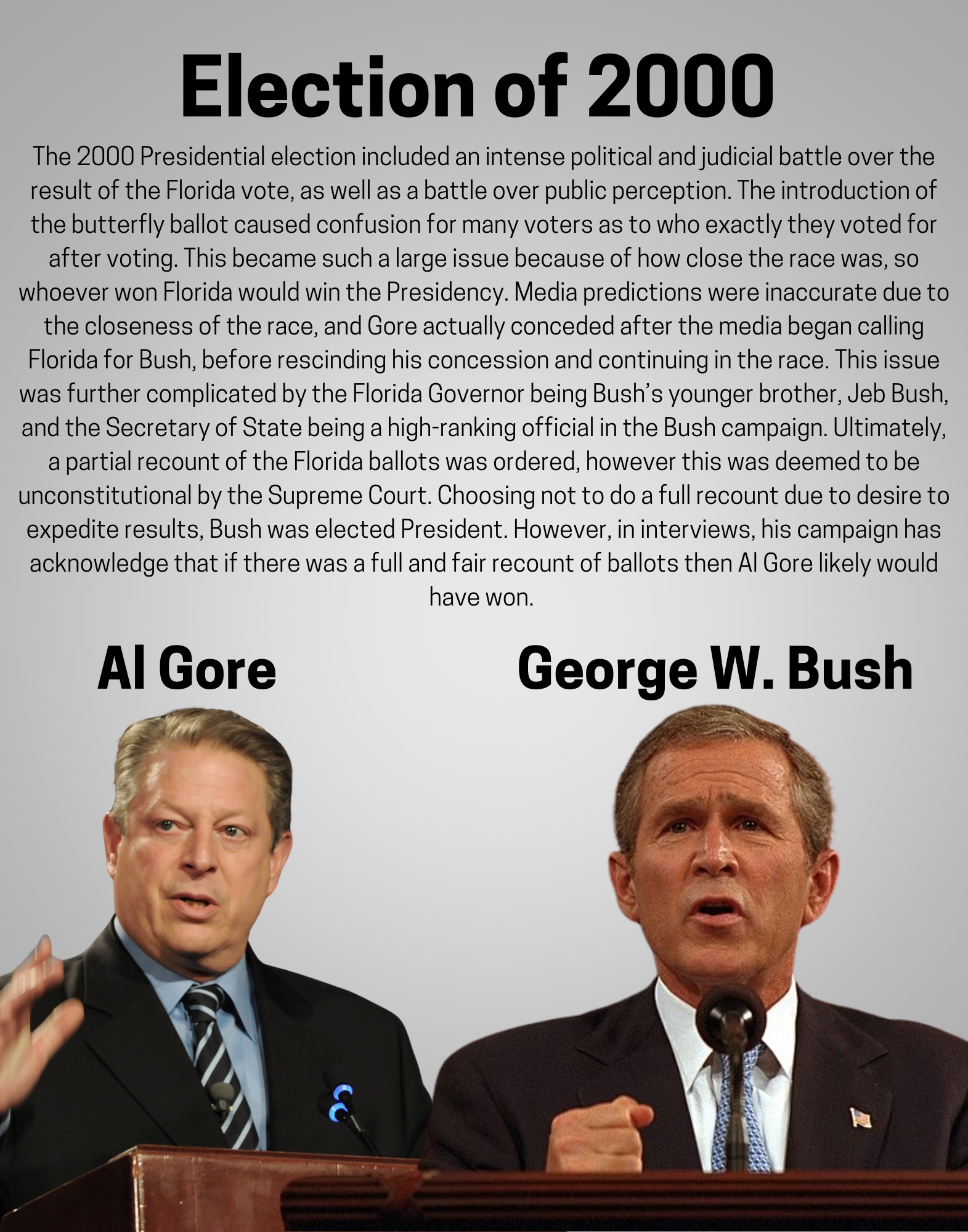
The 2000 election saw a tight race between incumbent vice president Al Gore and Republican party nominee George W. Bush for the presidency. The election was characterized by a battle between Gore and Bush for Florida, of which the result could decide the presidency. This was due to a new kind of ballot called the butterfly ballot used in the election, which made it confusing for voters to know who they were voting for. This means that some voters left the voting booth not knowing who they voted for, or even if they voted for the candidate they wanted to vote for.
What made this election unique compared to the other historic contested elections is that there was modern news media involved who were trying to call the election in real time. Conflicted news reports created confusion as to who actually won, which is in addition to the confusion about what should be done about the ballots. This meant that the election was sent to the courts. The issue with this, is that Bush had seemingly won the vote by the ballots, however many believed that Al Gore would have actually won the popular vote if you considered the amount of people who intended to vote for Gore and were unable to due to the election system.
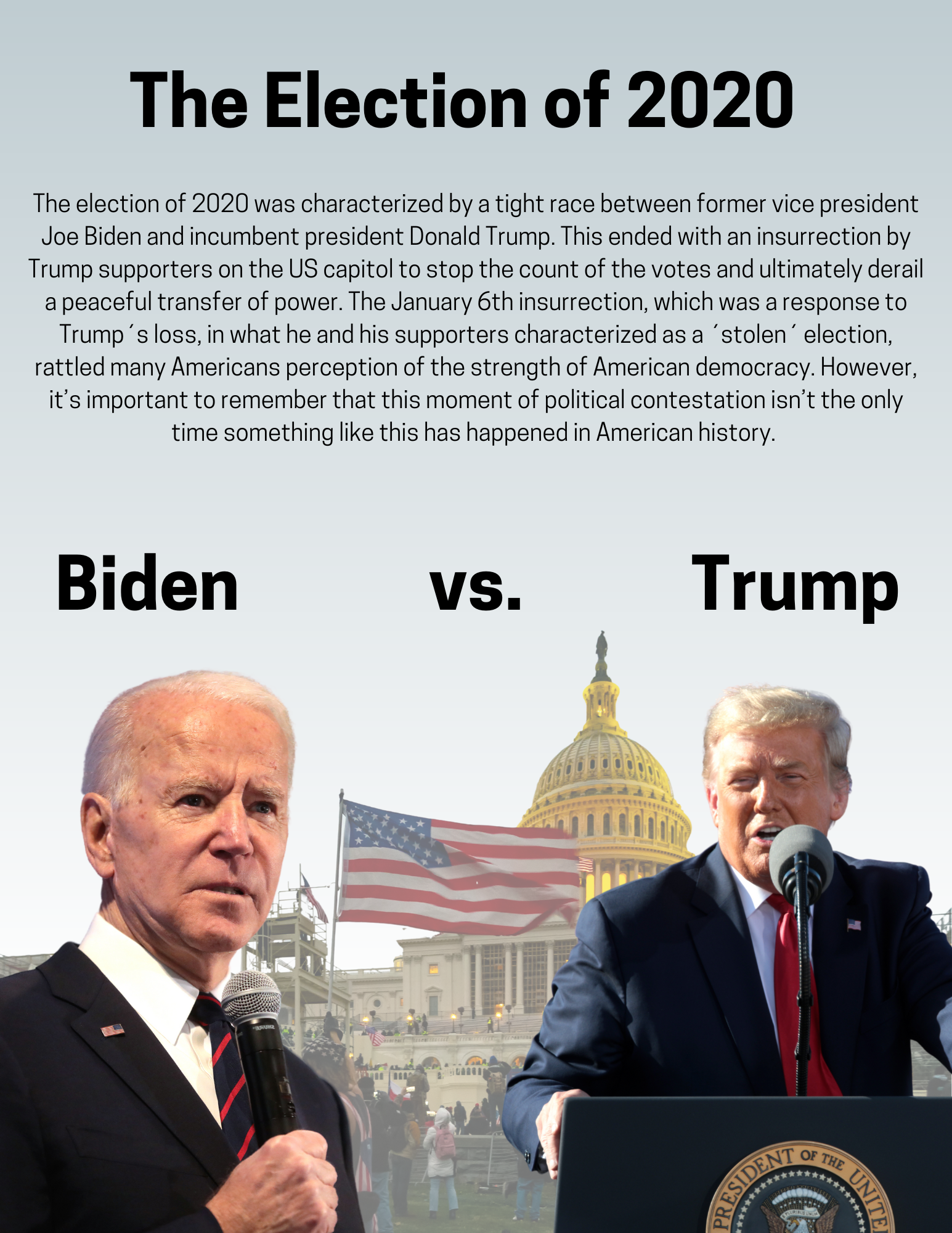
The instability caused by this crisis rattled the legitimacy of the election. Many media outlets called for the candidates to respond, including the Washington Post in an article titled “A Time to Act Presidential” which called for both candidates to endorse a full recount of Florida. This call for action is very interesting as it reflects how this crisis of legitimacy didn’t just affect who won, but it affected how the winner would be perceived as a president based on how they acted during the crisis. Applying this idea to a more recent election, Trump’s refusal to accept the results in 2020 was a huge hit to this credibility. Only time will tell how much this hit to his credibility will really matter when it comes to the 2024 election.
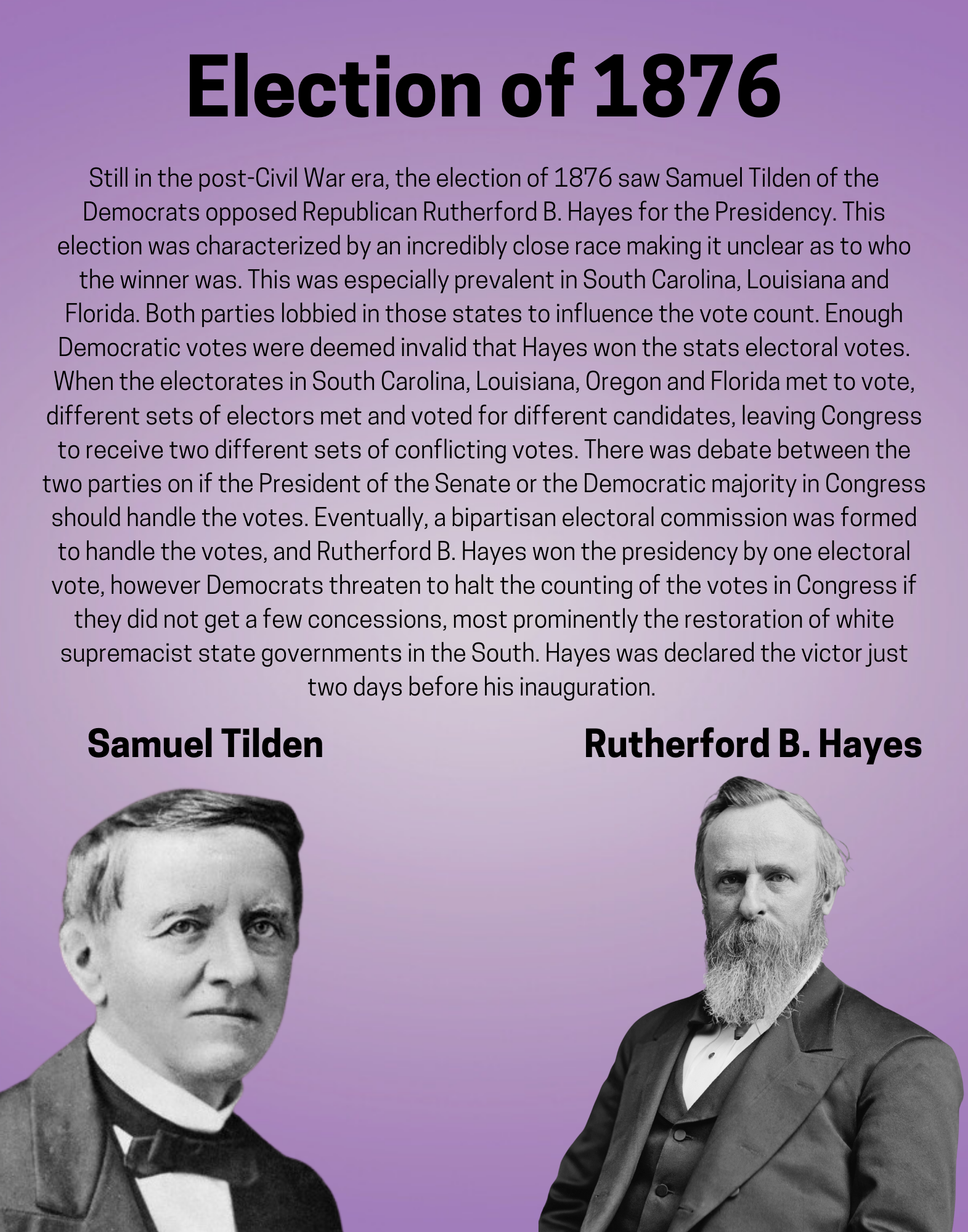
The election of 1876 was characterized by uncertainty and how close it was. The race was between Republican Rutherford B Hayes and Democrat Samuel Tilden. Tilden did win the majority popular vote, however he did not win the presidency due to the electoral college. Hayes won the college by only one vote, making this election incredibly close and controversial. This election draws parallels to the anticipated 2024 election between Vice President Harris and former President Trump. The upcoming election is anticipated to be a close race.
The election of 1876 was somewhat concerned with legitimacy, which is an issue we face right now in the fallout of the 2020 election and widespread fear over voter fraud. In 1876, Rutherford B Hayes had 20 contested electoral votes and 165 certified votes, while Tilden had 184. According to the webpage “Disputed Election of 1876” by Sheila Blackford, a commission was created to combat this issue. The commission was a compromise as the Constitution dictated that the then President of the Senate, Republican Thomas W. Ferry. However, the Democrats argued that Congress, which had a Democratic majority, should decide instead. The commission was made through the Electoral Commission Act, which made a commission of two Democratic senators, three Republican senators, two Republicans representatives, three Democratic representatives and five Supreme Court justices. The job of the commission was to handle the election votes. What’s very interesting about this election though, is that Hayes was initially against the commission but later came around to support it because it would bring greater legitimacy to the election.
This parallels many of the fears people have about the upcoming 2024 election, especially following the 2020 election which was marred with issues about legitimacy. The Washington Post article, “American Democracy is in Trouble–Even If Harris Wins” by Perry Bacon Jr. lays out some anticipated outcomes of the election. Even in the best case scenario for Harris, Bacon Jr. is concerned that conservatives won’t see her, a “liberal Black woman from California”, as a legitimate president.
All of these outcomes are concerned with legitimacy as the immediate election following the January 6th insurrection, which was a crisis of legitimacy so great it caused people to storm the Capitol building to stop the counting of the votes. As this election looms closer and closer, we can only wonder if we’ll be facing a similar crisis of legitimacy for the 2024 election, and, if so, what we can do to fix it.
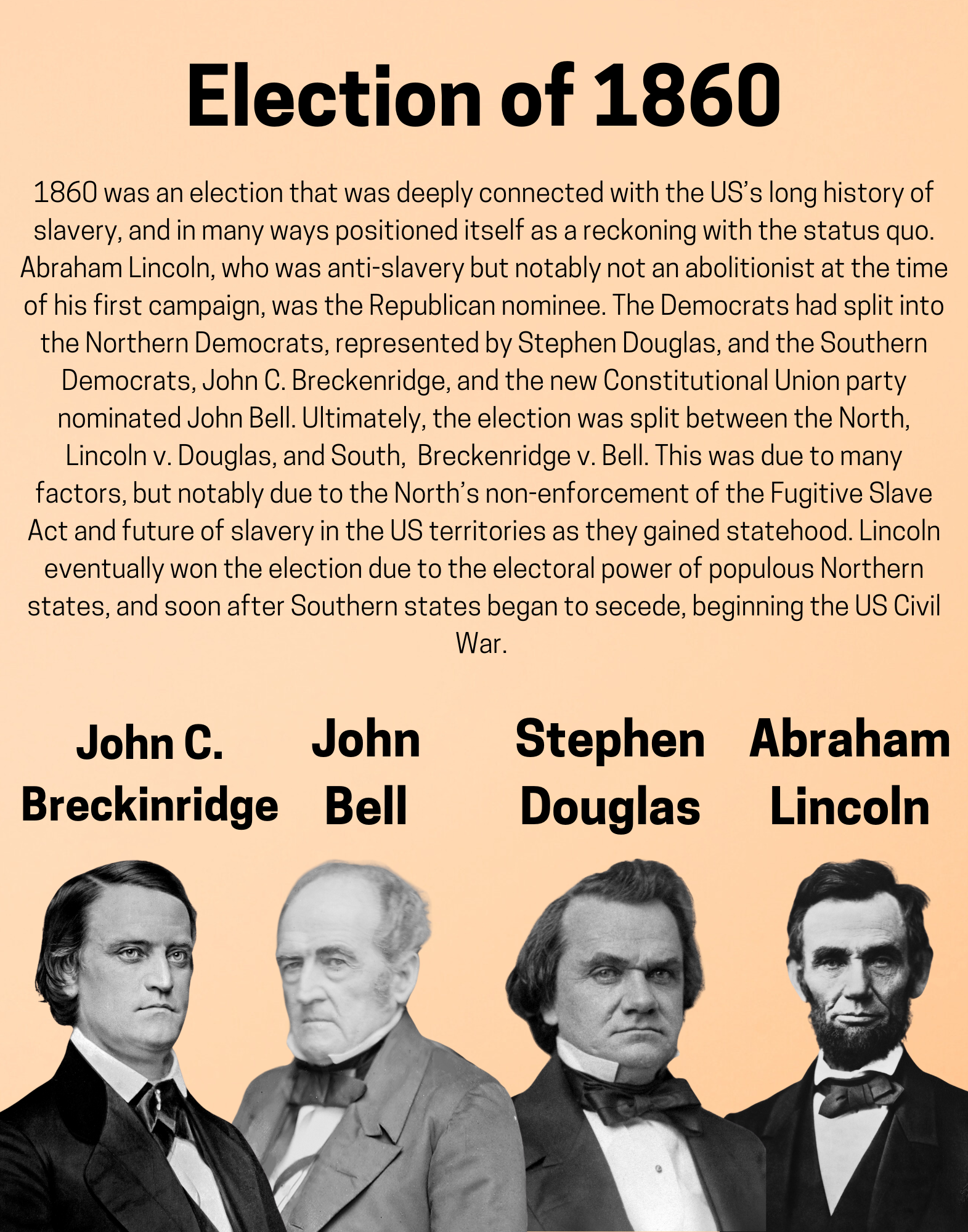
The election of 1860 saw the continuation of slavery as an integral political issue. The election of Abraham Lincoln, who was anti-slavery, but notably not abolitionist, ignited these tensions so much that it was a major contributor to the South’s secession from the Union. Often, the mythos surrounding secession is that it was due to states rights, and that the federal government was infringing on their rights. This poses the question, does imposition by the federal government really equal less freedom?
In 1860, Abraham Lincoln spoke at the Cooper Union and gave a powerful and impactful speech which ultimately argued that the federal government had the constitutional right to control slavery in the states. This would mean that the power of the federal government would supersede the power of the states when it comes to issues regarding slavery. Many of the Southern slave states didn’t like this, so much so that they succeeded from the Union. In South Carolina’s declaration of succession, they claim that “the frequent violations of the Constitution of the United States, by the federal government, and its encroachments upon the reserved rights of the States, fully justified the State in then withdrawing from the Federal Union.”
This shows that not only did states, in this instance South Carolina, think that the power of the federal government was overreach, they thought that it was so overreaching that it nullified the constitution. Looking towards the present to other issues regarding states rights, it becomes apparent that freedom for the states for the states to make their own decisions on issues doesn’t necessarily mean the freedom for people in the states. For exact, take the aftermath of Dobbs v. Jackson, which returned the issue of abortion back to the state by revoking the federal protection that came about from Roe v. Wade. However, despite the decisions being given back to the states, something that should have made it ‘freer’ as the federal government is no longer dictating what abortion bans states are or aren’t allowed to implement, most people who needed abortion as a civil liberty have actually seen less freedom for themselves with the bans.
The idea of state rights against the overreach of the federal government doesn’t ensure freedom for the people, it ensures freedom for the states to do what they want.
Additional Source:
Lincoln’s speech from the Library of Congress (https://www.loc.gov/exhibits/lincoln/the-run-for-president.html) titled “Lincoln’s Cooper Union Address”
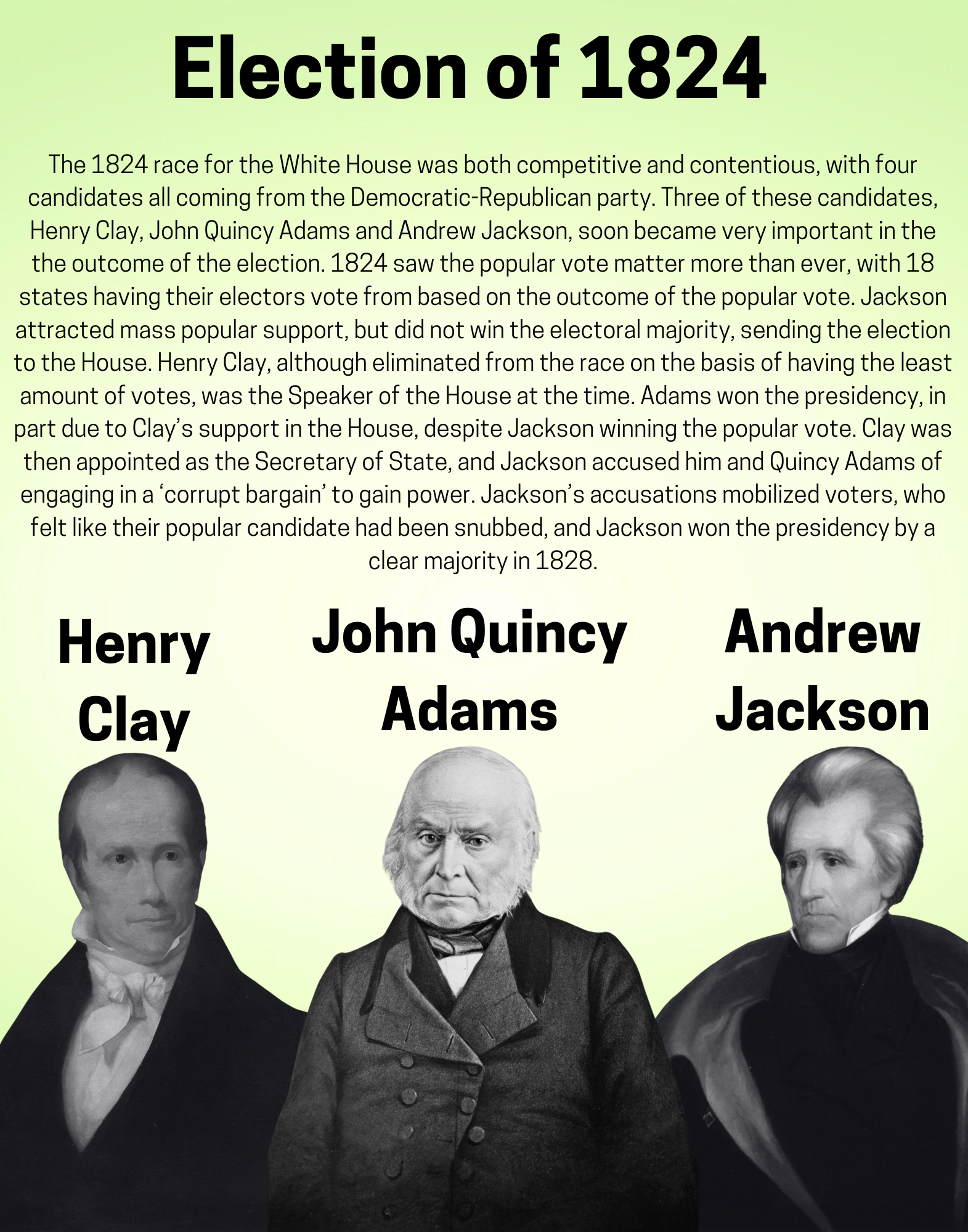
The election of 1824 saw Andrew Jackson, John Quincy Adams, Henry Clay, and William Crawford interlocked in a terse competition for the presidency, resulting in a presidential term for Adams and a bitter defeat for Jackson. However, the 1824 election has been rife with controversy, contempt, and accusations that Adams and Clay engaged in a ‘corrupt bargain’ that handed Adams’ the presidency when it should’ve gone to Jackson. It’s difficult to know if this bargain ever really happened, but the story goes that Henry Clay, who was the speaker of the house at the time, promised his support to Adams’ run for the presidency and, after Adams’ victory, Clay would be appointed as the secretary of state. This ‘bargain’ was only possible because none of the candidates received a majority of the votes in the electoral college, sending the election into the house of representatives.
Despite Adams winning the presidency, Andrew Jackson did win the popular and electoral votes. To him, this political loss seemed more like a conspiracy. This resulted in a hatred for Clay, whom he referred to as “the Judas of the West” in a letter advisor and friend William Berkeley Lewis sent on February 14th, 1825. The letter is accessible through the Library of Congress’s digital collections, specifically within the Andrew Jackson Papers’ selection. In this letter, Jackson is sharing the news to Lewis about Clay’s upcoming appointment as Secretary of State. He ends the letter claiming that “[n]o imputation will be left as [the senate’s] door”. Jackson went on to win the election of 1828.
Scholar’s have brought into question on how completely Jackson won the popular vote, such as Donald Ratcliffe, in his paper “Popular Preferences in the Presidential Election of 1824”, published in the Journal of the Early Republic, as well as the existence of the corrupt bargain, however the effects of the undemocratic perception of the election of 1824, legitimate or not, had a serious impact on future elections. According to the article, “Corrupt Bargain” from UVA’s Miller Center, by Margaret Hogan, the number of voters in the presidential election doubled from 1824 to 1828 and Andrew Jackson won the presidency in a landslide election.
Jackson’s loss during the 1824 election mobilized voters and drastically increased voter turnout, which could have parallels to the upcoming 2024 election 200 years later. Former president Donald Trump lost the 2020 election to now president Joe Biden, however his loss was colored by accusations of fraud and conspiracy, resulting in many claims that the election was stolen. Although these accusations were widely proven to be wrong, as seen in this AP article fact checking the former president’s claims, that doesn’t mean that they won’t have any impact on the 2024 election. Trump’s story, true or not, certainly calls back to Jackson’s alleged election snub. It’s important to acknowledge that we are living in different times and different circumstances than Jackson did, with expanded communication through social media and a very defined two-party system. History cannot dictate what happens next, but it can provide context, so I wouldn’t be surprised if as we see November 5th approach, we also see Trump supporters and the Republican party become louder and more mobilized.
© 2026 Contested U.S. Presidential Elections (Fall 2024)
Theme by Anders Noren — Up ↑
