
Many have drawn parallels between Andrew Jackson and Donald Trump. Although separated by 200 years, Jackson and Trump share many qualities, the most notable being their refusal to accept their presidential election results. According to David Brown, a history professor and author of a biography of Andrew Jackson, Jackson and Trump are the only two major American presidential candidates to challenge the results of an election. David Brown points out in this Time magazine piece that even Richard Nixon, someone generally viewed as a highly corrupt and self-interested figure, bucked calls from within his party to contest his electoral defeat. Brown writes that Jackson, like Trump, set the groundwork for his claims that the election was rigged against him before it was even certain he would lose. In the 1824 election that Andrew Jackson contests, there were four major candidates, resulting in Andrew Jackson winning merely a plurality of both the popular vote and electoral college, sending the race to a contingent election in the House. In Trump’s 2020 election, his opponent did win a majority in the electoral college, but Trump and his allies still tried to overturn the results in Congress. However, the claims by both Jackson and Trump that their elections were stolen from them are without evidence at best and blatant lies at worst.
But it isn’t just unsubstantiated claims of election fraud that unites Trump and Jackson. They also share several other traits. Most prominently, both Jackson and Trump ran on a populist message, and both have a tendency to resort to conspiracy theories to gin up public opinion. Additionally, both men ran for president in the immediate subsequent election to the one in which they lost and claimed fraud. The eventual administration of Andrew Johnson also expanded the purview of executive power and initiated the forceful relocation of hundreds of thousands of people, as Donald Trump hopes to do in a second term.
These similarities are not lost on Donald Trump, who compares himself to Andrew Jackson and claims Jackson was unfairly persecuted. Close current and former aides to Donald Trump see Jacksonian populism, as a guide for Trumpian populism to follow, as shown by the positive views of Jackson from Rudy Giuliani, Steve Bannon, and Tom Cotton, and the prominent placement of Andrew Jackson’s presidential portrait within the Oval Office. One noteworthy example of Trump’s admiration for Jackson is from when he held an event honoring Native American code talkers. At this event meant to honor pivotal American veterans, Trump speaks with a portrait of Andrew Jackson–the signatory of the Indian Removal Act which led to deadly events such as the Trail of Tears–behind him. This contrast is shown in the image of the event below.
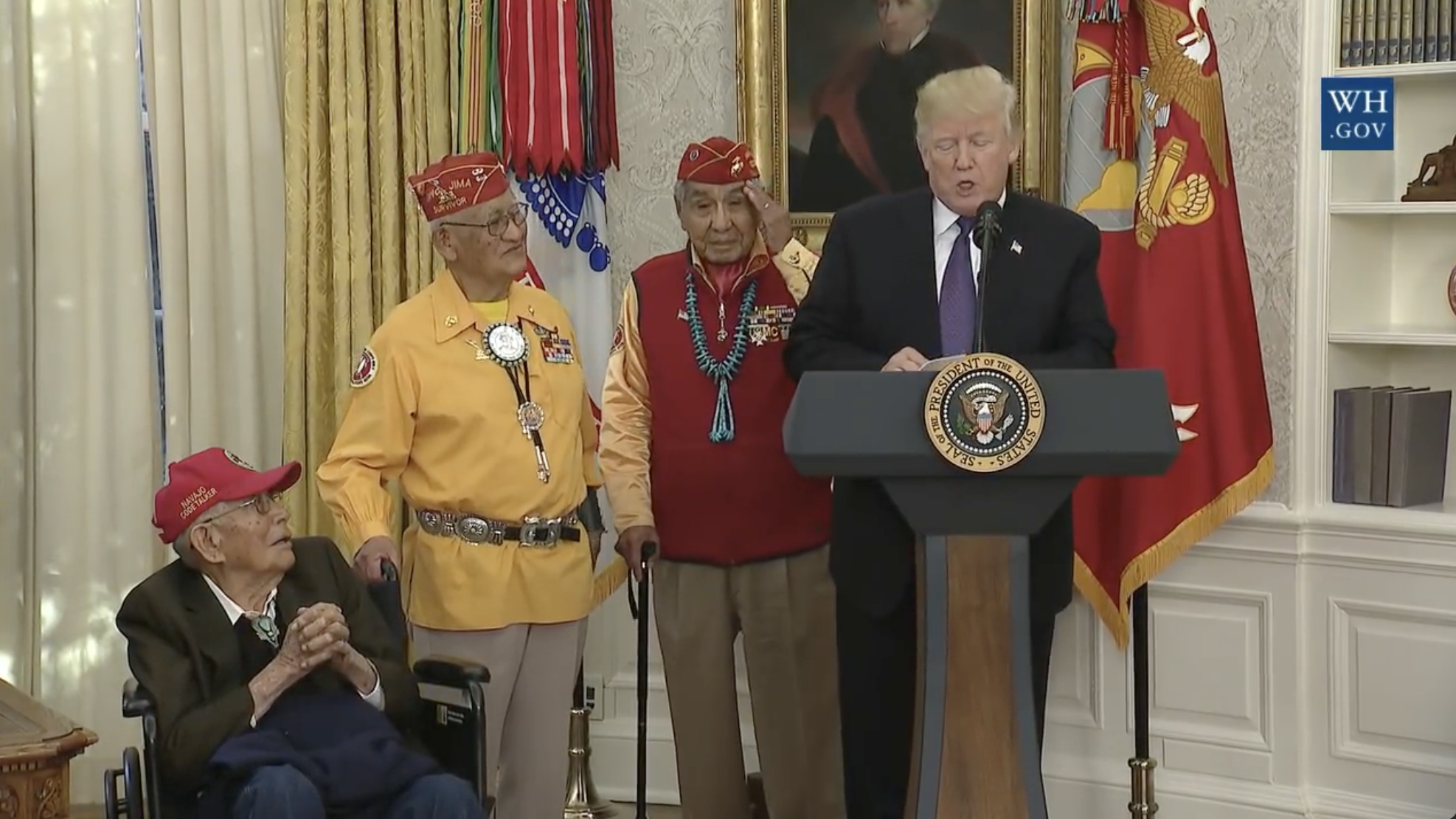
President Trump Hosts an Event Honoring the Native American Code Talkers, The White House, 27 November 2017 (Screenshot from video)

This is an interesting comparison and the similarities are numerous as you highlighted. The recent Supreme Court case on immunity serves as an example of expanded executive power (in the sense that the legal system is no longer a straightforward check on the executive). That may make it easier for any president to expand the power of the executive as things like Trump trying to force the DOJ to validate election fraud claims (https://americanoversight.org/investigation/trumps-pressure-campaign-on-the-justice-department-to-overturn-2020-election-results/) are now likely immune (https://www.nbcnews.com/investigations/trump-doj-officials-supreme-court-made-easy-trump-attack-enemies-rcna160144). I wonder how that would play into the deportation promise that you linked considering the DOJ oversees the immigration courts. It is also interesting that the DOJ hadn’t existed under Jackson which is another example of executive power expansion (and on a sad note the early DOJ that fought to defend civil rights may now be used to weaken one of the key civil rights – voting).