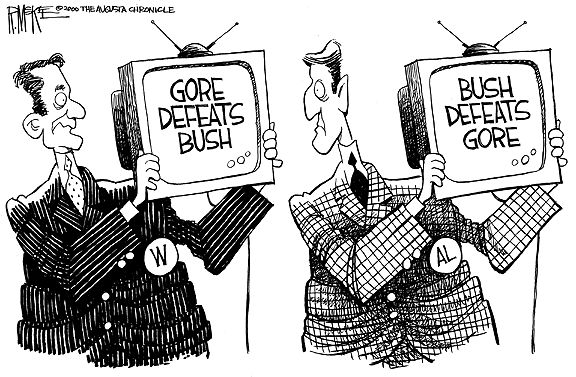
It is the year 2000 and as a believer in the American ideal of democracy, you want a fair and free election. The good news is that both of the candidates agree! The bad news: state courts will feud with federal courts, the powers afforded state legislatures will clash with interpretations of federal law, and the only bipartisan agreement will be lawyers from both sides making money.
November 7 approaches and passes without a winner. Razor-thin voting margins are deciding states across the country. Florida emerges as the deciding factor with its 25 electoral votes being enough to guarantee either candidate the Presidency. Supporters of Gore breathe a sigh of relief: all major news organizations just declared him the winner of Florida. Their method of analysis needed to be revised though. Exit polls were inaccurate and Bush appeared to be winning the actual vote tallies. News anchors across America would return Florida to the undecided category and await the results. Bush seemed to be the favorite and networks would once again declare a winner of Florida – this time being Bush. After another retraction, with the state once again becoming undecided, the Florida Election Code would necessitate a machine recount with Bush ending after with a historically slim lead of 327 votes.
The Gore campaign calls for hand recounts in the key democratic counties of Volusia, Palm Beach, Broward, and Miami-Dade. The Florida Secretary of State would keep the requirement for counties to submit votes by November 14. Manual recounts would fail to meet the deadline and the Gore campaign would sue to extend the required reporting date. The Florida Supreme Court ultimately decided to allow the counties to manually recount if they needed to. During this, the Bush campaign would unsuccessfully sue to halt the manual recount. Likewise, Judge Terry Lewis would rule that the Secretary could certify the election results without a recount. The Florida Supreme Court would step in again to halt this decision and support hand recounts until November 26. Republican legislators would convene to certify the electors at this point and the Florida Supreme Court would back manual recounts of all “undervotes” (a term that means a discarded ballot due to unclear markings). The next day the U.S. Supreme Court would block the ruling after hearing arguments from Bush and Gore’s legal team and issuing their controversial opinion outlined in Bush v. Gore that the “Equal Protection Clause” was violated. Gore would concede after this and Bush would be awarded Florida’s electoral votes winning the Presidency.
Opinions differ today. Looking at “The Unbearable Rightness of Bush v. Gore” where Lund argues that the partial recount ordered by the Florida Supreme Court constitutes “a form of vote dilution” and that the Florida Supreme Court issued opinions that do not reasonably fit within processes outlined in Article II of the Constitution that states, “Each State shall appoint, in such Manner as the Legislature thereof may direct, a Number of Electors”.
Lund argues that the Florida Supreme Court was ruling in opposition to the legislature’s view that the election was ready to be certified, violating Article II. Central to that disagreement was the Florida Court’s assumption that close elections created enough uncertainty about outcomes to justify recounts even if the burden of proof that recounts would change the results hasn’t been met. Lund argues that this logic is undermined by the Florida Court’s decision to request recounts only with ballots that Gore contested (Lund specifically highlights the recount of Miami-Dade being the 9000 “undervotes” and not the entire county or simply a statewide recount). The court would also order some votes to be added to Gore’s certified totals, including ones that were only partially recounted.
Yet, the Florida Supreme Court ultimately dictates what Florida law is valid and what isn’t. Could the Florida Supreme Court make such an erroneous decision in interpreting that law (that governs the legislature) that it betrays the power given to the legislature in the Constitution? In Bush v. Palm Beach County Canvassing Board, the (Federal) Supreme Court would hold that when it comes to choosing electors the state legislatures get their power from Article II of the Constitution which supersedes the Florida Supreme Court interpretation.
Secondly, Lund (agreeing with Bush’s argument in Bush v. Gore) argues that selectively recounting was improper. Why so? For example: If Gore was able to successfully challenge the results in the specified countries it established a precedent that candidates could obtain a geographically biased recount in a statewide election. Would this not be in opposition to the Equal Protection Clause of the Constitution?
Simply, did the Florida Court’s decision create an untenable mess of an election system? Lund argues it did, and the Supreme Court’s decision was correct in Bush v. Gore.
The case isn’t settled yet though, Laurence H. Tribe offers a subtle rebuttal titled “The Unbearable Wrongness of Bush v. Gore”. Does Article II impose substantive constraints on a state court’s power to interpret its state election laws, does the Equal Protection Clause mandate precisely drawn and completely uniform standards for recounting electoral ballots? Tribe finds it questionable how Lund dismisses these difficult procedural questions.
Tribe argues that the court’s interpretation of the Equal Protection Clause conflicts with its remedy to halt the recounts. He presents Bush v. Gore as fundamentally an issue for a state court that the Supreme Court had no business intervening in. Why? First, Tribe highlights that Article II, the Florida Supreme Court overstepping its bounds and conflicting with the state legislature’s constitutional powers, failed to convince a majority of the Justices (who ruled exclusively on equal protection grounds). Tackling the Equal Protection Clause, Tribe points out that by discounting recounts as a form of selective vote counting you give zero protection to the ballots that remain uncounted and potentially valid. Especially concerning is the idea that if the Florida Supreme Court had improperly ordered recounting the correct remedy would be halting the count process instead of proposing an alternative.
Adding on he points out that recounting specific ballots would not violate the Equal Protection Clause if one asks the reasoning for the special treatment of those ballots. Was it based on race, gender, or a specific category or voter? Tribe argues no. The court has been lenient with giving extra weight to voters based on political partisanship and Tribe cites Gaffney v. Cummings where the court allowed gerrymandering expressly designed to help incumbent politicians as long as it wasn’t disenfranchising a group of people based on race, gender, or any constitutionally recognized group.
Lastly, Tribe rejects the notion that the recount was a form of court activism. It was not guaranteed to help Gore, not shown to only help Gore, and perhaps could have helped Bush. In the first place, if there was a “partisan” choosing of the four democratic-leaning counties to initiate a manual recount it would have been due to Gore petitioning the court. If Bush had petitioned the court (through the legal means laid out in the Florida Constitution) he could have had recounts in close counties. The Florida Supreme Court had responded to the only requests for recounts they had in front of them. Lastly, Tribe highlights the Florida Supreme Court only permitted looking into whether a thrown-out ballot was legal, it did not underweight any of the legally cast votes.
The election of 2000 showcased two partisan parties using legal means within our system to dispute a too-close-to-call election. It highlighted an oddity of the United States system that appeals to a constitution and written set of laws but ultimately cedes authority to an unelected court to interpret those laws. In 2000, the Supreme Court opened the door to intervene in state elections when it disagreed with a state court. This year the state court decides if Pennsylvania (a close substitute for Florida in 2000) can throw out “undated ballots”. Could the Supreme Court be appealed to again in another decisive election?
Bush v. Gore is remembered by some as a partisan decision that further discredited the Supreme Court and by others as an authoritative court blocking partisan challenges. Today the Supreme Court further intertangles itself into state election processes with cases granting broad immunity to Presidents like Trump v. United States, blocking Colorado courts that viewed Section 3 of the Fourteenth Amendment as prohibiting insurrectionists from office in Donald J. Trump v. Norma Anderson, and allowing South Carolina to use a congressional map that had previously been ruled discriminatory (which seems at odds with the Equal Protection Clause reasoning) in Alexander v. South Carolina State Conference of the NAACP.
The Supreme Court’s willingness to intervene in electoral matters increasingly creates uncertainty over how state laws surrounding elections will be held up. Whether you agree with Lund or Tribe, is an increasing reliance on unelected courts safeguarding our democracy? While it may prevent partisan abuses, it could also deepen distrust in the democratic process if the court becomes viewed as the partisans themselves. Bush v. Gore served as a warning for the future: increasingly close elections in battleground states will find their ultimate resolution not at the ballot box, but in the courtroom. If elections are decided in the courtroom, where does that leave us, the voters? Courtrooms should not become the ultimate deciders of elections and the best defense against that is following the intention of the Constitution: focusing on counting every vote, not partisan conflicts deciding which vote counts.
Sources:
https://www.law.cornell.edu/wex/due_process
https://constitution.congress.gov/constitution/article-2/
https://www.law.gmu.edu/pubs/papers/03_33
https://papers.ssrn.com/sol3/papers.cfm?abstract_id=267874
https://www.jstor.org/stable/10.7864/j.ctvddztfj
https://www.npr.org/2024/09/26/nx-s1-5111886/pennsylvania-mail-in-ballot-lawsuit-2024-election