Grinnell College Logo

Contested U.S. Presidential Elections (Fall 2024)

HIS 295, Professor Sarah J. Purcell

Page 6 of 10

U.S. Politics: Abnormality is the Norm

Most might not know the name of Rutherford B. Hayes or remember anything special about him and his presidency, but his election to the presidency might show us that our current political atmosphere is not as special as we might think. 

The election I’m talking about is the election of 1876. What was so interesting about this election is not the campaign but what followed. The parties were the same as they are today but  the base was a bit different than what we see today from the Democrats and Republicans. Democrats had their support in the former confederacy and from immigrants across the nation while Republcian’s strength was found in the north and out west. The Republicans nominated Governor of Ohio Rutherford B. Hayes to succeed 18th president Ulysses S. Grant, while the Democrats nominated the northerner New York Governor Samuel J. Tilden. Here is where things got weird. First off, no one really knew who won. Some papers just sided with the candidate they supported and declared them the winner like “The National Republican” that declared Hayes the winner and others like “The Louisiana Democrat” ran headlines that said that Tilden won and the Republican rule was over. While in the electoral college, things would become messy to say the least. In Oregon, one of the electors for Hayes was replaced due to the fact he was a postmaster and being a “federal office holder” disqualified you from being an elector. He was replaced by a Tilden elector by the Governor. While in Louisiana, South Carolina and Florida “White thugs had stuffed or stolen ballot boxes, intimidated black voters, and printed Democratic ballots with the Republican symbol to trick illiterate voters.” (Ross, 2016).  As a compromise between the Democrats who controlled the House and the Republicans in the Senate, both parties agreed to a plan to have a bipartisan commission with five Republicans, three senators and two representatives, and five Democrats, two senators and three representatives. The commission would also include Supreme Court Justices, three appointed by Republicans, two by Lincoln and one by Grant, and one appointed by the Democrat James Buchanan. However, Justice Stephen Johnson Field was a Democrat so the leaning composition was really two and two. There would also be an independent Supreme Court justice appointed by Lincoln but he resigned to be a senator and was replaced by Joseph P. Bradley, appointed by Grant,  who was considered to be the most moderate of the Republican appointed justices on the bench. In the end, the vote was unsurprising with Hayes winning 8-7, and Hayes was inaugurated. However, things were not done just yet and the Democrats had a last card up their sleeves. They threatened to filibuster the commission until inauguration causing it to be thrown in the House where they had the majority. To avoid this constitutional shenanigans “…four Southern Democrats met with five Ohio Republicans… in return for the presidency, to allow “local self-­ government” in the South.” He would pursue a policy of noninterference in Southern affairs, order federal troops to stop protecting the remaining Republican governments…” (Ross, 2016). This deal would be called the “Compromise of 1876” and was viewed as the end of Reconstruction. 

Sure, compared to the last century of politics, our two and half decades since 2000 might seem like a hot mess, but compared to 1876 things are pretty normal or even business as usual. We saw recently (in 2000) ballots being thrown out and their validity debated and many people remember the “hanging chad” debacle. Or, not new, is ‘not news’ agencies calling elections for people who did not win,we still see people today saying Trump won in 2020. This happened in Oregon when they replaced the Hayes voter too. Recently in Nebraska, we see  they almost changed the system of voting from a congressional system to a winner take all. I can say this about learning about past elections, living through this and talking to family, things will never be normal because U.S. politics is just not that normal.


References


E.W. Halsey. (1876, November 15). The Louisiana Democrat. [volume] (Alexandria, La.) 1845-1918, November 15, 1876, Image 2. https://chroniclingamerica.loc.gov/lccn/sn82003389/1876-11-15/ed-1/seq-2/


Sanderford, A. (2024, September 24). State Sen. Mike McDonnell deflates GOP hopes for Nebraska winner-take-all in 2024. Nebraska Examiner. https://nebraskaexaminer.com/2024/09/23/state-sen-mike-mcdonnell-deflates-gop-hopes-for-nebraska-winner-take-all-in-2024/


Ross, M. A. (2016). Rutherford B. Hayes. In K. Gormley (Ed.), The Presidents and the Constitution: A Living History (pp. 253–265). NYU Press. https://www.jstor.org/stable/j.ctt1803zfw


W.J. Murtagh. (1876, November 9). National Republican. (Washington City (D.C.)) 1872-1888, November 09, 1876, Image 1. https://chroniclingamerica.loc.gov/lccn/sn86053573/1876-11-09/ed-1/seq-1/
 

Soundtracking Elections

Music has long played an instrumental role in American public life, and it has especially made an underrated impact on American politics. The social effect musicians can have on the general public is truly insurmountable. From songs like Give Peace a Chance by John Lennon to We are the World by U.S.A. for Africa, music has been used as a tool to galvanize the American people to a point of action. In instances of presidential elections, the effect is similar; music is used to arouse support for presidential candidates.

The importance of music in presidential campaigns has become especially evident in the 2024 presidential election. Headlines like More and more artists want Trump to stop using their music dominate the news, as artists fight for their rights over their own music.

Though the use of music has evolved, employing music as a campaign strategy is not a new approach. Earlier campaigns, such as the election of 1876, also utilized music as a campaign strategy. 

The election of 1876 was a heated one between Republican Rutherford B. Hayes and Democrat Samuel J. Tilden. As the election was ramping up, the candidates needed songs to soundtrack their campaigns. Because of this, catchy tunes began to circulate with supporters.

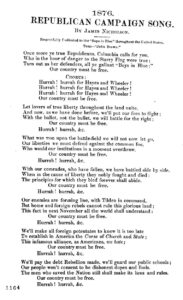
Republican Campaign Song, 1876

One tune, the Republican Campaign Song, was a sheet of lyrics created and distributed by advocates for Hayes. The lyrics of this song expressed support for Hayes and Wheeler’s Republican ticket. The lyrics give reference to battles and the rebellion, pointing to the recent Civil War and secession.


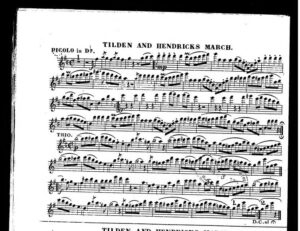
In addition to these tunes meant to be sung by the common man, sheet music was produced for musicians to play as well. One example of this is the Tilden and Hendricks March music. This nineteen page score was most likely played during campaign speeches or parades. Associating music to a specific candidate was a smart way to get more of the senses involved during a presidential election.  


Tilden and Hendricks March, 1876


Now, in a modern day context, politicians aren’t relying on their supporters to write music for them, they are using musicians’ copyrighted songs and applying them to their own campaigns. This, as one could imagine, has been much cause for controversy if done illegally. In fact, over the years, Trump has received many cease and desist orders from artists who don’t want their music associated with the Trump Campaign. And 2024 is no different. Artists like Beyonce and Celine Dion have made public statements barring Trump from using their music, all on top of taking legal action. This evolution of music being made for a candidate like what we see in 1876 to taking a musician’s work without consent in 2024 is truly thought provoking. When has the collision of creativity and politics gone too far?


Sources:

RollingStone, “All the Artis’s Who Don’t Want DonalD Trump Using Their Music,”  RollingStone, August 30m 2024 https://www.rollingstone.com/music/music-lists/all-the-artists-who-dont-want-donald-trump-using-their-music-1235080043/r-e-m-8-1235080077/

Tracy Smith, “A Political Playlist: The Fight over Campaign Songs,” CBS Sunday Morning, September 8, 2024 https://www.cbsnews.com/news/a-political-playlist-the-fight-over-campaign-songs/

Harris and Obama comparisons are natural. The Harris campaign should lean in.

As the Harris campaign unfolded after Biden’s withdrawal from the election, there was an undeniable excitement brewing in the Democratic party. Looking back, the tik tok edits, Charli XCX endorsements, and Lil Jon DNC performances brought a distinctly youthful energy to the earliest days of Harris’ campaign. For Gen Z voters like myself, the excitement behind the Harris campaign was a far cry from the 2016 and 2020 elections we remember most vividly. For older voters, the comparisons came quickly: it felt like 2008. 

The comparisons that have been made between 2024 Kamala Harris and 2008 Barack Obama are not necessarily about tangible policy issues. Instead, the comparisons focus on the sense of energy and excitement that their campaigns seemed to capture. Stefanie Brown James, Obama’s 2012 national African American vote director told U.S. News, “They are very similar in the way they do politics. It is very relational with an air of joy.”

Leaning into a political predecessor to inspire voters isn’t a novel idea. Donald Trump’s “Make America Great Again” slogan was previously used in 1980 by the successful Reagan-Bush campaign (United States Studies Centre). Reusing slogans or other campaign tactics that have previously proven successful is intuitive and resourceful. 

Source: United States Studies Centre


A similar strategy was used in 1876 by Rutherford B. Hayes and William A. Wheeler. Instead of generating an entirely new campaign song, the Hayes campaign recycled the melody from William Henry Harrison and John Tyler’s popular “Tippecanoe and Tyler, Too.” The new version – “Haye’s the True and Wheeler, Too” – appealed to older voters, successfully building a sense of nostalgia. For younger voters, the catchy melody created a similar sense of excitement as the original lyrics had in 1840 (Library of Congress).

Source: Library of Congress


As Kamala seeks to energize her base in the final month of her campaign, she doesn’t need to completely reinvent the wheel. Historical evidence shows that slogans, songs, and ideas that successfully energized Obama’s base in 2008 will hold up 16 years later.


Source:

Pop stars, massive crowds and history: How the Obama and Harris Campaigns compare, Phillip M. Bailey, Swapna Venugopal Ramaswamy, 8/20/2024, https://www.usatoday.com/story/news/politics/elections/2024/08/20/obama-kamala-harris-campaigns-compared/74772276007/

Voices, Votes, Victory: Presidential Campaign Songs, https://www.loc.gov/exhibits/presidential-songs/issues-and-slogans.html#obj7

Reagan: ‘Making America great’ the first time, https://www.ussc.edu.au/reagan-making-america-great-the-first-time

The Electoral Count: Robust or Weak?

While the situation on January 6th, 2021 in which Mike Pence re-asserted the pastoral role of the Vice President in certifying electoral votes was unique, both the Vice President and many others looked to the precedent of 1876 on how to proceed. With this in mind, how did the election of 1876 inform the electoral count in 2021, and what might this tell us about the upcoming election?
The election of 1876, between Republican Rutherford B. Hayes and Democrat Samuel Tilden, had a massive impact on the legacy and continuation of federal reconstruction efforts. More importantly for this discussion, it was a highly contentious election that ended with the election of Hayes being contingent on 20 disputed electoral votes. The dispute came from Florida, Louisiana, South Carolina, and Oregon, who all submitted multiple slates of electors to the Senate in hopes of preventing the election of Hayes. The solution that was chosen by Congress was a bipartisan commission of 15 Senators, Representatives, and Supreme Court justices. Eventually, with inauguration looming, the commission came to a decision, known as another “corrupt bargain” that elected Hayes in exchange for (essentially) the end of federal reconstruction efforts.
The facts of the election of 1876 invite many comparisons to 2021, although the comparison is not perfect. The concept of the electoral count being the place to challenge the results of the election is a major similarity, and the creation of alternate slates of electors unconnected to the vote returns is a major point of comparison.
These comparisons are not new or unique to years after the 2020 election. Instead, they were happening in the moment, and the election of 1876 was a guide for many people on both sides of the 2020 certification. For example, on the morning of Jan. 6th, Vice President Mike Pence, whose job was to oversee the certification, released a letter in which he commits to following the lessons learned from 1876, and to carry out the “largely ceremonial” role that he is assigned. As a lesson from 1876, Pence reasserted his role of not challenging the election, adding new language to the historical script of the electoral certification that helped to shut down challenges to the validity of slates of electors. At the same time, others used 1876 as a template for challenging the election. Minutes before the Senate was placed into an emergency recess and locked down, Republican senator James Lankford of Oklahoma called for the formation of a 15 member electoral commission, the same as the one created in 1876. By attempting to create this commission, it is possible that Lankford and other Republicans hoped to either re-elect Trump, or to create something with which to bargain.
What do these comparisons mean for today? Well, first of all, it can provide some comfort in recognizing that the American electoral system, while imperfect, is resilient, and has endured (potentially larger political) challenges before. Similarly, it is a reminder that electoral challenges are not uncharted territory, and that there exist (somewhat) robust systems to address challenges that worked in 2021, and could work moving into the upcoming election.

Elections in the Wake of Political Violence

After the events of January 6th, many are rightly concerned about the possibility of political violence and whether the results of the election will be free and honest. The country has seen how easily the results of an election can be resisted, and mobs motivated by partisan candidates can become unruly and dangerous. This is not the first time an election has come in the wake of political violence.

The 1876 election happened 8 years after the the election of 1868, one in which the KKK enacted mass political suppression and violence against the newly enfranchised black voters in the South. This election also came a decade after the end of the Civil War, the largest-scale act of political violence ever seen in America. It can then be assumed and confirmed by the documents that exist from the time that those living through the 1876 election had the same, if not greater, concerns that plague our modern-day election.

Though political violence and suppression did occur in the election of 1876, the government’s breakdown of the KKK after 1968  election was mostly successful in preventing that violence from being mass-organized. Instead, what made the 1876 election contentious was the voting count, namely that neither party was able to get a majority of the electoral votes due to unclear results in three southern states.

Bringing this back to a modern comparison, the breakup of the KKK could be compared to the government’s efforts to find and uncover the insurrectionists on January 6th and bring them to justice. The consequences these people faced might mean that this election will not be one made contentious by political violence, like in 2020 and 1868, but instead, one made contentious by a struggle to certify votes like in 1876. This possibility is already occurring in Georgia, where Trump’s stacked election board is making plays to resist certifying the election results and, therefore, create confusion come election day. If this were to occur, like in 1876, both sides might be forced to come together to find a subconsutional compromise like what happened with the 1876 committee and subsequent bargain. The question becomes, then, are we in 2024 capable of creating such a compromise to keep the union going, or are we more divided now than in post-civil war America?

Voter? I Hardly Know Her: When Gender is on the Ballot

In the election of 1876, suppression of black voters gained a new prong of attack: ideologies about gender roles. If white men won in former Confederate states like South Carolina, their ideologies of what a man’s role and a woman’s role ought to be would be reinforced as the ideal. Notions of masculinity and femininity for white Democrats were inextricable from white supremacy — and were key to their subsequent victory. If white men were the ultimate aggressors — or as they would call it, protectors — then white women were the ultimate victims. Through political cartoons and depictions of Columbia, of angels, and of America personified, white women dominated notions of purity and goodness.

White femininity, tied to virtue and piety as much as white masculinity was steeped in violence, was also a weapon to beat down black voters with. They were the standard against which black women were derogatorily compared, and their claims that black men had been aggressive against them always resulted in violence from their male protectors. Women of both races turned out in huge numbers in support of their chosen candidates (despite still lacking the right to vote) through clubs, canvassing, and attending rallies. White women acted out melodramatic scenes to play up their perception as a populace who must be protected at all costs.

Black people were therefore maligned as a threat against white men’s ability to protect white women — usually in highly sexualized language to paint black men as uncivilized aggressors and black women as demons of iniquity. Black women were the most passionate political participants despite having the least enfranchisement and least protection because as a particularly vulnerable group they had arguably the most at stake in the election. They were smeared by white voters as the antithesis to white femininity — and thus, the antithesis of good.

The goal of these ideologies of femininity and masculinity — and of these ideals being inseparable from whiteness — was to separate and subjugate, and determine once and for all what the roles of white men v. black men and white women v. black women were. The election of 1876 determined what the roles of women in politics absent the ability to vote were, and furthermore put white male dominance back on the political menu.

Gender ideology is once again at stake in the 2024 election. Hundreds of years of political precedent have established the presidency as a man’s job, and for the first time, a black woman has a good chance of winning it.

Donald Trump has built his campaign on the very same notions of white supremacy and masculinity that hallmarked the 1876 South Carolina gubernatorial race — anti-political correctness, whiteness as a virtue, and violence in the face of defeat. His political persona posits itself as the ideal of white masculinity, and his base feel empowered. Even his slogan — Make America Great Again — draws parallels to cries by white Democrats in 1876 to make politics white again. These parallels aren’t so much eerie as easily foreseeable: of course a culture where whiteness and masculinity are rewarded would see equal rights as a loss of advantage.

The threat that Kamala Harris poses to Trump is not just Democrat versus Republican. A Harris victory would redefine what a woman ‘can’ do — what a black woman can achieve. And rather than celebrate this as indicative of the American ideal that anyone can succeed, Trump’s followers will believe that her win is a threat to the white supremacy they have thrived under. A threat to white people, a threat to men — nevermind the forty-five other presidents and Harris’s own vice presidential nominee that prove white men are far from becoming a minority in politics.

Shirley Chisolm tried in 1972. Barack Obama elicited many of the same fears from white Republicans, all of which came to naught. What Democrats in South Carolina did in 1876 was re-assert white male dominance as the status quo, and thus as immutable — but Kamala Harris’s campaign has proven otherwise. Voter demographics are more important now than ever: college-educated white women are still a determining group, though now with equal enfranchisement to their male counterparts. Thus, race and gender are still practically inseparable in modern politics, and a Harris victory would assert that the place of a black woman in politics is in the White House.

Lessons From the Election of 1876…

…Will 2024 be the Same?

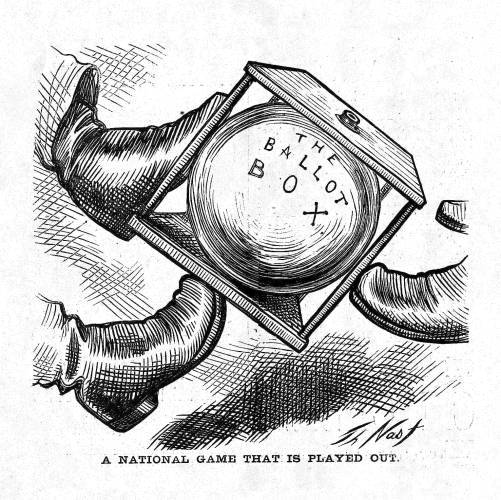
The election of 1876 at the time, seemed to be an election to end all elections. The election candidates were, Rutheford B. Hayes (Republican) and Samuel J. Tilden (Democrat). However, the turmoil of the election came to head during the counting of the ballots and subsequently affecting the electoral votes. Samuel J. Tilden won the popular vote in the United States but was one electoral vote short of winning the majority, that would make him President of the United States. However, the states of South Carolina, Louisiana, and Florida (19 electoral votes) and 1 electoral vote of Oregon was still in dispute. However, it wasn’t until the United States Congress created the Electoral Commission to break the deadlock between the two candidates. However, there was more than just the electoral votes that triggered this commission. Claims of stolen ballots and electoral fraud was reflected in the political cartoon from Thomas Nast (September 26, 1840 – December 7, 1902) published in Harpers Weekly on December 23, 1876. Thomas Nast, after  was considered the father of the American cartoon.

The political cartoon entitled “A National Game that is Played Out” demonstrates how the vote kept getting kicked between the four different states that had disputed electoral votes. The Republican controlled states disagreed with the votes because the Democratic controlled counties had put barriers for black, male voters. These barriers included creating false ballots, parliamentary violence, and violence against black, male voters. However, even within this corruption, to make sure the 1876 election went through they had to let white supremacy win for fear that a president would not be inaugurated on January 20th.

One would think that corruption techniques and claims would remain in the 1800’s but in the 2020 election, there once again was cries of voter fraud. Unlike in 1876 when there were ballot boxes stolen, 2020 had other election “fraud”. The sitting president (Donald Trump) claimed that the election was stolen (this was incorrect – he just didn’t want to admit that he lost) and claiming that dead people voted (how does a dead person vote?). However, the most bizarre claim came from an Arizona election audit team in Maricopa County who would be analyzing the ballots for bamboo fibers in order to make sure that China didn’t submit any ballots in the 2020 election. This investigation was done on the belief by some election officials who were allies to Donald Trump that China smuggled in ballots to interfere and influence the outcome of the 2020 election, which the US Intelligence Department deemed incorrect.

What about the future? Historians cannot predict the future but can use the past to interpret what is going on in the present. Former President Donald Trump, to this day, still believes that he won the 2020 United States Presidential election. Furthermore, he is turning to bully tactics comparable to the 1876 election with poll worker intimidation and intimidation of voters encouraging police to “Watch for the voter fraud, because we win without voter fraud… They’re afraid of you [police] people”. Democracy goes through cycles, and it is important to realize what goes around comes around – what happened in 1876 has and could happen again.

Voter Suppression: A Modern-Day Issue with an Extremely Violent History

In 2013, the U.S. Supreme Court ruled (Shelby County v. Holder) that key elements of the Voting Rights Act of 1965 – an act that put an end to many of the forms of voter suppression that had been used to effectively disenfranchise  voters of color since the era of post-Civil War Reconstruction (1865-1876) – were unconstitutional; namely, Section 4(b) of the Voting Rights act which provided guidelines to determine which jurisdictions were subject to Section 5 of the Act, which stated that jurisdictions with a history of voter discrimination must gain approval from the U.S. Attorney General or a federal court before making changes to any elements of election procedures and/or practices. In deeming Section 4(b) of the Act unconstitutional, the Supreme Court essentially nullified Section 5 of the act, by releasing all jurisdictions previously monitored under Section 4(b) from federal oversight, thus allowing these jurisdictions with histories of voter discrimination to enact new voting laws and procedures without the previously required federal approval (U.S Office of Public Affairs, “Reflecting On the 10th Anniversary of Shelby County v. Holder”, 2023). While acts, such as the Voting Rights Advancement Act (HR4), have been proposed to patch the holes that the Supreme Court’s Shelby County decision created in the Voting Rights Act of 1965, none of these rehabilitory acts have been instated, allowing discriminatory voting laws and procedures to continue suppressing voters of color.


The suppression of Black Americans’ right to vote is a modern issue with a very long and violent history. After the passing of the Fifteenth Amendment to the U.S Constitution in 1870, which guaranteed the right to vote to all citizens regardless of “race, color, or previous condition of servitude” (The Fifteenth Amendment to the U.S. Constitution  ), many white Southerners – particularly former Confederate Civil War soldiers – attempted to take matters into their own hands; which, through their violent attempts to gain control over the changing election landscape and suppress Black voters, would become and continue to be stained with the blood of Black Americans (Michael W. Fitzgerald and Mark Bohnhorst, “Reconstruction, Racial Terror, and the Electoral College” (2024), The Journal of the Civil War (Vol. 14, 1)).


In the U.S. presidential Election of 1876, rampant voter suppression and the resulting contestation of election results paved the path towards the destruction of Reconstruction era amendments and the prolonging of the country’s historic trampling of Black Americans’ civil rights. Contestation of the 1876 election began on election day and continued right up until the inauguration, as no winner could be determined due to conflicting results from two separate groups of electors in Columbia, South Carolina; Salem, Oregon; Tallahassee, Florida; and New Orleans, Louisiana — leaving Congress with 184 electoral votes for Democratic candidate, Samuel J. Tilden, and 165 electoral votes for Republican candidate Rutherford B. Hayes, with 20 votes still being disputed. These conflicting results, and arguments between the two parties as to whether the House of Representatives or Congress should be in charge of deciding the election, led to the creation of a (mostly) bipartisan Electoral Commission. This Electoral Commission would end up awarding the electoral votes from the states in question (OR, SC, FL, and LA) to Republican Rutherford B. Hayes. This decision was informed by, though not directly stated as the result of, the fact that the initial results from a number of districts in these states, which had reported a majority of their electoral votes for the Democratic candidate Tilden, were invalidated by the rampant fraud, intimidation, and racial violence committed during and ahead of election day by groups such as the Ku Klux Klan (KKK) in the name of white supremacist ideals and in pursuit of a Democratic party victory (Sheila Blackford, “Disputed Election of 1876”, The University of Virginia Miller Center). In other words, this Electoral Commission recognized that, as Michael W. Fitzgerald and Mark Bohnhorst argued in an article published in The Journal of the Civil War, “terrorist violence could manufacture Democratic majorities”, making many of the electoral votes for Tilden either effectively or literally (in the case of illegitimately selected “fake” electors) fraudulent (Michael W. Fitzgerald and Mark Bohnhorst, “Reconstruction, Racial Terror, and the Electoral College” (2024), The Journal of the Civil War (Vol. 14, 1)).

“Carnival of blood! Republicans to be massacred at the polls! Secret Democratic circular. Tilden’s desparate plan to carry a solid South … New York 1876.” – Library of Congress, Rare Book and Special Collections Division, Printed Ephemera Collection.

Despite both Democratic and Republican parties agreeing that the Electoral Commission would decide the Election of 1876, the results of the Commission’s decision faced backlash, with Democratic members of congress threatening a slew of measures to delay the resolution of the election in an effort to gain concessions from Republicans; namely, a federal railroad subsidy as well as more control over their state governments, which would, in turn, allow them to enact more racist laws and policies in an effort to further their white supremacist agendas (Sheila Blackford, “Disputed Election of 1876”, The University of Virginia Miller Center). The prospect of further delays scared many Republicans, including the apparent presidential elect Rutherford B. Hayes, as they feared what a prolonged contestation of the election would mean for the perceived legitimacy of the election results. In an effort to ward off these delays and appease Democratic politicians, Hayes made a compromise of unknown terms (known as the Compromise of 1877) with Southern politicians, which, as Michael A. Ross describes in his book The Presidents and the Constitution: A Living History, boiled down to Hayes pledging to, in exchange for the presidency, “pursue a policy of noninterference in Southern affairs”, remove troops from Southern states and, in removing these troops, allow Democrats to take control of any remaining Republican governments in Southern states (Chapter 19 of The Presidents and the Constitution: A Living History (2016) by Michael A. Ross). In making this compromise with Democratic leaders, Hayes ushered in the end of Reconstruction and set the stage for another century of extreme racial violence and many forms of discrimination – including, but certainly not limited to, voter suppression – in the American South.


While we as a country have certainly made progress towards ensuring that, in the words of Fifteenth Amendment of the U.S. Constitution:


“the right of citizens of the United States to vote shall not be denied or abridged by the United States or by any State on account of race, color, or previous condition of servitude”


we still have quite a ways to go, as evidenced by the continued passage of restrictive and discriminatory voting legislation in states with histories of voter suppression (The Brennan Center for Justice, “States Have Added Nearly 100 Restrictive Laws Since SCOTUS Gutted the Voter’s Rights Act Ten Years Ago” (2023)). This continued fight for equal voters’ rights makes discussing the history of voter suppression, as well as raising awareness for modern instances of discriminatory voting rules and procedures, incredibly important; especially today, post-Shelby County decision, and ahead of what is likely to be a very pivotal election which – in the eyes of LaTosha Brown, the co-founder of the Black Voters Matter organization – carries a high risk for instances of voter suppression as well as the proliferation of targeted misinformation and falsehoods among populations of Black voters, which can prove to be a covert but still dangerous form of election tampering (National Public Radio, “Disinformation and suppression loom over Georgia, says Black Votes Matter co-founder” (2024)).


Works Cited

(in order of first appearance)


U.S Office of Public Affairs, “Reflecting On the 10th Anniversary of Shelby County v. Holder”, 2023


The Fifteenth Amendment to the U.S. Constitution  


Michael W. Fitzgerald and Mark Bohnhorst, “Reconstruction, Racial Terror, and the Electoral College” (2024), The Journal of the Civil War (Vol. 14, 1)


Sheila Blackford, “Disputed Election of 1876”, The University of Virginia Miller Center


Chapter 19 of The Presidents and the Constitution: A Living History (2016) by Michael A. Ross


The Brennan Center for Justice, “States Have Added Nearly 100 Restrictive Laws Since SCOTUS Gutted the Voter’s Rights Act Ten Years Ago” (2023)


National Public Radio, “Disinformation and suppression loom over Georgia, says Black Votes Matter co-founder” (2024)

Scapegoats, scare tactics, and white fear: The lead-up to the 1860 and 2024 elections

After President Lincoln’s 1860 election victory, the end of slavery lay in wait, a latent threat for the Democratic party. Most of the Republican party saw no need for an immediate end to slavery and instead advocated for a gradual change. Lincoln noted in a debate with Stephen Douglas that the end of slavery would take “a hundred years at the least.” Yet, Democrats continued to insist Republicans wanted to abolish slavery then and now. 

One-off incidents turned to scapegoats in support of Southern secession. The raid at Harpers Ferry, led by abolitionist John Brown, threatened a cycle of repeat uprisings for Southern Democrats. The success of the Wide Awakes, a grassroots political movement based in Democratic strongholds across Northern states, was bad enough; even worse was when Black men began marching with the group in their processions and “confirmed the southern narrative of the coming Republican apocalypse.”

Democratic papers used scare tactics in their reporting of these one-off events. When Black men started showing up to Republican rallies, the Quincy Herald turned to writing blatantly racist, galvanizing headlines—”Another N-word in the Crowd.” They also reported on the event “where a white and black man “join[ed] hands” while holding a U.S. flag.” 

For Southern Democrats, though they likely knew the threat of abolitionism was not immediate, the Republican party’s rise to power was domineering. No longer would they be able to continue their tarnished legacy for ages to come. An immediate, strong response was necessary. What better way to facilitate it than spreading exaggerated stories?

We still see scare tactics like these used by politicians today. Take the first presidential debate for example. Somewhere along the way, Donald Trump starts employing a rather familiar scare tactic to the 1860 idea that Republicans were staunch sympathizers to immigrants or enslaved people—so much so, that it would be at the expense of white Americans. 

In reference to Haitian immigrants in Springfield, Ohio, Trump insists that these immigrants are eating neighbors’ cats and dogs. The lurking message behind this obvious xenophobic quote is that Kamala Harris and the Democrat party are supporting these so-called violent, Haitian immigrants. 

Both Trump and the Democrats of the South in 1860 centralized white fears in their arguments by exaggerating and caricaturing their opponents’ policies. 


Sources: 

Jon Grinspan. “‘Young Men for War’: The Wide Awakes and Lincoln’s 1860 Presidential Campaign.” The Journal of American History 96, no. 2 (2009): 357–78. http://www.jstor.org/stable/25622297.


Sally Heinzel. “‘To Protect the Rights of the White Race:’ Illinois Republican Racial Politics in the 1860 Campaign and the Twenty-Second General Assembly.” Journal of the Illinois State Historical Society (1998-) 108, no. 3–4 (2015): 374–406. https://doi.org/10.5406/jillistathistsoc.108.3-4.0374.


Do State Rights Really Mean Freedom?

The election of 1860 saw the continuation of slavery as an integral political issue. The election of Abraham Lincoln, who was anti-slavery, but notably not abolitionist, ignited these tensions so much that it was a major contributor to the South’s secession from the Union. Often, the mythos surrounding secession is that it was due to states rights, and that the federal government was infringing on their rights. This poses the question, does imposition by the federal government really equal less freedom?


In 1860, Abraham Lincoln spoke at the Cooper Union and gave a powerful and impactful speech which ultimately argued that the federal government had the constitutional right to control slavery in the states. This would mean that the power of the federal government would supersede the power of the states when it comes to issues regarding slavery. Many of the Southern slave states didn’t like this, so much so that they succeeded from the Union. In South Carolina’s declaration of succession, they claim that “the frequent violations of the Constitution of the United States, by the federal government, and its encroachments upon the reserved rights of the States, fully justified the State in then withdrawing from the Federal Union.”  


This shows that not only did states, in this instance South Carolina, think that the power of the federal government was overreach, they thought that it was so overreaching that it nullified the constitution. Looking towards the present to other issues regarding states rights, it becomes apparent that freedom for the states for the states to make their own decisions on issues doesn’t necessarily mean the freedom for people in the states. For exact, take the aftermath of Dobbs v. Jackson, which returned the issue of abortion back to the state by revoking the federal protection that came about from Roe v. Wade. However, despite the decisions being given back to the states, something that should have made it ‘freer’ as the federal government is no longer dictating what abortion bans states are or aren’t allowed to implement, most people who needed abortion as a civil liberty have actually seen less freedom for themselves with the bans. 


The idea of state rights against the overreach of the federal government doesn’t ensure freedom for the people, it ensures freedom for the states to do what they want.


Additional Source:

Lincoln’s speech from the Library of Congress (https://www.loc.gov/exhibits/lincoln/the-run-for-president.html) titled “Lincoln’s Cooper Union Address”

« Older posts Newer posts »
css.php
The views and opinions expressed on individual web pages are strictly those of their authors and are not official statements of Grinnell College. Copyright Statement.