Grinnell College Logo

HIS 295, Professor Sarah J. Purcell

Category: Uncategorized

Trump Portrays Himself as a Strongman. At What Cost?

Former President Donald Trump has repeatedly compared himself to Former President Andrew Jackson, in some ways imitating the post-election behavior of Jackson. Donald Trump’s rhetoric of mass deportations also reeks of Andrew Jackson’s initiation of the ‘Trail of Tears’, the forced relocation of a hundred thousand Native Americans. Trump’s use of ‘Palestinian’ as a slur is also reminiscent of the antebellum rhetoric of 1960, when antislavery politicians were derogatorily referred to as ‘Black Republicans’ and another racist, derogatory term I cannot repeat here.

This pattern of comparing himself to people he sees as ‘strongmen’, even if those people are deeply controversial, speaks to Trump’s goal of being seen as a ‘savior’ figure for the country. Another piece of proof that he aims to be a ‘strongman’ is his promise to be a dictator for a day. This all adds up to a throughline of a desire to take unprecedented amounts of power to do what he sees as necessary to, supposedly, save the soul of the country.

However, despite claims to the contrary, Trump’s aims are to ‘save’ a country for specific groups of people, at the expense of others. For example, he has tried to paint an image of Christians as a targeted group within the country, a move that has led to his campaign having a deep connection to one particular religious group. Further, his America that is ‘great again’ would be without millions of undocumented immigrants, especially from Central America, who he plans to deport en masse. This shows how he has the desire to be a strongman, but his view of that entails alienating and expelling groups that makeup parts of the core of this country to supposedly improve the lives of the straight white Christian majority that he sees as the true America–something that would impact the lives of those who do not make up the majority group in a very different way than is implied by rhetoric such as ‘Make America Great Again’.
Election of 1876 Video

References:


File:1876DemocraticPoster.png – Wikimedia Commons. (1876).

https://commons.wikimedia.org/wiki/File:1876DemocraticPoster.png

File:1876 Electoral map.png – Wikimedia Commons. (n.d.). https://commons.wikimedia.org/wiki/File:1876_Electoral_Map.png

File:Colton’s South Carolina LOC 78696479.jpg – Wikimedia Commons. (1876). https://commons.wikimedia.org/wiki/File:Colton%27s_South_Carolina_LOC_78696479.jpg

File:Electoral Commission (United States).jpg – Wikimedia Commons. (n.d.). https://commons.wikimedia.org/wiki/File:Electoral_Commission_(United_States).jpg

File:Joseph Philo Bradley – Brady-Handy.jpg – Wikimedia Commons. (n.d.). https://commons.wikimedia.org/wiki/File:Joseph_Philo_Bradley_-_Brady-Handy.jpg

File:Samuel Tilden. Portrait of the American politician, who served as the 25th Governor of New York, Samuel Jones Tilden (1814-1886), by José María Mora, c. 1870.jpg – Wikimedia Commons. (n.d.-b). https://commons.wikimedia.org/wiki/File:Samuel_Tilden._Portrait_of_the_American_politician,_who_served_as_the_25th_Governor_of_New_York,_Samuel_Jones_Tilden_%281814-1886%29,_by_Jos%C3%A9_Mar%C3%ADa_Mora,_c._1870.jpg

Images, I. a. B. (n.d.). Image from page 11 of “The story of Washington, the National Capital” (1889). Flickr. https://www.flickr.com/photos/internetarchivebookimages/14578076170/

Wikipedia contributors. (n.d.-a). File:DDAvis.jpg – Wikipedia. https://en.m.wikipedia.org/wiki/File:DDavis.jpg

Wikipedia contributors. (1876). File:Hayes-Wheeler.jpg – Wikipedia. Retrieved from https://en.m.wikipedia.org/wiki/File:Hayes-Wheeler.jpg


Wikipedia contributors. (n.d.). File:President Rutherford Hayes 1870 – 1880 restored.jpg – Wikipedia. https://en.wikipedia.org/wiki/File:President_Rutherford_Hayes_1870_-_1880_Restored.jpg

Wikipedia contributors. (n.d.-b). File:Ulysses S Grant by Brady C1870-restored.jpg – Wikipedia. https://en.m.wikipedia.org/wiki/File:Ulysses_S_Grant_by_Brady_c1870-restored.jpg


Cartooning the Elections

Humor has always found its way into elections, especially in the context of the most recent presidential elections. Perhaps one of the most effective ways humor has been used consistently over time in elections has been through political cartoons. 

These pieces of political art allow for both humor as well as commentary, important in especially hotly contested presidential elections. Over time, these cartoons have obviously evolved, particularly due to the rise of social media use, but their usage throughout the various elections remains constant. From Lincoln to Trump, cartoons have acted as a means to engage with the public during presidential elections.

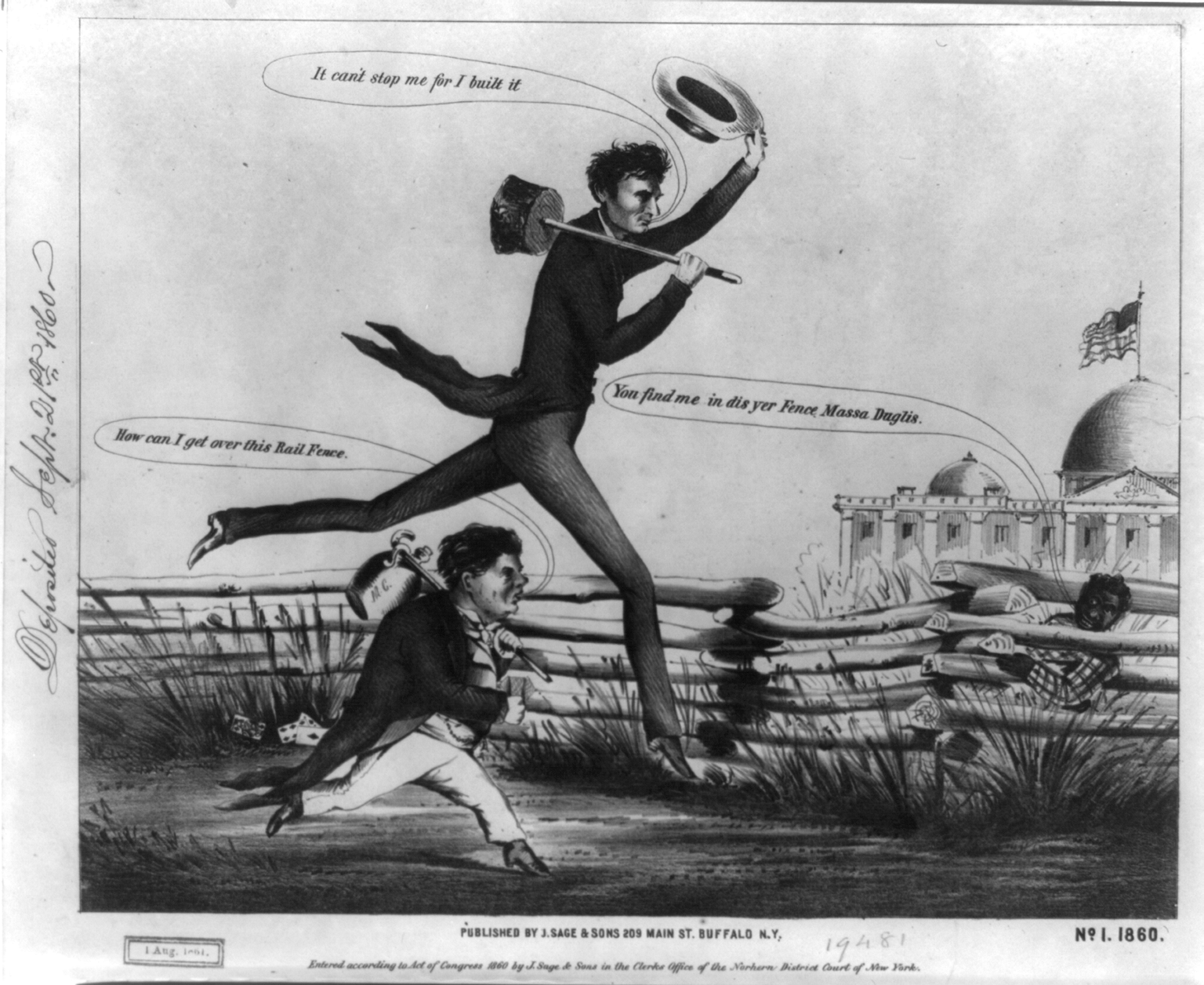
In this cartoon, Lincoln and Douglas are literally racing to the White House. Lincoln’s taller figure rivals Douglas’ tiny one, clearly making faster and longer strides to win the presidency much quicker than Douglas. The third figure in this photo is an enslaved person, evident by his use of “Massa Duglis” inside his speech bubble. This enslaved individual signifies the contention in the 1860 election surrounding slavery.

[Lincoln & Douglas in a presidential footrace]. No. 1, 1860


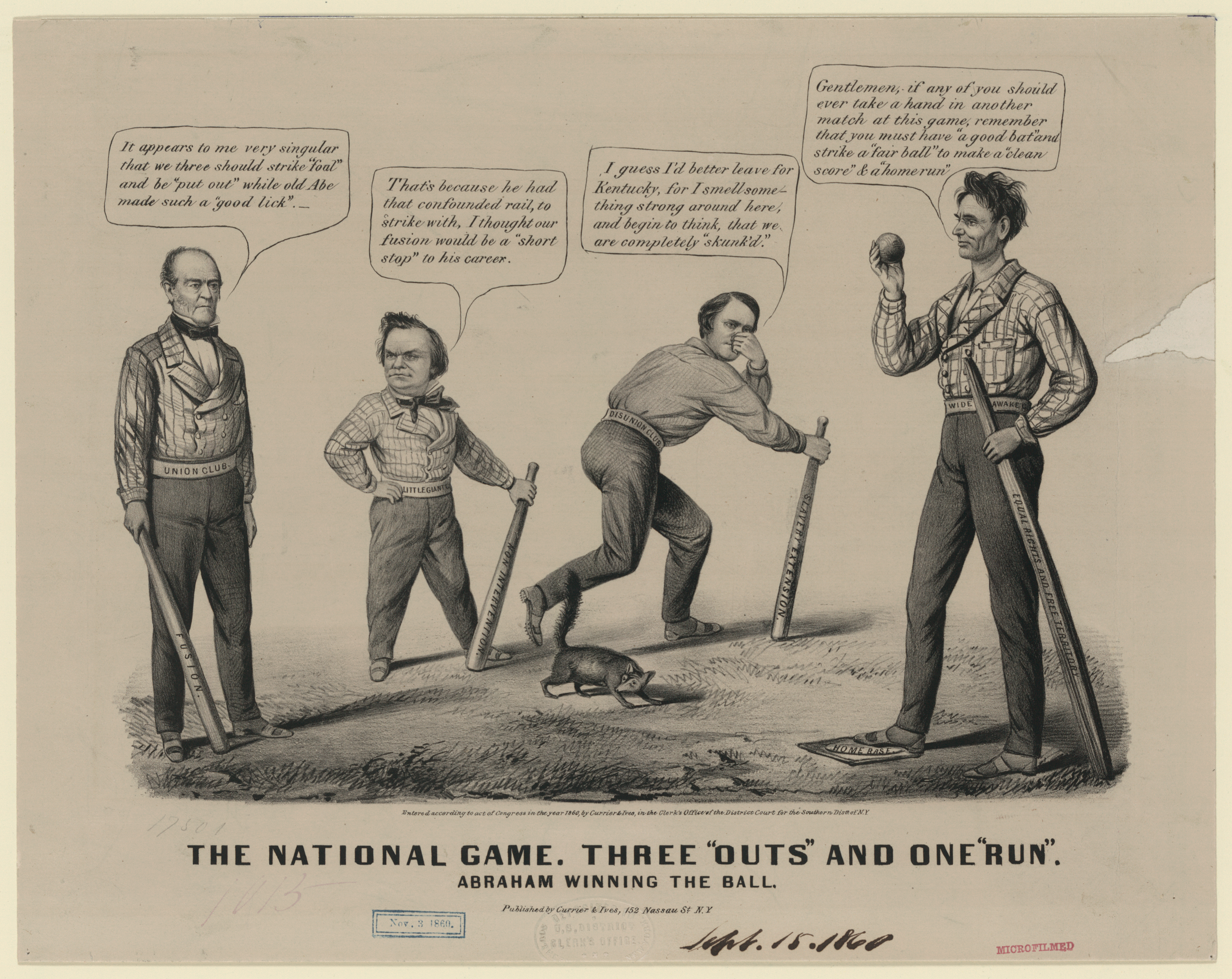
This cartoon includes all of the candidates from the 1860 election, including Stephen Douglas, John C. Breckenridge, John Bell, and Abraham Lincoln. Each candidate has much to say about the results of the election, but Lincoln seemingly flaunts his win as he ‘wins the ball’ as well as the election.​​

“The national game. Three ‘outs’ and one ‘run'”, 1860

In terms of more modern day cartoons, this work from the 2020 election depicts Trump standing near two gravestones, one that says 200,000+ COVID-19 Deaths and the other says Peaceful Transition of Power. 

The gravestones act as a clear reference to President Trump’s claims that President Biden’s win was a fraud as well as the enormous number of people who lost their lives during the pandemic. On top of an already deadly pandemic, President Trump stands near the grave of the newly dead ‘Peaceful Transition of Power’, a keystone of American democracy which was killed during the 2020 election when Trump rejected the results of the election.

In another cartoon, both candidates Trump and Biden look less than ideal in their boxing uniforms, awaiting for one of their arms to be lifted victoriously by annoyed looking Uncle Sam.

The more modern cartoons use less wording, relying more heavily on images to produce their point  rather than speech bubbles. This is made easier through image-centric social media, where wordy things are less likely to be engaged with by audiences. Cartoons and images such as these also easier to be circulated on these different platforms. While these cartoons are in fact different, the fact that they have maintained a popular medium for hundreds of years is testament to their effectiveness in engaging the public in presidential campaigns.


Is Twinning Winning?

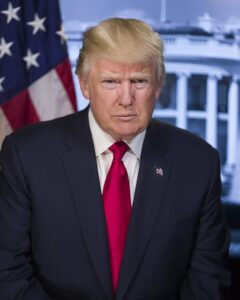
Portrait of President-elect Donald Trump, 2016

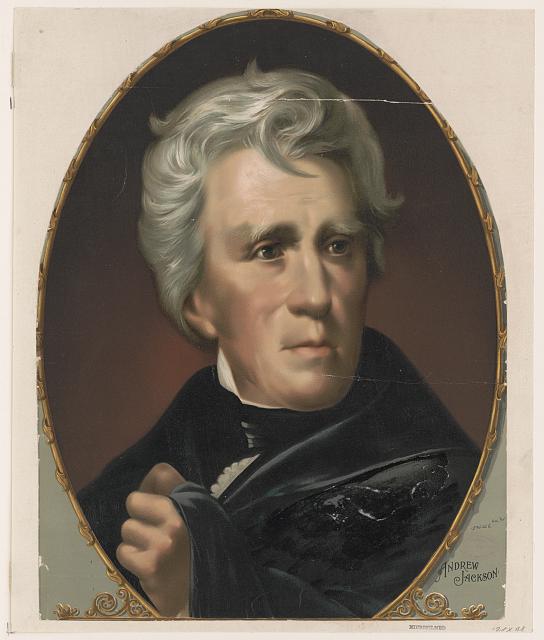
Andrew Jackson, c1896


In 2017, President Donald Trump compared himself to Andrew Jackson, citing that many people have told him that they have had similar elections. But what made them so similar that the president felt the need to equate them during his visit to Tennessee? How similar are the two really? 

In the election of 1824, Andrew Jackson had won the popular vote and the most electoral college votes, but still ending up losing the presidency to John Quincy Adams. Jackson had the most electoral votes just not the majority, so the outcome of the election was up to the House of Representatives.This is similar to the way in which Hillary Clinton won the popular vote in 2016, but lost the electoral college vote to Donald Trump, ending with her losing the election because of this. 

But what Trump didn’t realize when he made these comments in 2017 was that he would relate to the1824 election a lot more in 2020, especially when he accused the some votes as being corrupt. In the same vein, Andrew Jackson attributed his loss in the 1824 election to what he described as a “corrupt bargain”. This ‘corrupt bargain’ referred to how Henry Clay voted for John Quincy Adams for president when it was taken to the House of Representatives, and then Clay being appointed Adam’s Secretary of State after he became president . This idea of corruption is similar to what Trump claimed when he lost the 2020 election to Biden. Claims of voter fraud and election corruption became Trump’s mantra for the outcome of the 2020 election, and his platform for the 2024 election. 

During the Jackson’s next presidential election in 1828, he had a come back story for the ages after being successfully elected as president despite his loss four years prior. Now, after calling 2020’s election corrupt, will Trump have a similar comeback story to Jackson in the 2024 election?


Fake News

Bush Country, 2000

In just over the hundred years that had passed after the 1876 contested election between Rutherford B. Hayes and Samuel J. Tilden, there wasn’t really any other contested elections that could match that scale, that is, until the turn of the twenty-first century. 


The election of 2000 is one that most people remember as an incredibly close race between Republican George W. Bush and Democrat Al Gore. There were concessions made, taken back, and ballots recounted, leaving the overall general American public just really confused as to who had emerged victorious in the 2000 presidential election. 

What added to this confusion was the people putting out the information to the American people: the news. While Americans waited with bated breath to hear what the remaining state Florida’s votes look like, one news source broke the story that Bush had won. 

Other news channels followed suit, only to ultimately take this back because Florida ended up being too close to call. Since news channels had being using different systems to count the votes, their information was contradictory. So where does that leave us in 2024 with already partisan and conflicting news sources? 

In the 2024 election between President Donald Trump and Vice President Kamala Harris, there have already been tensions over news media. When determining what news network the second presidential debate should be on, Trump argued that he would not participate unless the debate was held on Fox News

Parties aren’t just splitting people apart anymore, they’re splitting the news we receive as well. News audiences have to comb through the information they receive, weeding out the ‘fake’ from the real.

With media contesting elections like we saw the 2000 election, how will we know what to believe in the predictably contested 2024 presidential election? Further, having gone over a hundred years without a contested election, does evolving and ever-present media mean we have to prepare for contested elections to become the norm for American democracy?


What Can Harris learn from Lincoln?

In last week’s blog post, I compared the tone of the 1800 and 2024. In these elections, candidates framed the stakes as particularly consequential. The same can be said of the election of 1860. 


In 1860, the nation’s debate around slavery had reached “a boiling point” (UVA Miller Center). The debate around slavery complicated each party’s nomination process. The Democratic convention was so heated, that the party wasn’t even able to make a decision when they initially met; debate between the Northern and Southern delegates about how the party should address slavery was too intense. When the party reconvened six weeks later, Stephen Douglas was eventually nominated. However, Southern democratic delegates were unsatisfied with this choice. These delegates would reconvene and nominate John C. Breckenridge as the Southern Democratic nominee.  


On the Republican side, the convention was also somewhat contested. Entering the convention, William H. Seward was seen as the frontrunner. However, by the third ballot, Abraham Lincoln had captured the nomination. Additionally, John Bell of the Constitutional Union party was elected.


As the campaign heated up, Lincoln was seen as a frontrunner. The divided support of the Democrats paired with the North’s views on slavery gave Lincoln a clear advantage. This perceived advantage made Lincoln the target of dramatic personal attacks. These attacks dramatized how Lincoln’s position on slavery would direct the future of the country. A secessionist in Georgia claimed Lincoln wanted to “force the inter-marriage of black and white children” (UVA Miller Center). 


In the last presidential debate, Trump similarly criticized the future a Harris presidency would create. These critiques often include racial undertones, particularly when Trump critiques Harris’ plans on immigration. 


Like Jefferson in 1800 and Lincoln in 1860, Kamala faces bold attacks against the future of America that could be created by her presidency. Lincoln seemed to follow the mentality adopted by Jefferson when he faced these attacks; he stayed calm and non combative. While it might be difficult for Kamala to appear unfazed by Trump’s attacks – especially in a modern media environment – history seems to encourage such a mentality. 


References: 

“Abraham Lincoln: Campaigns and Elections,” Michael Burlingame, https://millercenter.org/president/lincoln/campaigns-and-elections


“Harris says ‘We’re not going back!’ So did Thomas Jefferson?”, jarviser2, https://his295-fall2024.sites.grinnell.edu/week-3/harris-says-were-not-going-back-thomas-jefferson/

css.php
The views and opinions expressed on individual web pages are strictly those of their authors and are not official statements of Grinnell College. Copyright Statement.