
In December of 1800, Alexander Hamilton, a framer and honored member of the Federalist party, wrote to his friend Harrison Gray Otis, a fellow Federalist, about his preference for Thomas Jefferson, the unofficial leader of the Democratic-Republicans, over Aaron Burr, another Democratic-Republican. Yes, lots of fancy jargon, let us take a step back for a moment.
Simply said, in 1800, there were two political parties that dominated the American political scene; the Democratic-Republicans, who stood for smaller federal government and more freedom to the people, and the Federalists, who stood for stronger federal government and a more elitist structure of society. Now, the idea that our ancestors had some distant and modified version of our current “two-party” system might not seem chocking, however, one must remember that before 1789, the idea of political parties, or factions as they called them, was seen as a threat not only to democracy but also to the survival of the republic. Humans being human quickly became divided however, into the two parties mentioned above, and this almost innocent idea that the country would be able to function under the leadership of one united government trickled down. Even though the existence of political parties was very much present and known throughout the 1790’s, the electoral process was still functioning under the idea that there would be no political parties. More specifically, there was no procedure for a president and a vice-president to run together on a same ticket. Instead, the candidate with the majority votes would be elected president and the candidate with the second most votes would be vice-president. Today, this system would be nothing but a funny thought experiment (picture it: Harris-Trump, Make America Not Go Back Again?) but one can clearly see how this system was thought out with the intension of staying clear of political parties.
Now that the context has been established, we may return to the impact the election of 1800 had on the rise of political parties. This dissonance between the electoral system and the political parties finally came to a head when Thomas Jefferson and Aaron Burr, both of the same party but strongly against one another, were ultimately going to end up being voted into office together. While the election process was long and cumbersome (that is another story for another time), the “enemy pair” did end up being voted in together, which lead to the birth of the 12th amendment. Shortly, the 12th amendment stated that the president and vice-president would be voted in together on the same ticket. This amendment is seen by many as being the catalyst towards the party system in the United States.
Hamilton and Otis were far from knowing that their political party would soon cease to exist, but what they were even further from knowing is that the election system they had built would disappear and leave room for the rise of very strong factions, everything they had ever feared. That is how I would recommend remembering the election of 1800, the election of 1800 is the year the unity died.
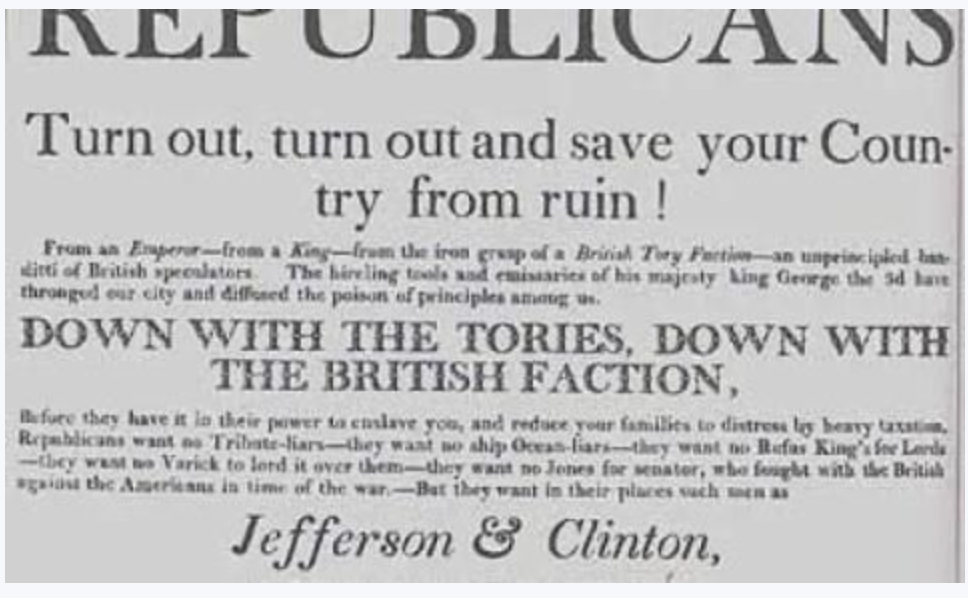
Jefferson and Clinton grouped ticket for the election of 1804. Image from the Ronald Reagan Presidential Museum and Library.

Leave a Reply
You must be logged in to post a comment.