In 2013, the U.S. Supreme Court ruled (Shelby County v. Holder) that key elements of the Voting Rights Act of 1965 – an act that put an end to many of the forms of voter suppression that had been used to effectively disenfranchise voters of color since the era of post-Civil War Reconstruction (1865-1876) – were unconstitutional; namely, Section 4(b) of the Voting Rights act which provided guidelines to determine which jurisdictions were subject to Section 5 of the Act, which stated that jurisdictions with a history of voter discrimination must gain approval from the U.S. Attorney General or a federal court before making changes to any elements of election procedures and/or practices. In deeming Section 4(b) of the Act unconstitutional, the Supreme Court essentially nullified Section 5 of the act, by releasing all jurisdictions previously monitored under Section 4(b) from federal oversight, thus allowing these jurisdictions with histories of voter discrimination to enact new voting laws and procedures without the previously required federal approval (U.S Office of Public Affairs, “Reflecting On the 10th Anniversary of Shelby County v. Holder”, 2023). While acts, such as the Voting Rights Advancement Act (HR4), have been proposed to patch the holes that the Supreme Court’s Shelby County decision created in the Voting Rights Act of 1965, none of these rehabilitory acts have been instated, allowing discriminatory voting laws and procedures to continue suppressing voters of color.
The suppression of Black Americans’ right to vote is a modern issue with a very long and violent history. After the passing of the Fifteenth Amendment to the U.S Constitution in 1870, which guaranteed the right to vote to all citizens regardless of “race, color, or previous condition of servitude” (The Fifteenth Amendment to the U.S. Constitution ), many white Southerners – particularly former Confederate Civil War soldiers – attempted to take matters into their own hands; which, through their violent attempts to gain control over the changing election landscape and suppress Black voters, would become and continue to be stained with the blood of Black Americans (Michael W. Fitzgerald and Mark Bohnhorst, “Reconstruction, Racial Terror, and the Electoral College” (2024), The Journal of the Civil War (Vol. 14, 1)).
In the U.S. presidential Election of 1876, rampant voter suppression and the resulting contestation of election results paved the path towards the destruction of Reconstruction era amendments and the prolonging of the country’s historic trampling of Black Americans’ civil rights. Contestation of the 1876 election began on election day and continued right up until the inauguration, as no winner could be determined due to conflicting results from two separate groups of electors in Columbia, South Carolina; Salem, Oregon; Tallahassee, Florida; and New Orleans, Louisiana — leaving Congress with 184 electoral votes for Democratic candidate, Samuel J. Tilden, and 165 electoral votes for Republican candidate Rutherford B. Hayes, with 20 votes still being disputed. These conflicting results, and arguments between the two parties as to whether the House of Representatives or Congress should be in charge of deciding the election, led to the creation of a (mostly) bipartisan Electoral Commission. This Electoral Commission would end up awarding the electoral votes from the states in question (OR, SC, FL, and LA) to Republican Rutherford B. Hayes. This decision was informed by, though not directly stated as the result of, the fact that the initial results from a number of districts in these states, which had reported a majority of their electoral votes for the Democratic candidate Tilden, were invalidated by the rampant fraud, intimidation, and racial violence committed during and ahead of election day by groups such as the Ku Klux Klan (KKK) in the name of white supremacist ideals and in pursuit of a Democratic party victory (Sheila Blackford, “Disputed Election of 1876”, The University of Virginia Miller Center). In other words, this Electoral Commission recognized that, as Michael W. Fitzgerald and Mark Bohnhorst argued in an article published in The Journal of the Civil War, “terrorist violence could manufacture Democratic majorities”, making many of the electoral votes for Tilden either effectively or literally (in the case of illegitimately selected “fake” electors) fraudulent (Michael W. Fitzgerald and Mark Bohnhorst, “Reconstruction, Racial Terror, and the Electoral College” (2024), The Journal of the Civil War (Vol. 14, 1)).

“Carnival of blood! Republicans to be massacred at the polls! Secret Democratic circular. Tilden’s desparate plan to carry a solid South … New York 1876.” – Library of Congress, Rare Book and Special Collections Division, Printed Ephemera Collection.
Despite both Democratic and Republican parties agreeing that the Electoral Commission would decide the Election of 1876, the results of the Commission’s decision faced backlash, with Democratic members of congress threatening a slew of measures to delay the resolution of the election in an effort to gain concessions from Republicans; namely, a federal railroad subsidy as well as more control over their state governments, which would, in turn, allow them to enact more racist laws and policies in an effort to further their white supremacist agendas (Sheila Blackford, “Disputed Election of 1876”, The University of Virginia Miller Center). The prospect of further delays scared many Republicans, including the apparent presidential elect Rutherford B. Hayes, as they feared what a prolonged contestation of the election would mean for the perceived legitimacy of the election results. In an effort to ward off these delays and appease Democratic politicians, Hayes made a compromise of unknown terms (known as the Compromise of 1877) with Southern politicians, which, as Michael A. Ross describes in his book The Presidents and the Constitution: A Living History, boiled down to Hayes pledging to, in exchange for the presidency, “pursue a policy of noninterference in Southern affairs”, remove troops from Southern states and, in removing these troops, allow Democrats to take control of any remaining Republican governments in Southern states (Chapter 19 of The Presidents and the Constitution: A Living History (2016) by Michael A. Ross). In making this compromise with Democratic leaders, Hayes ushered in the end of Reconstruction and set the stage for another century of extreme racial violence and many forms of discrimination – including, but certainly not limited to, voter suppression – in the American South.
While we as a country have certainly made progress towards ensuring that, in the words of Fifteenth Amendment of the U.S. Constitution:
“the right of citizens of the United States to vote shall not be denied or abridged by the United States or by any State on account of race, color, or previous condition of servitude”
we still have quite a ways to go, as evidenced by the continued passage of restrictive and discriminatory voting legislation in states with histories of voter suppression (The Brennan Center for Justice, “States Have Added Nearly 100 Restrictive Laws Since SCOTUS Gutted the Voter’s Rights Act Ten Years Ago” (2023)). This continued fight for equal voters’ rights makes discussing the history of voter suppression, as well as raising awareness for modern instances of discriminatory voting rules and procedures, incredibly important; especially today, post-Shelby County decision, and ahead of what is likely to be a very pivotal election which – in the eyes of LaTosha Brown, the co-founder of the Black Voters Matter organization – carries a high risk for instances of voter suppression as well as the proliferation of targeted misinformation and falsehoods among populations of Black voters, which can prove to be a covert but still dangerous form of election tampering (National Public Radio, “Disinformation and suppression loom over Georgia, says Black Votes Matter co-founder” (2024)).
Works Cited
(in order of first appearance)
U.S Office of Public Affairs, “Reflecting On the 10th Anniversary of Shelby County v. Holder”, 2023
The Fifteenth Amendment to the U.S. Constitution
Michael W. Fitzgerald and Mark Bohnhorst, “Reconstruction, Racial Terror, and the Electoral College” (2024), The Journal of the Civil War (Vol. 14, 1)
Sheila Blackford, “Disputed Election of 1876”, The University of Virginia Miller Center
Chapter 19 of The Presidents and the Constitution: A Living History (2016) by Michael A. Ross
The Brennan Center for Justice, “States Have Added Nearly 100 Restrictive Laws Since SCOTUS Gutted the Voter’s Rights Act Ten Years Ago” (2023)
National Public Radio, “Disinformation and suppression loom over Georgia, says Black Votes Matter co-founder” (2024)

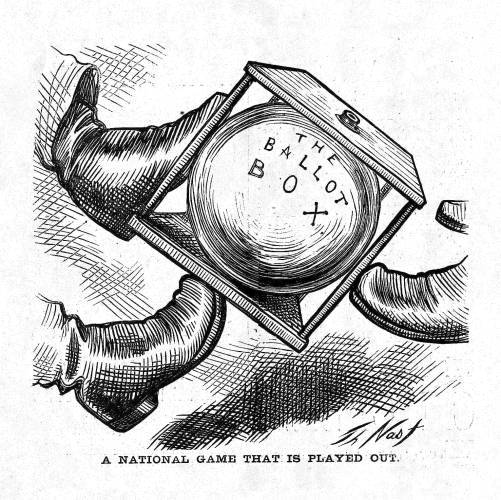 es (Republican) and Samuel J. Tilden (Democrat). However, the turmoil of the election came to head during the counting of the ballots and subsequently affecting the electoral votes. Samuel J. Tilden won the popular vote in the United States but was one electoral vote short of winning the majority, that would make him President of the United States. However, the states of South Carolina, Louisiana, and Florida (19 electoral votes) and 1 electoral vote of Oregon was still in dispute. However, it wasn’t until the United States Congress created the Electoral Commission to break the deadlock between the two candidates. However, there was more than just the electoral votes that triggered this commission. Claims of stolen ballots and electoral fraud was reflected in the political cartoon from Thomas Nast (September 26, 1840 – December 7, 1902) published in Harpers Weekly on December 23, 1876. Thomas Nast, after was considered the father of the American cartoon.
