
Music has long played an instrumental role in American public life, and it has especially made an underrated impact on American politics. The social effect musicians can have on the general public is truly insurmountable. From songs like Give Peace a Chance by John Lennon to We are the World by U.S.A. for Africa, music has been used as a tool to galvanize the American people to a point of action. In instances of presidential elections, the effect is similar; music is used to arouse support for presidential candidates.
The importance of music in presidential campaigns has become especially evident in the 2024 presidential election. Headlines like More and more artists want Trump to stop using their music dominate the news, as artists fight for their rights over their own music.
Though the use of music has evolved, employing music as a campaign strategy is not a new approach. Earlier campaigns, such as the election of 1876, also utilized music as a campaign strategy.
The election of 1876 was a heated one between Republican Rutherford B. Hayes and Democrat Samuel J. Tilden. As the election was ramping up, the candidates needed songs to soundtrack their campaigns. Because of this, catchy tunes began to circulate with supporters.
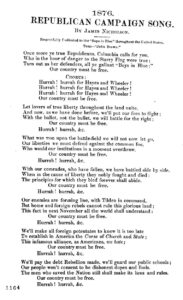
Republican Campaign Song, 1876
One tune, the Republican Campaign Song, was a sheet of lyrics created and distributed by advocates for Hayes. The lyrics of this song expressed support for Hayes and Wheeler’s Republican ticket. The lyrics give reference to battles and the rebellion, pointing to the recent Civil War and secession.
In addition to these tunes meant to be sung by the common man, sheet music was produced for musicians to play as well. One example of this is the Tilden and Hendricks March music. This nineteen page score was most likely played during campaign speeches or parades. Associating music to a specific candidate was a smart way to get more of the senses involved during a presidential election.
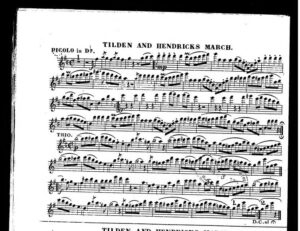
Tilden and Hendricks March, 1876
Now, in a modern day context, politicians aren’t relying on their supporters to write music for them, they are using musicians’ copyrighted songs and applying them to their own campaigns. This, as one could imagine, has been much cause for controversy if done illegally. In fact, over the years, Trump has received many cease and desist orders from artists who don’t want their music associated with the Trump Campaign. And 2024 is no different. Artists like Beyonce and Celine Dion have made public statements barring Trump from using their music, all on top of taking legal action. This evolution of music being made for a candidate like what we see in 1876 to taking a musician’s work without consent in 2024 is truly thought provoking. When has the collision of creativity and politics gone too far?
Sources:
RollingStone, “All the Artis’s Who Don’t Want DonalD Trump Using Their Music,” RollingStone, August 30m 2024 https://www.rollingstone.com/music/music-lists/all-the-artists-who-dont-want-donald-trump-using-their-music-1235080043/r-e-m-8-1235080077/
Tracy Smith, “A Political Playlist: The Fight over Campaign Songs,” CBS Sunday Morning, September 8, 2024 https://www.cbsnews.com/news/a-political-playlist-the-fight-over-campaign-songs/

Leave a Reply
You must be logged in to post a comment.